Full Xero Review With Updated US Pricing and Features (2026)
Home
/
Blog
/
Best Revenue Recognition Software (2026): A Complete Guide
Best Revenue Recognition Software (2026): A Complete Guide
Written by
Reviewed by
Revenue recognition software automates ASC 606 and IFRS 15 compliance: recognition schedules, deferred revenue, journal entries, and audit trails. Here are the seven platforms worth evaluating in 2026.

Revenue recognition software automates ASC 606 and IFRS 15 compliance: it takes contract and billing data as inputs and produces auditable recognition schedules and general ledger entries as outputs. The best choice depends on your billing model (subscription, usage-based, hybrid), your ERP, and whether you need a standalone compliance engine or a combined billing-and-recognition platform. Zuora Revenue and Sage Intacct suit enterprises; Maxio and Chargebee RevRec work best for SaaS teams at Series A-B; RightRev is the strongest standalone compliance engine for complex multi-element contracts.
If your company bills customers in advance, bundles multiple products in one contract, or deals with any pricing that isn't a straight fixed fee, congratulations; you have a revenue recognition problem.
ASC 606 tells you when that money is actually earned. Revenue recognition software is what makes applying that rule at scale something other than a spreadsheet nightmare.
This guide covers what such software needs to do, how the major platforms compare, and how to match the right tool to your situation.
What Does Revenue Recognition Software Do?
Revenue recognition software is different from billing software, which is a different function that often gets conflated with it.
Revenue recognition software specifically handles the following:
- Contract intake and obligation identification: Parsing signed contract terms and identifying each distinct performance obligation, the unit of account under ASC 606.
- Standalone selling price (SSP) allocation: Distributing the transaction price across obligations proportionally, which is required when a contract includes multiple elements at a bundled price.
- Recognition schedule generation: Producing a period-by-period schedule showing when each dollar moves from deferred revenue to recognized revenue.
- Deferred revenue management: Posting the liability when cash is received but revenue isn't yet earned and releasing it as obligations are satisfied.
- Contract modification handling: Detecting when a contract changes, like upgrades, downgrades, cancellations, and amendments, and applying the correct prospective or retrospective treatment automatically.
- Journal entry generation: Producing the accounting entries and posting them to the GL, eliminating the manual step between the recognition schedule and the books.
- Audit trail and disclosure reporting: Maintaining a contract-to-revenue trace that auditors can follow and producing the disclosure notes ASC 606 requires in financial statements.
Note: Revenue recognition errors are among the most scrutinized items in SEC reviews, particularly for public companies and those preparing for audit. Restatements triggered by misapplication have cost companies greatly in market value and audit fees. The software doesn't replace the judgment calls (identifying performance obligations still requires accounting expertise), but it replaces the manual execution where most errors actually occur.
What Must Revenue Recognition Software Handle? The ASC 606 Five-Step Model
Every platform on this list needs to automate all five steps reliably. Where they differ is in depth, edge-case handling, and integration architecture.
What to Watch For: A platform that handles steps 1 to 3 cleanly but falls apart on SSP allocation (step 4) will require manual spreadsheet work every time you have a bundled contract. For most SaaS businesses, bundled contracts are the norm rather than the exception: implementation services alongside subscriptions, add-on modules at discounted rates, and prepaid credits. This is the gap worth probing during any vendor evaluation.
The 7 Best Revenue Recognition Software Platforms in 2026
These seven platforms cover the realistic shortlist for most finance teams evaluating rev rec software in 2026. The right one depends on your billing model, your ERP, and whether you need a billing-plus-recognition platform or a dedicated compliance engine.
1. Zuora Revenue — Best for Enterprise Subscription and Usage-Based Companies
Zuora Revenue is the largest dedicated revenue recognition platform in the market, ranked number one in the Forrester Wave for Recurring Billing Solutions and used by enterprises including Zendesk, Box, and Siemens Healthineers.
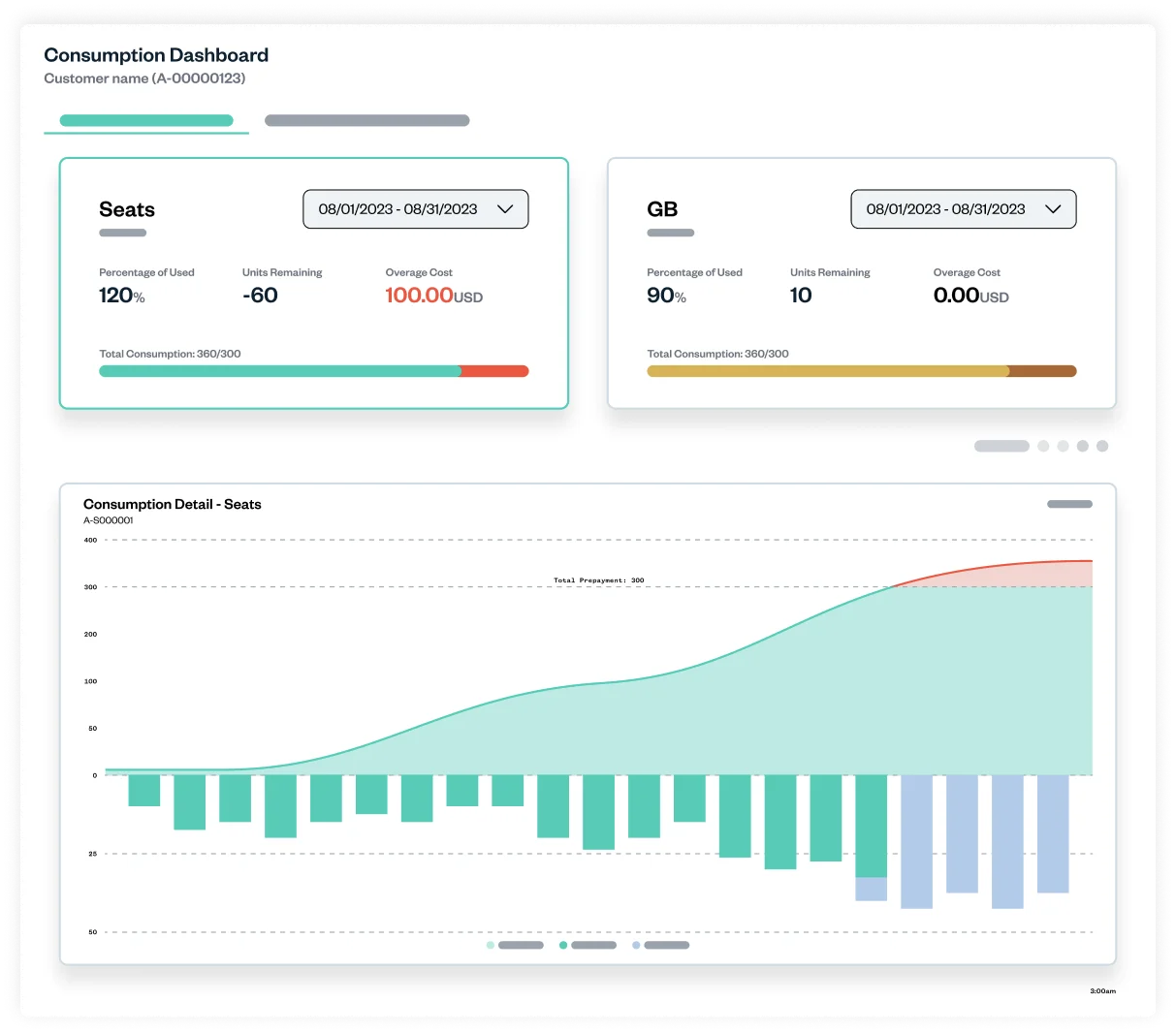
It automates all five ASC 606 steps, handles SSP allocation, generates disclosure-ready reports, and cuts close time by up to 50% according to Zuora's self-reported benchmarks.
In June 2026, Zuora launched its AI Monetization Suite, extending the platform to handle AI product pricing, including usage-based consumption models, credits, prepaid commitments, and outcome-based pricing. This puts it ahead of most platforms in handling the emerging pricing complexity around AI-delivered SaaS.
Zuora Revenue’s pricing is quote-based across all tiers.
2. Maxio — Best for B2B SaaS Teams Wanting Billing and Rev Rec Together
Maxio is purpose-built for B2B SaaS and earned six G2 Leader badges in Winter 2026, with satisfaction scores above 90 across multiple categories.
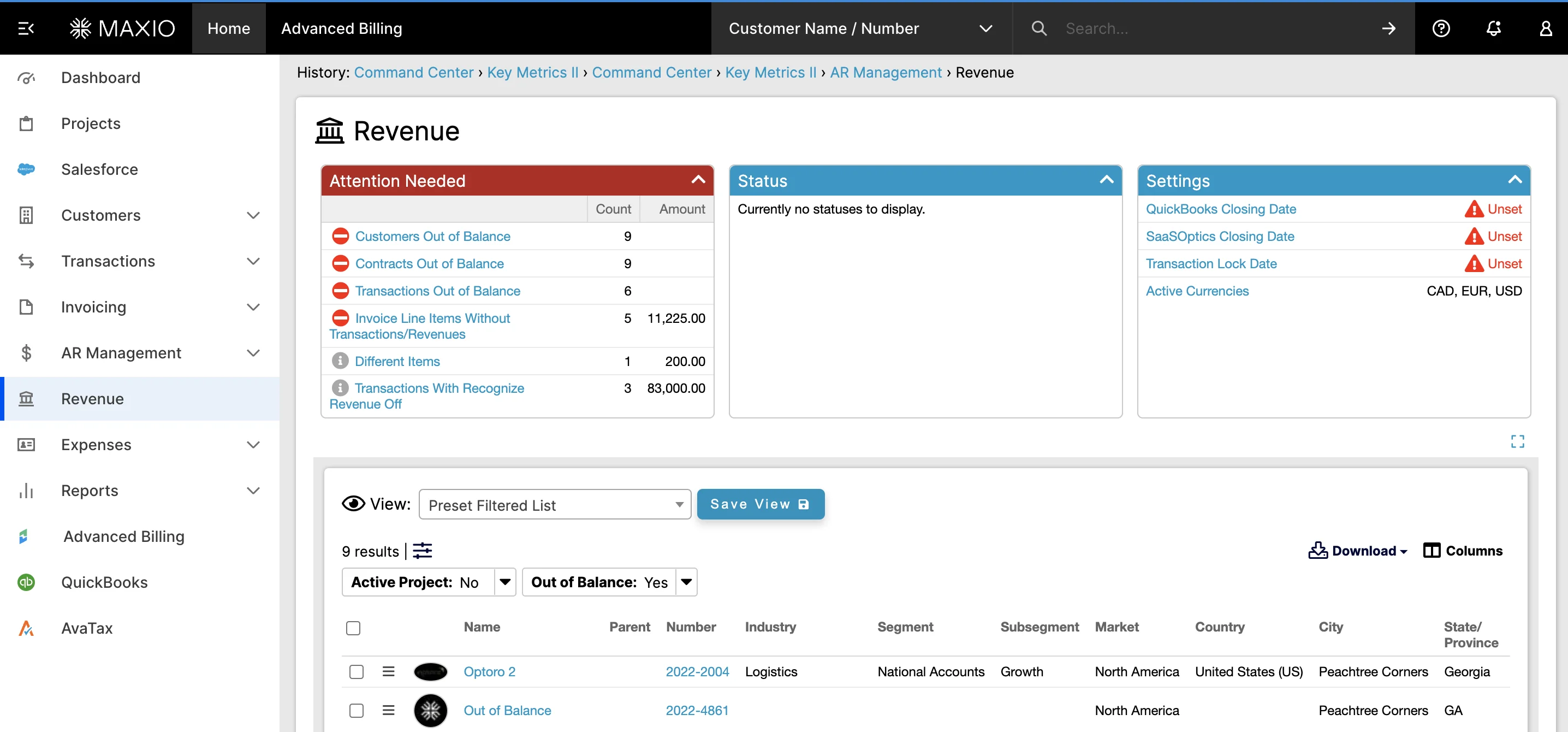
It combines subscription billing, usage-based pricing, contract management, and full ASC 606/IFRS 15 revenue recognition in one platform. Recognition templates and SSP configurations auto-generate schedules across every contract, and waterfall reports give a complete view of deferred and recognized revenue by period.
Maxio's rev rec module syncs journal entries to NetSuite, Sage, and QuickBooks automatically. It supports dual reporting: running ASC 606 and older standards simultaneously, which matters for companies mid-transition.
Its key limitation is implementation speed: it's a billing migration, not just a rev rec add-on, and implementation timelines can run longer than expected.
Maxio starts at the $599/mo. (Grow) plan that supports up to $100,000 in monthly billings. The Scale plan supports over $100,000, is quote-based, and comes with extra features.
3. Sage Intacct — Best for Mid-Market Organizations That Want ERP and Rev Rec Together
Sage Intacct is the only accounting platform endorsed by the AICPA, and its revenue recognition module is native to the core ERP rather than a bolt-on.
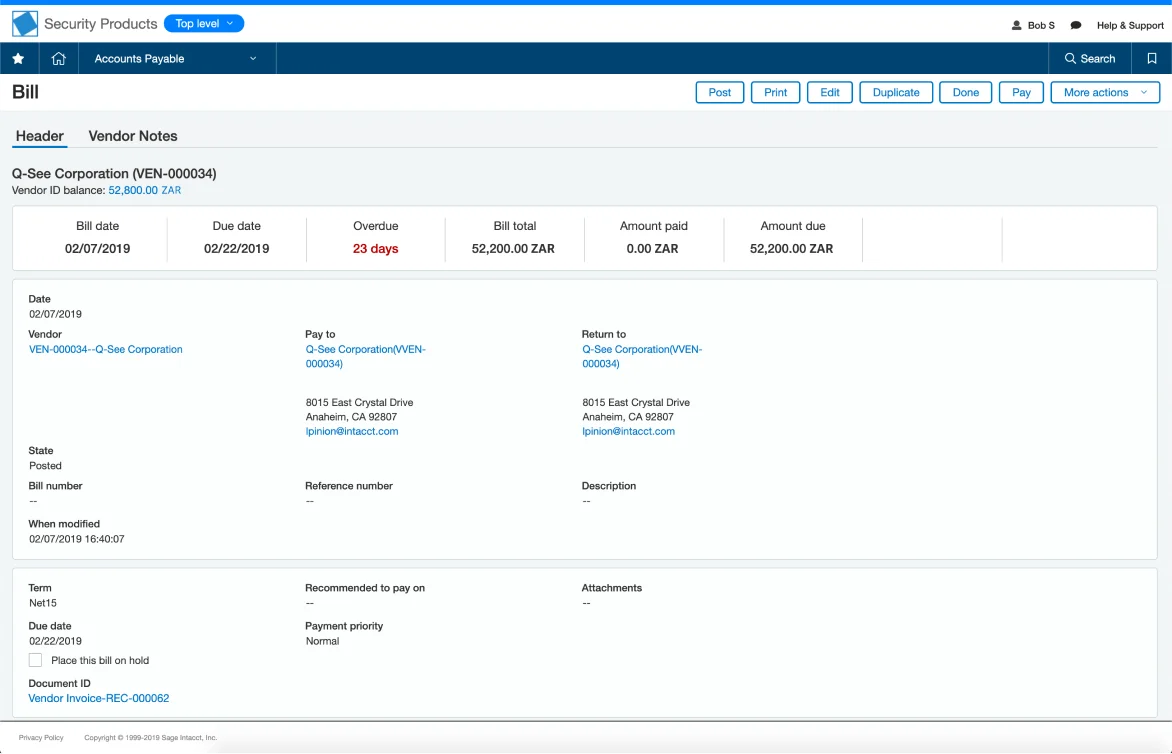
It supports ASC 606 and IFRS 15 through template-based recognition schedules, dual-treatment reporting, and a bi-directional Salesforce integration that flows order, customer, and contract data automatically.
Over 600 billing scenarios are configurable. For example, when a deal closes in Salesforce, order details flow automatically into Sage Intacct, the finance team validates the revenue schedule, and an invoice is generated in five minutes.
Cornerstone Information Systems saves nearly two weeks of manual data entry per month and roughly $150,000 annually as a result.
Sage’s pricing is quote-based. It’s estimated that core financials range from $12,000 to $15,000 per year, with the revenue recognition module being an add-on. Mid-market deployments run from $25,000 a year.
4. NetSuite Advanced Revenue Management — Best for Companies Already on NetSuite
NetSuite's ARM module delivers ASC 606-compliant revenue recognition natively within the NetSuite ERP ecosystem.
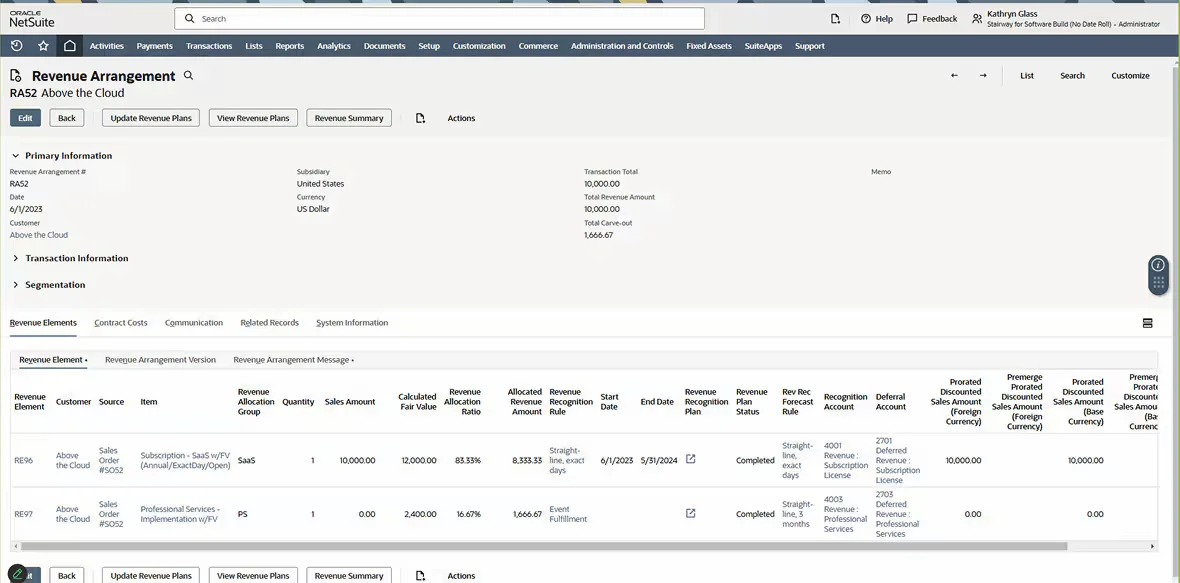
For the tens of thousands of mid-market companies already on NetSuite, ARM provides automated recognition without data migration or complex integration work. It uses existing contract, order, and customer data already in the system.
NetSuite added AI enhancements to ARM: machine learning suggests performance obligation templates based on item configurations, automatically proposes standalone selling prices based on historical transactions, and flags recognition anomalies for review.
Multi-element arrangement support, flexible recognition schedules, and native integration with advanced billing and global subsidiaries are included.
NetSuite’s pricing is quote-based, but the starter package (without add-on modules) is estimated to cost around $999/mo. Advanced financials, encompassing advanced revenue recognition, cost around $500 to $1,000 per month extra.
5. Chargebee RevRec — Best for Subscription-First SaaS Ready to Migrate Billing
Chargebee serves 6,500+ SaaS and AI companies across 180 countries and earned a 2025 Gartner Magic Quadrant Leader title.
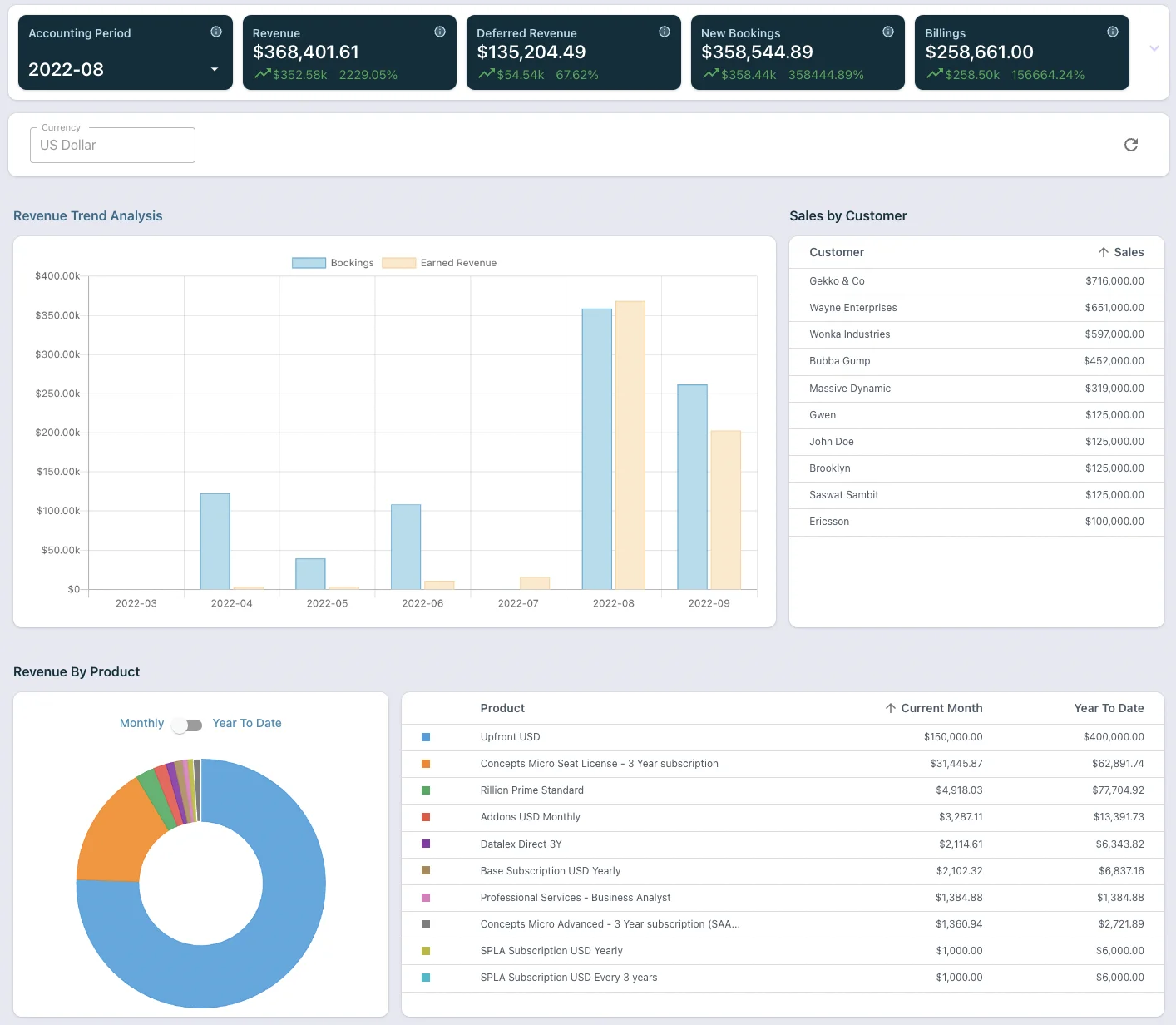
Its RevRec module is a separate add-on from the core billing platform. Crucially, Chargebee's built-in billing engine only supports ASC 605 (the legacy standard replaced by ASC 606 in 2018 for public companies and 2019 for private firms).
If you rely solely on Chargebee Billing without the RevRec module, your system is running on outdated accounting rules that won't pass a modern GAAP audit. The dedicated RevRec module is mandatory to achieve full ASC 606 and IFRS 15 compliance through the five-step framework.
RevRec posts summarized journal entries to QuickBooks, NetSuite, Xero, or Sage Intacct automatically on the fiscal calendar, generates recognition schedules for every billing event, and supports multi-entity accounting, multi-currency, and 60+ native integrations.
Chargebee offers a free plan for up to $250,000 of cumulative billing, then 0.75% on billing. The Performance plan costs $7,188/year (annual commitment/billed monthly for up to $100,000 billing/mo. The Enterprise plan is custom and quote-based.The Revenue Recognition add-on requires you to be on a Billing plan (Performance/Enterprise) and is quote-based.
6. RightRev — Best Standalone ASC 606 Engine for Complex Multi-Element Contracts
RightRev is a dedicated revenue recognition engine rather than a billing platform; it consumes contract and billing data from the systems you already run (Salesforce-native, with NetSuite and billing-system integrations) and applies a deep compliance layer on top.
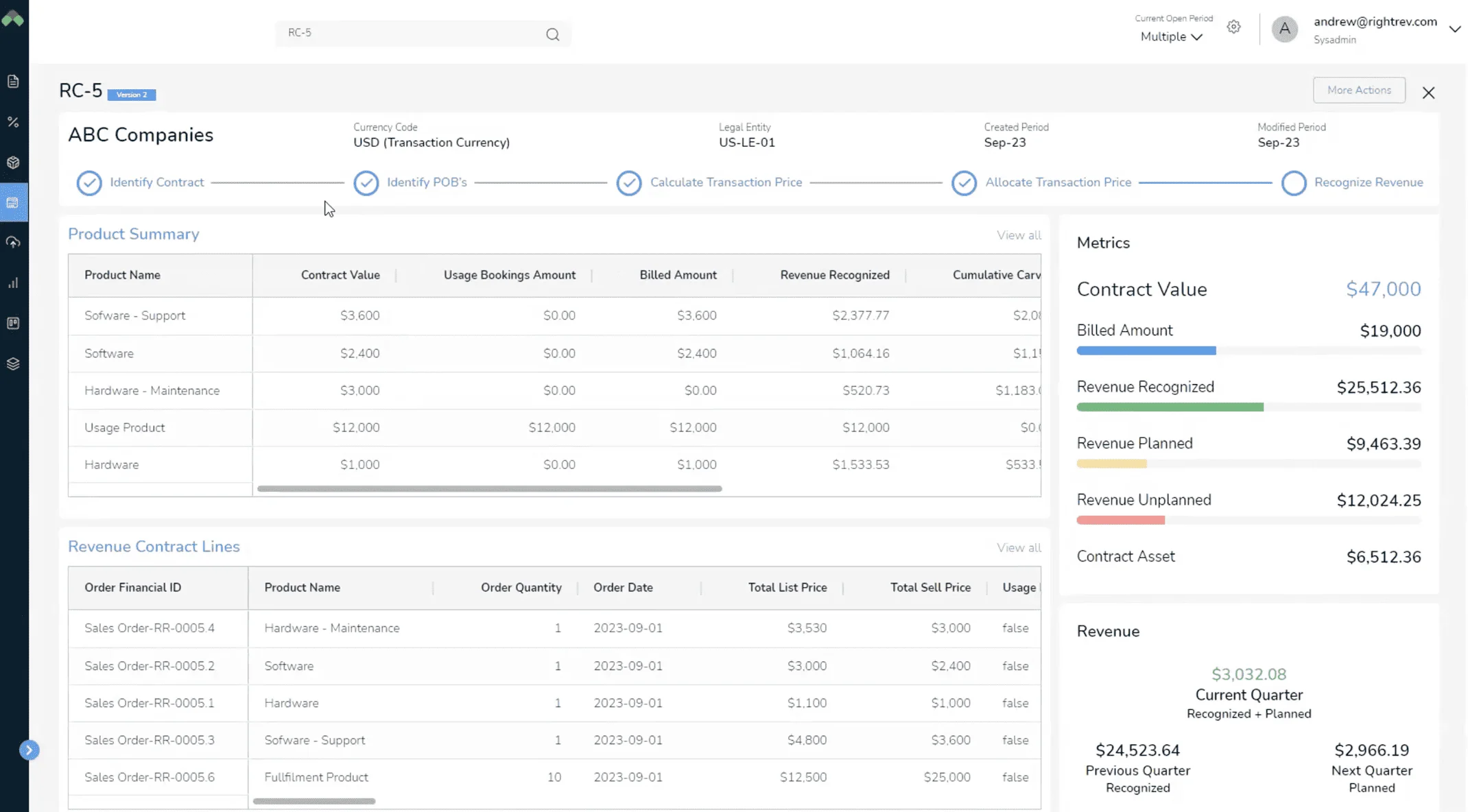
This makes it uniquely valuable for organizations that don't want to migrate their billing stack but have outgrown their current rev rec setup.
RightRev is particularly strong on SSP allocation depth: stratified SSP analysis and the documentation auditors expect for complex bundles. Contract modification handling covers both prospective and retrospective treatment applied by policy. Dual ASC 606 and IFRS 15 support is full, not partial.
RightRev’s pricing is custom and quoted based on your contract volume and complexity.
7. Stripe Revenue Recognition — Best for Stripe-Native Businesses
Stripe Revenue Recognition is the easiest entry point if your billing already lives on Stripe.
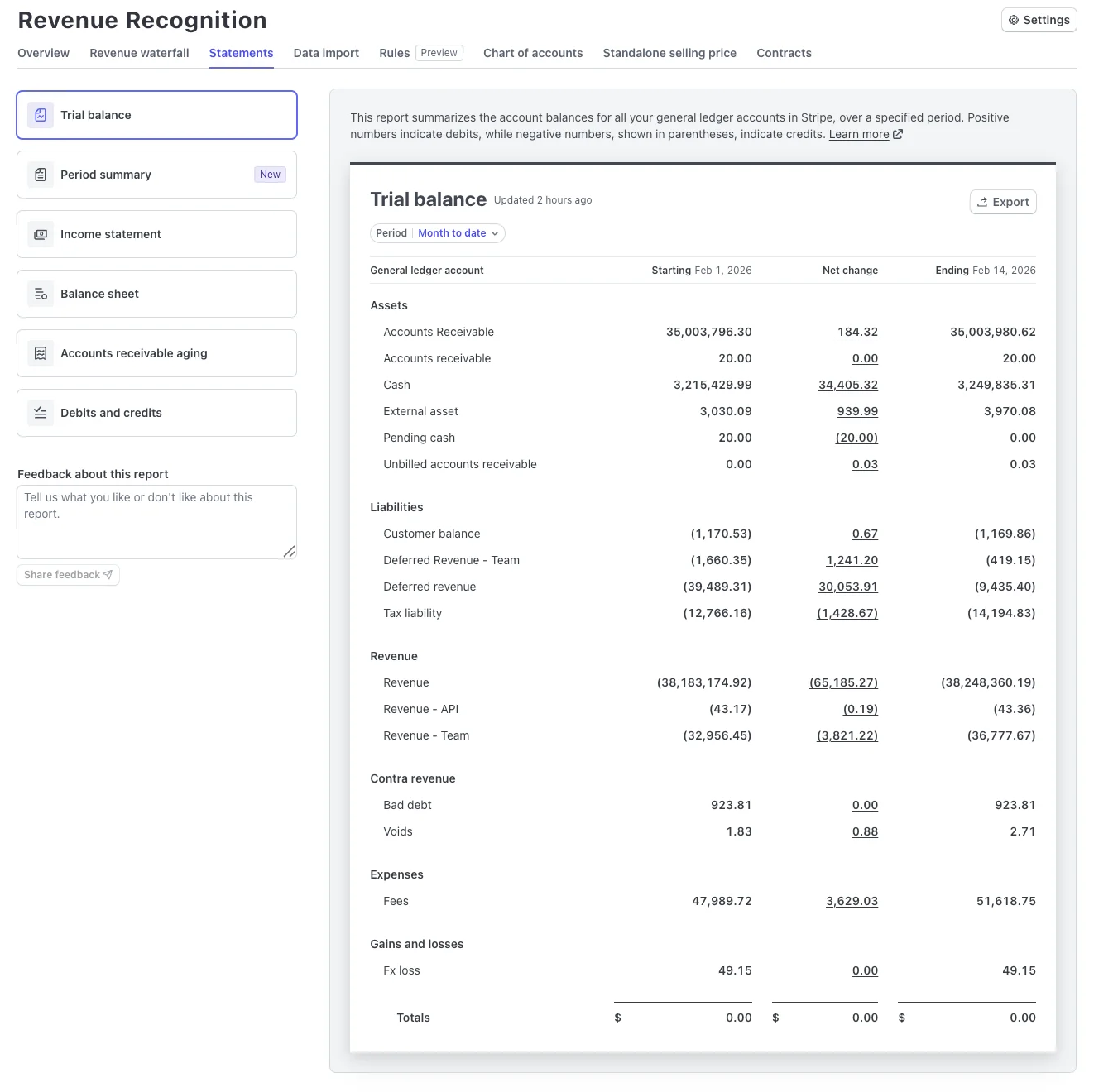
It automatically aggregates all Stripe transactions (subscriptions, one-off charges, and usage events) into revenue contracts, applies the selected recognition policy (ratable vs. point-in-time), and produces compliant revenue and deferral schedules. Journal entries are generated automatically, and books can close same-day.
It supports multicurrency, handles credits, refunds, and adjustments within the same framework, and provides drill-down audit trails through the Stripe dashboard. The ceiling is equally clear: it only natively covers Stripe payments, and revenue from other platforms must be imported manually.
As of late 2026, following Stripe's updated pricing structure, Stripe Revenue Recognition starts at $25/mo. ($190/yr.) for businesses processing up to $10,000 in monthly volume. As your transaction volume grows, the cost scales up to a maximum of $1,650/mo. for up to $1,000,000 in monthly volume. If your business processes more than $1,000,000 a month, you’ll need to contact their sales team for custom enterprise pricing.
What to Look for When Evaluating Revenue Recognition Software
The evaluation criteria that matter most depend on your business model. Here’s how to prioritize:
Accounting Platforms and Revenue Recognition: What You Need to Know
Revenue recognition software is a specialized compliance layer. It sits on top of (or alongside) your accounting system, handling the ASC 606 calculation and posting journal entries back to the GL.
Some accounting platforms include native rev rec modules (Sage Intacct, NetSuite). Others require a standalone tool layered on top. If you're using a cloud accounting platform like Eleven for multi-entity GL work across your CPA firm's clients or family office portfolio, the right answer for revenue recognition depends on what your clients' contracts actually look like.
- For clients with complex subscription or usage-based revenue models, one of the dedicated tools above is the right layer.
- For straightforward service-based revenue where recognition happens at delivery, a well-configured accounting system handles this natively.
Our accounting software for CPA firms guide covers how firms typically structure the broader software stack across different client types.
Frequently Asked Questions (FAQs)
What is revenue recognition software?
Revenue recognition software automates ASC 606 and IFRS 15 compliance. It takes contract and billing data as inputs and produces recognition schedules, deferred revenue postings, journal entries, and audit trails as outputs, replacing the manual spreadsheet work most finance teams rely on for this process.
It's distinct from billing software, which determines what to invoice; revenue recognition software determines when invoiced amounts can be counted as earned revenue.
What is ASC 606 and why does it require software?
ASC 606 is the US GAAP standard governing when and how revenue is recognized from contracts with customers. It requires applying a five-step model to every contract: identify the contract, identify performance obligations, determine the transaction price, allocate the price across obligations, and recognize revenue as each obligation is satisfied.
For a company with thousands of contracts, variable pricing, and frequent mid-contract modifications, applying this consistently and producing a clean audit trail is a human-scale problem that software solves.
What's the difference between revenue recognition software and billing software?
Billing software determines what to invoice and when (the commercial decision). Revenue recognition software determines when the cash received can be counted as earned revenue (the accounting treatment).
Many SaaS companies need both: a subscription might be billed annually upfront but recognized monthly as the service is delivered, creating deferred revenue that needs managing separately from the billing record.
Which revenue recognition software is best for SaaS companies?
For B2B SaaS teams at Series A or B wanting billing and rev rec in one platform, Maxio and Chargebee RevRec are the most common recommendations.
For enterprise subscription and usage-based companies, Zuora Revenue is the market leader.
For complex multi-element arrangements requiring a standalone compliance engine without billing migration, RightRev is the strongest option.
For companies already on NetSuite, NetSuite ARM avoids a separate vendor relationship entirely.
How much does revenue recognition software cost?
Costs range widely by scale and platform type. Maxio starts at $599/month for up to $100K monthly billing volume; Chargebee RevRec costs $7,188/yr. with a free tier under $250K cumulative billing.
Sage Intacct's rev rec module comes on top of core financials starting around $12,000 to $15,000/year. Zuora Revenue, RightRev, and NetSuite ARM are all custom-quoted.
Enterprise implementations carry additional one-time costs: setup and professional services for Zuora typically run $10,000 to $50,000, with total first-year cost often one to three times the subscription fee for complex deployments.
Can accounting software handle revenue recognition without a dedicated tool?
For simple revenue models, like services billed and recognized at delivery or straightforward straight-line subscription recognition, a well-configured accounting system handles this natively.
For multi-element contracts, variable consideration, or complex modification scenarios, a dedicated rev rec layer becomes necessary.
The test is whether you can trace any revenue line item back to a specific performance obligation in a contract and produce that trail on demand for an auditor. If that requires manual reconstruction, you need a dedicated tool.
Was this article helpful?
Thank you! Your feedback has been received!
Oops! Something went wrong while submitting the form.