Wave Accounting Review 2026: Is It Still Worth It?
Home
/
Blog
/
Family Office Structure: SFO, MFO, VFO, and How to Choose
Family Office Structure: SFO, MFO, VFO, and How to Choose
Written by
Reviewed by
This in-depth guide to family office structures compares SFOs, MFOs, VFOs, and embedded models, with practical breakdowns of legal entity stacks, ManCo tax domiciles, org charts, cost benchmarks, and multi-entity accounting requirements.
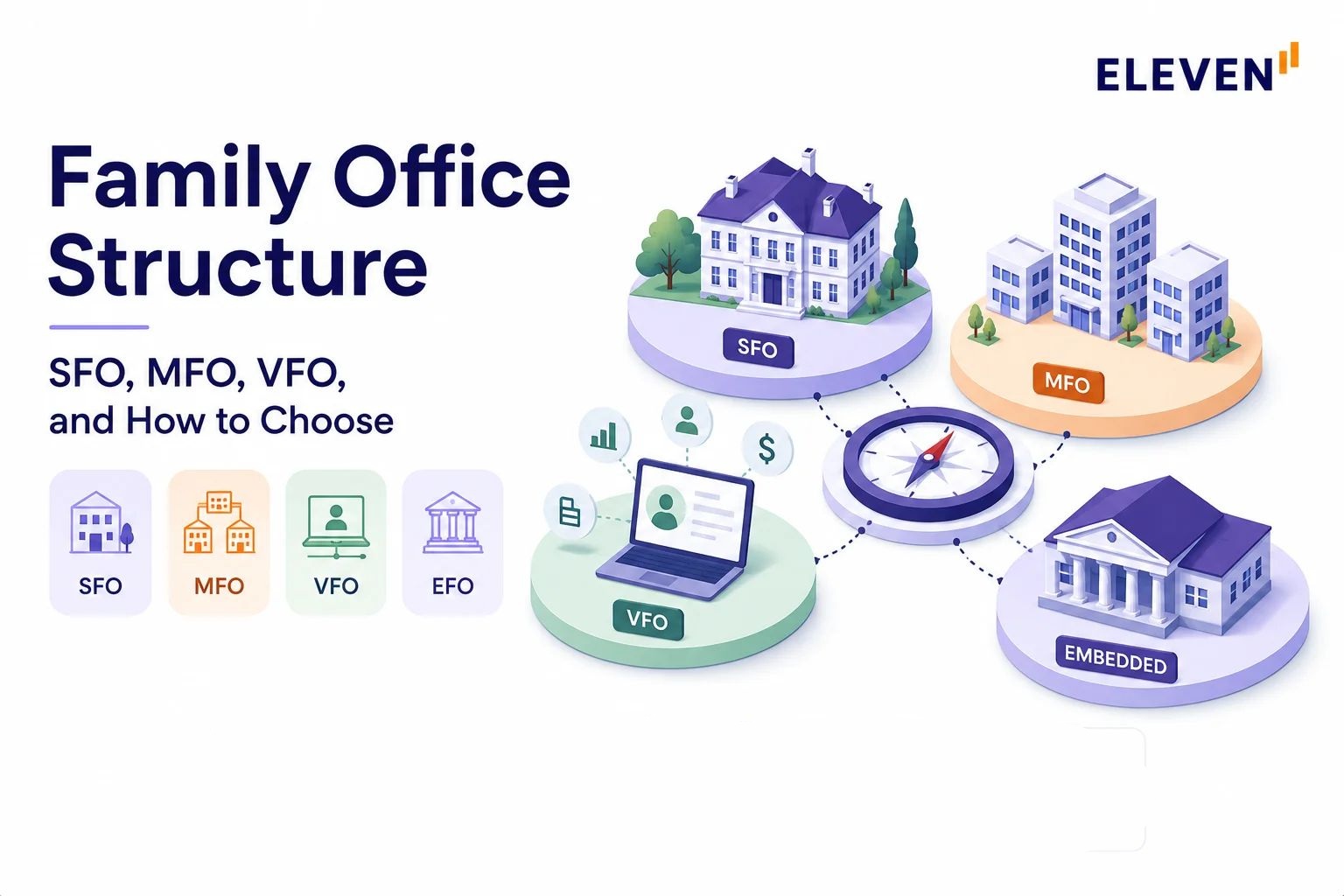
A family office structure is the combination of legal entities, governance bodies, and staffing that a wealthy family uses to manage its wealth. Four models dominate: the single-family office (SFO, dedicated to one family, typically $100M+ in assets), the multi-family office (MFO, shared infrastructure across several families, from roughly $10M to $250M), the virtual family office (VFO, a lean internal coordinator plus outsourced specialists, $10M to $100M), and the embedded family office (housed inside an existing family business). The right structure depends on assets, complexity, desired control, and how much the family wants to build in-house versus outsource.
Family offices now manage more than $5.2 trillion globally, making your family office structure the foundational operational decision once wealth outgrows a conventional wealth advisor.
Choosing the wrong family office structure forces governance, multi-entity reporting, cross-border tax coordination, and succession planning into an immediate operational mismatch.
Finding the right fit comes down to balancing four dominant operating models against your actual legal entity stack, cost benchmarks, and family complexity.
What Is a Family Office Structure?
A family office structure is the combination of legal entities, governance bodies, and staffing a family uses to manage its wealth, investments, tax obligations, estate planning, and often its lifestyle needs across generations.
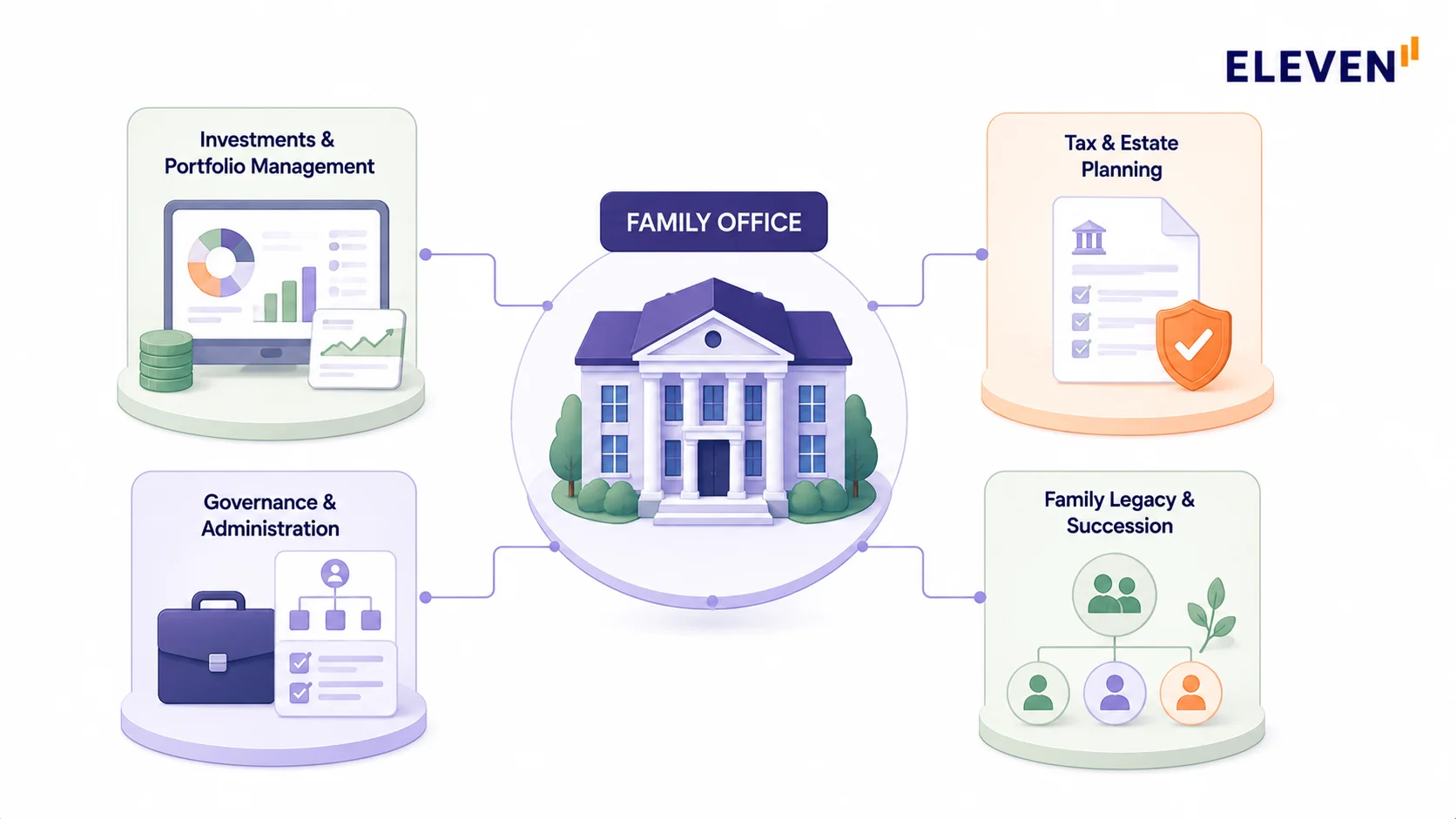
It's the whole operating architecture: who has decision authority, which entity owns what, who reports to whom, and how information reaches the family.
Insight: The first diligence question for any family office isn't "how much AUM?" It's structure, because structure determines cost, governance, risk exposure, and how fast decisions actually get made. Two families with identical net worth can have completely different operating realities depending on which model they chose.
What Are the 4 Types of Family Office Structures?
Four models dominate the family office landscape. They aren't mutually exclusive; many families run a hybrid (an SFO for investment management alongside an MFO relationship for tax and estate work), but the four pure types are the anchors for the decision.
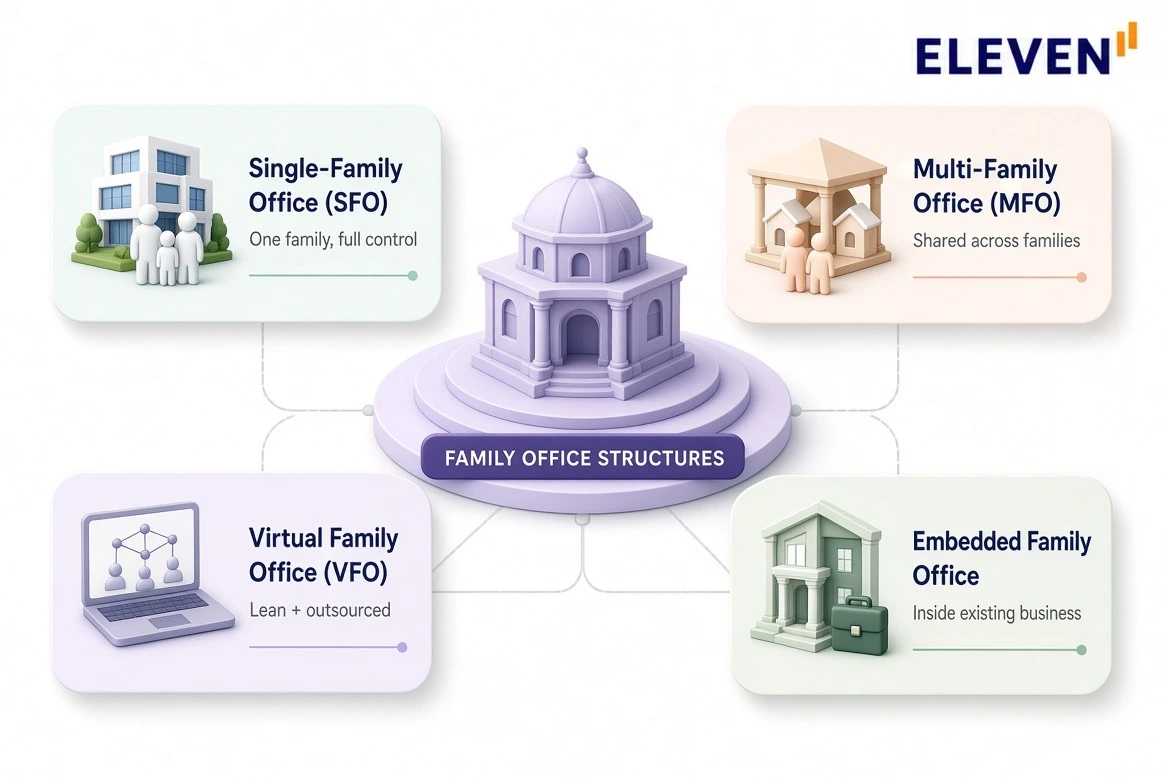
1. Single-Family Office (SFO)
An single-family office is a private operating entity owned by and dedicated exclusively to a single family.
Under the Dodd-Frank Act (SEC Rule 202(a)(11)(G)-1), SFOs are exempt from registration as Investment Advisers under the Investment Advisers Act of 1940, provided they give advice solely to defined "family clients," are wholly owned and controlled by family members or family entities, and do not hold themselves out to the public as investment advisers.
This exemption preserves complete privacy and bespoke portfolio governance but requires roughly $100M to $250M+ in assets to justify the fixed overhead.
- Full control and complete customization of investment strategy, governance, and services.
- Maximum privacy, no shared staff or shared reporting with other families.
- The most expensive and operationally demanding model to run.
2. Multi-Family Office (MFO)
A multi-family office is an independent firm serving multiple wealthy families on shared infrastructure. Most are organized as Registered Investment Advisers and must register with the SEC once assets under management cross $100M.
MFOs make sense roughly from $10M to $25M at the low end up through $250M, most efficiently in the $25M to $100M range, before the economics tip toward a dedicated SFO.
- Institutional-grade services and expertise at a fraction of an SFO's fixed cost
- Fees typically run 1.0% to 1.5% of AUM on the first $25 to $50M, sliding to 0.5% to 0.75% at $250M+, and down to 0.25% to 0.50% above $1B.
- Less customization than an SFO; strategies and processes are standardized across client families to some degree.
3. Virtual Family Office (VFO)
A virtual family office is a technology-enabled, largely outsourced model: one or two internal coordinators (often a part-time CFO or family wealth coordinator) overseeing a network of external advisors, investment managers, accountants, and legal counsel.
It fits families roughly in the $10M to $100M range who want SFO-quality oversight without SFO-level fixed cost.
- Lower overhead than an SFO, and full flexibility to swap underperforming advisors
- A la carte specialist fees can add up faster than families expect if not actively managed.
- Requires a genuinely capable internal coordinator. Without one, service quality fragments across providers.
Without centralized operational systems, a lean structure concentrates immense key-person risk: when entity mappings, intercompany loan schedules, and reporting logic live solely inside a single coordinator's or CFO's head, any personnel transition creates immediate operational blindness.
Mitigating this requires institutionalizing reporting and ledger workflows into a dedicated multi-entity system from day one.
4. Embedded Family Office (EFO)
An embedded family office operates inside an existing structure, either a family operating business or a financial institution (private bank, trust company), rather than as its own standalone legal entity.
It leverages the parent organization's infrastructure, technology, and often global reach.
- Leverages parent operating company accounting, legal, and IT systems without redundant fixed costs.
- Using operating company staff for personal family affairs without a formal Shared Services Agreement (SSA) and market-rate arm's-length management fees risks IRS recharacterization as constructive dividends, while exposing the family to minority shareholder scrutiny.
- If the embedded unit manages non-operating capital or advises extended relations outside the operating entity's scope, it risks triggering unintended SEC registration requirements.
How Do the 4 Family Office Structures Compare?
These are general fit ranges, not hard rules. Complexity matters as much as asset size: a $300M family with a single liquid portfolio may need less structure than a $150M family with operating businesses, real estate across jurisdictions, and active philanthropy.
Map the model to the actual work, not just the balance sheet.
What Legal Entities Make Up a Family Office Structure?
Regardless of which model a family chooses, most family office structures are built from the same basic set of legal wrappers, combined differently depending on complexity.
Under IRC § 67(g) (originally introduced under the Tax Cuts and Jobs Act (TCJA) and made permanent under the One Big Beautiful Bill Act of 2025) miscellaneous itemized deductions, which include IRC § 212 investment expenses, are permanently suspended. As a result, family offices cannot deduct passive investment management expenses on individual family member tax returns.
To claim ordinary and necessary business expense deductions under IRC § 162, SFOs rely on the tax court precedent established in Lender Management, LLC v. Commissioner (2017).
Under this structure, the ManCo operates as an active, independent trade or business providing bona fide investment management services to separate family investment entities in exchange for arm's-length management fees and profits interests, rather than merely managing proprietary assets.
Choosing a ManCo Domicile
While trust vehicles are commonly anchored in top-tier asset-protection and dynasty states like South Dakota, Delaware, or Nevada, the domicile of the management company itself carries direct state income tax, franchise tax, and nexus implications.
Family offices frequently form and physically seat their ManCo in zero-income-tax jurisdictions like Florida, Texas, or Wyoming to optimize operational margins and mitigate multi-state corporate tax exposure, provided executive management and physical nexus substantiate the filing position.
What Does a Family Office Organization Chart Look Like?
Most established family offices organize around three functional groups, each reporting through a distinct executive, with reporting lines deliberately structured to separate who makes investment decisions from who reports on them.
- CEO/Managing Director: Oversees the entire operation, sets organizational strategy, and serves as the primary liaison between staff and the family principal or board.
- CIO (Chief Investment Officer): Directs asset allocation, direct deal underwriting, manager selection, and liquidity profiling. To compete with institutional PE compensation, mature SFO structures integrate carried interest, co-investment SPVs, and long-term incentive plans (LTIPs) directly into the investment entity tier.
- CFO/Controller: Directs accounting, treasury operations, multi-entity cash flow, tax compliance, and internal controls. Deliberately reports independently of the investment team to prevent segregation-of-duties conflicts between deal execution and performance reporting.
- COO: Coordinates across the investment and finance functions and is typically the day-to-day point of contact for anything not requiring direct family involvement.
- General Counsel: Legal matters, entity structuring, and coordination of external legal resources.
What to Watch For: The separation between the CFO/Controller and the CIO is an intentional internal control, not an organization chart formality. Beyond investment reporting independence, it acts as a critical line of defense against the industry's top operational vulnerability: unauthorized disbursements and wire fraud. Structuring granular entity-level access controls, multi-signature treasury approval thresholds, and immutable accounting audit logs ensures no single user can initiate and approve capital movements across separate entity accounts unchecked.
Staffing scales with AUM and complexity, not AUM alone:
A mid-size SFO ($500M to $1B) typically has 5 to 15 in-house professionals.
A large SFO ($1B to $5B) typically has 15 to 50 professionals.
An ultra-mega SFO ($5B+) can exceed 100 professionals.
A lean SFO or VFO often has just a family office leader, a CFO or controller, an administrative coordinator, and a network of outsourced specialists.
What Governance Bodies Does a Mature Family Office Need?
Structure without governance drifts. Mature offices typically run three distinct governance bodies, each with a different scope:
Governance Note: According to global family office industry benchmarks (such as UBS and Campden research), while roughly 80%+ of family offices maintain formal governance mechanisms (like an investment committee or written IPS), only about 35% maintain a documented leadership succession plan for the operating office itself. That void remains the leading structural point of failure when founding principals or senior executives step down. That gap is one of the most common points of failure when a founding CEO or CIO eventually departs.
How Much Does Each Family Office Structure Cost to Run?
Cost is often the deciding factor once a family has assessed complexity and control preferences.
Staffing is consistently the largest single line item across all in-house models: roughly 53% of family-office operating spend goes to pure operating costs, and staffing dominates that figure.
Non-investment professionals (operations, accounting, legal, and lifestyle) typically make up around 40% of total family-office headcount, more than most families expect before they build one.
How to Choose the Right Family Office Structure
Choosing the right family office structure comes down to five factors, weighed against each other rather than in isolation.
Pro Tip: Start with clarity on decision rights and goals before building the legal structure. Families that reverse this order, standing up entities and hiring staff before agreeing on governance, tend to end up rebuilding within a few years once the ambiguity around who decides what becomes a real cost.
Eleven’s Group Management feature allows family offices model their ownership structure within the accounting platform, rather than treating each company as a separate ledger with no visible connection.
You can organize holding companies, investment sub-groups, trusts, operating businesses, and other entities into a hierarchy that reflects how the family’s structure actually works.
This gives accountants and family office teams a consolidated view of relationships between entities while retaining separate ledgers, currencies, reporting settings and access controls at the entity level.
Why Does Structure Matter for Accounting and Reporting?
Regardless of structure, every family office faces the same operational challenge: managing multiple distinct legal entities (ManCos, holding LPs, series LLCs, and trusts) that each require separate books while rolling into a unified view.
While a lean VFO with three entities can manage in spreadsheets, an SFO overseeing a dozen entities across currencies and jurisdictions quickly outgrows general-purpose software, demanding purpose-built accounting with native multi-currency handling, strict entity segregation, and automated consolidation.
Our guides on family office accounting software and multi-entity accounting go deeper into what that infrastructure actually needs to do, from intercompany eliminations to IAS 21-compliant currency translation across entities.
Are you managing multiple family office entities and need consolidated reporting that doesn’t rely on spreadsheets? Start a free 14-day Eleven trial today →
Frequently Asked Questions (FAQs)
What is the difference between a single-family office and a multi-family office?
A single-family office (SFO) is a private company dedicated exclusively to one family, typically viable starting around $100M in investable assets, offering full control and privacy at the highest fixed cost.
A multi-family office (MFO) serves several families on shared infrastructure, generally fitting families in the $10M to $250M range, trading some customization for significantly lower cost through pooled resources and staff.
What is a virtual family office?
A virtual family office (VFO) is a technology-enabled model where a lean internal team, often just one or two coordinators, oversees a network of outsourced specialists: investment managers, tax advisors, legal counsel, and accountants.
It suits families roughly in the $10M to $100M range who want family-office-level oversight without the fixed cost of a fully staffed SFO, provided the internal coordinator is capable enough to prevent service fragmentation across providers.
How much does it cost to run a family office?
Costs vary widely by structure. A lean SFO or VFO can run $250,000 to $500,000 a year. A fully staffed SFO typically costs $1M-$5M annually, rising to $8M+ at the largest scale.
An MFO relationship typically costs 0.5% to 1.5% of assets under management, or a retainer in the $200,000 to $800,000 range, shared across the client families the MFO serves.
What legal entities does a family office typically use?
Most family office structures combine a management company (usually an LLC or C-corp that employs staff and runs operations), investment holding entities (commonly limited partnerships or series LLCs holding private capital and real estate), and trusts (often dynasty trusts in favorable jurisdictions like South Dakota, Delaware, or Nevada) for wealth transfer and asset protection.
Larger families sometimes add a private trust company to serve as trustee with more direct family control than an external corporate trustee provides.
What roles are typically in a family office org chart?
Most established offices include a CEO or Managing Director, a CIO overseeing investment strategy, a CFO or controller running accounting and financial reporting, a COO coordinating daily operations, and general counsel for legal matters.
A deliberate design choice in mature offices is keeping the CFO's reporting line independent from the CIO's, so financial reporting isn't produced by the same function making investment decisions.
Was this article helpful?
Thank you! Your feedback has been received!
Oops! Something went wrong while submitting the form.