Wave Accounting Review 2026: Is It Still Worth It?
Home
/
Blog
/
Single Family Office: Definition, Regulation, and Direct Investing
Single Family Office: Definition, Regulation, and Direct Investing
Written by
Reviewed by
This comprehensive guide to single-family offices (SFOs) explains how they operate, their regulatory exemptions under SEC Rule 202(a)(11)(G)-1, typical staffing costs, the rise of direct investing, and the accounting infrastructure needed to manage complex multi-entity structures.
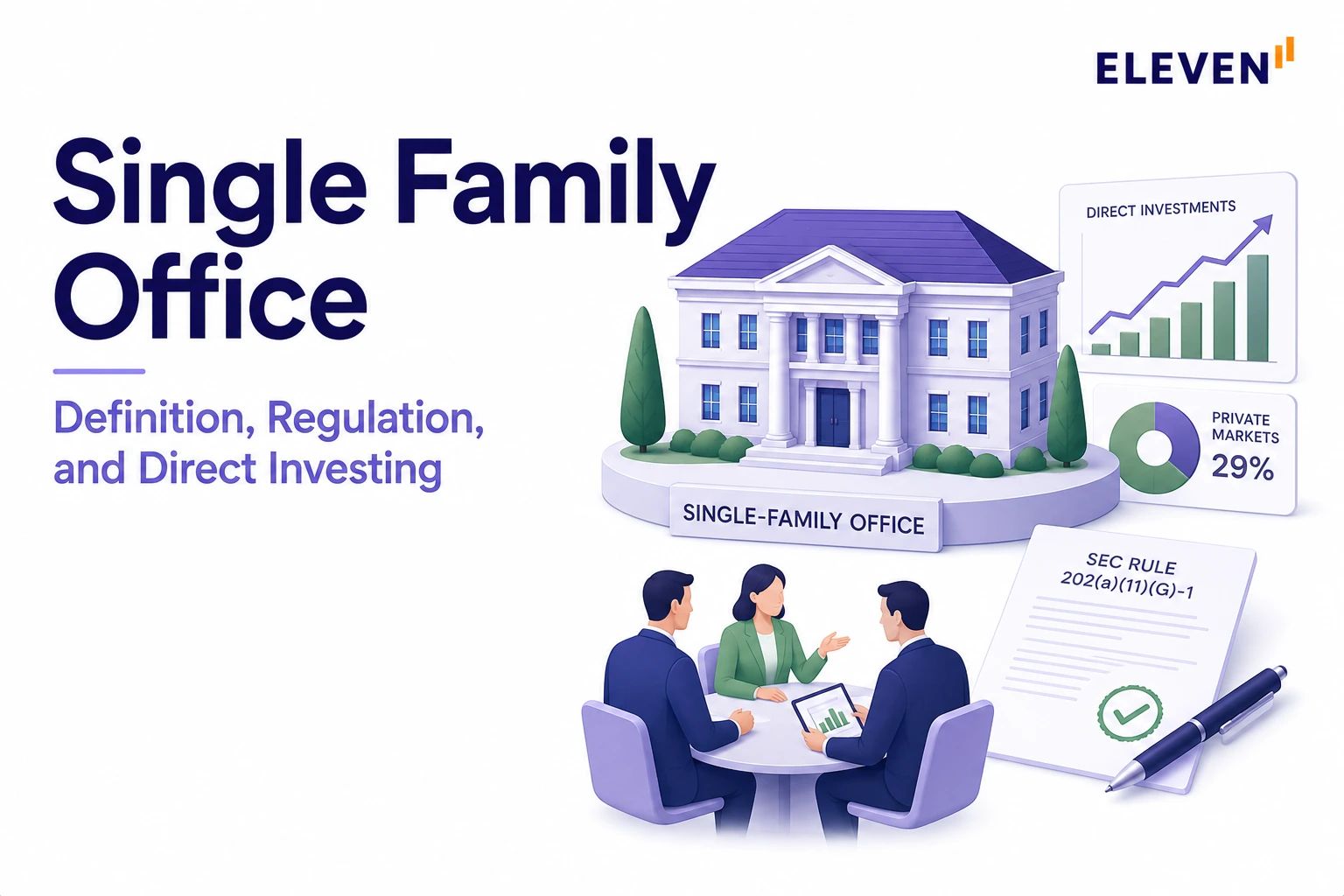
A single-family office (SFO) is a private company, owned and controlled exclusively by one family, that manages the family's investments, tax planning, estate structuring, governance, and often its lifestyle needs. It's the most expensive and highest-control family office model, generally viable starting around $100M in assets. A distinct regulatory advantage sets it apart from other structures: under SEC Rule 202(a)(11)(G)-1, a qualifying SFO is fully exempt from investment adviser registration, an exemption multi-family offices generally can't claim.
Single-family offices made up 70.8% of new family office formations added to the FINTRX database in Q2 2026, up from 63% the quarter before.
First-generation entrepreneurs are driving that growth, and they're doing something notably different from the family offices of a decade ago: writing direct checks into private companies instead of just allocating to funds.
This guide covers what actually distinguishes a single-family office from other family office models, the specific SEC exemption that makes it structurally different, the direct investing trend reshaping how SFOs deploy capital, and the talent and cost realities of running one.
For the broader comparison against MFO, VFO, and embedded structures, see our family office structure guide. This article focuses on the SFO model.
What Is a Single Family Office?
A single-family office is a private company owned by and dedicated exclusively to one family's wealth.
Unlike a wealth advisor relationship or a multi-family office, an SFO exists solely to serve that one family, employing its own staff, holding its own leases, and signing contracts on the family's behalf.
It's typically organized as an LLC owned by a family trust and it functions operationally like a small business built around a single client.
About two-thirds of family offices globally are SFOs, and the model is generally viable starting around $100M in investable assets, with a fully staffed office more realistically requiring $150 to $250M+ to justify its fixed cost base.
What Makes a Single Family Office Different?
There’s a clear legal distinction between an SFO and every other model. Under the Dodd-Frank Act, the SEC adopted Rule 202(a)(11)(G)-1 in 2011, creating a specific exemption from Investment Adviser registration for qualifying family offices.
To qualify, a family office must strictly satisfy the conditions established in the SEC's adopting release:
- Advises exclusively "Family Clients": Defined relative to a single designated common ancestor (living or deceased, no more than 10 generations removed from the youngest generation). The term includes lineal descendants, spouses, spousal equivalents, stepchildren, and qualifying family trusts, charities, and estates. It specifically permits advisory relationships with "key employees" (executive officers, directors, and investment personnel), but excludes in-laws outside lineal descent and commercial co-investors.
- Wholly owned and controlled by family clients: Voting control must reside entirely with family members or family-controlled entities. However, the rule explicitly permits key employees to hold non-controlling equity stakes in the management company as part of incentive compensation.
- No public holding out: The office cannot advertise, market investment advisory services to the public, or hold itself out as a commercial investment manager.
A qualifying SFO is excluded from the definition of "investment adviser" entirely. There’s no Form ADV filing, no public disclosure of assets under management, and no ongoing SEC reporting as an adviser. That's a meaningful privacy and compliance advantage.
What to Watch For: The SEC explicitly rejected requests for an equivalent multi-family office exemption when it finalized this rule. An MFO serving several families generally cannot claim this exclusion and typically must register as an RIA once assets under management cross $100M. This is one of the clearest legal, not just operational, differences between the SFO and MFO models, and it's a real factor in why some families choose SFO status even below the AUM level where it's the more cost-efficient option.
Note: The exemption isn't absolute. A family office that qualifies as an "institutional investment manager" can still be subject to Form 13F filing requirements under the Securities Exchange Act, separately from the Advisers Act exemption. And key employees can actually hold an ownership stake in the family office entity itself under the rule, worth discussing with counsel when structuring compensation. This is a summary for orientation, not legal advice. Work with securities counsel to confirm exemption status for any specific structure.
What Is the Difference Between a Single-Family Office and Other Structures?
Under IRC § 67(g), introduced under the TCJA and made permanent by the One Big Beautiful Bill Act of 2025, miscellaneous itemized deductions, including IRC § 212 investment expenses, are permanently disallowed.
Individual family members cannot deduct passive advisory or portfolio management expenses.
SFOs navigate this by structuring their management company under IRC § 162 (Lender Management framework), operating an active trade or business that provides services to underlying investment entities in exchange for arm's-length management fees and profits interests.
Why Are Single-Family Offices Increasingly Direct Investors?
The passive, fund-of-funds family office is becoming less representative of how SFOs actually deploy capital.
Direct investments (buying equity in operating companies directly, rather than committing capital to a third-party fund) have grown from roughly 9% of family office portfolios in 2010 to about 28% by 2025.
Insight: The shift toward co-investment rather than solo sourcing is a practical response to check size. A $10M check into a growth round alongside a lead fund earns pro-rata information rights and board observer access that a family office would struggle to negotiate sourcing the same deal alone. It's also a lighter internal lift, the lead fund does the heavy diligence, the family office writes the check and gets the access.
For business owners in the lower middle market ($1-25M EBITDA), this shift matters directly: SFOs are increasingly a distinct buyer category from private equity. They offer patient capital and multi-decade hold periods rather than a fund's fixed exit timeline.
This has implications for SFO staffing; direct investing requires internal deal sourcing and diligence capability that a purely allocative office doesn't need.
What Does It Cost to Staff a Single Family Office?
Staffing is the largest cost driver in any SFO, and compensation at the senior level is competitive with private equity and hedge funds, which is exactly the problem: SFOs compete directly with those industries for the same talent pool.
Note: These compensation benchmarks reflect nationwide mid-points; actual packages vary significantly based on AUM tier, asset complexity, and geography. SFOs operating in Tier-1 financial centers (New York, San Francisco, Miami) or managing substantial direct-investment deal flow command top-of-market base salaries and institutional long-term incentive plans (LTIPs/co-investment rights) relative to smaller, regionally anchored offices.
That's a direct consequence of the direct investing trend: a CIO evaluating and structuring $10M+ direct deals needs skills that command PE-level compensation, and SFOs have to pay for it or lose the talent to firms that will.
Why Do Families Choose an SFO Over Other Structures?
Cost aside, the decision usually comes down to a handful of specific priorities an SFO satisfies better than any shared model can.
- Full customization: Investment mandate, governance structure, and services align entirely with one family's specific goals, with no consensus-building across other client families.
- Maximum privacy: Combined with the SEC exemption's lack of public disclosure, an SFO offers the strongest confidentiality profile of any structure.
- Direct investing capability: An SFO can build internal deal sourcing and diligence capacity specifically calibrated to the family's target sectors and check sizes. That’s harder to replicate through a shared MFO platform serving multiple families' differing mandates.
- Legacy and governance institutionalization: For multi-generational families, an SFO becomes the governance vehicle itself, not just an investment manager, housing the family council, the investment committee, and next-gen education programs.
What Are the Risks of Running a Single Family Office?
The control and customization come with structural risks that must be acknowledged.
Pro Tip: Document succession planning for the office itself as a standing agenda item, not a one-time exercise. The families that handle a CIO or CEO transition smoothly are consistently the ones who treated it as an ongoing governance function well before the transition became urgent.
How to Set Up a Single-Family Office?
Here’s the sequence that avoids the most common early mistakes:
- Confirm the asset threshold justifies the fixed cost. Below roughly $100M, the math rarely works; an MFO or VFO typically delivers more value per dollar.
- Structure the legal entities with counsel, the management company, investment holding entities, and trusts, with SEC exemption qualification in mind from the start if privacy and registration avoidance matter to the family.
- Build governance before staffing, a family board, an investment committee, and defined decision rights should exist on paper before the first hire.
- Hire the CEO/CIO/CFO core first, and resist the urge to over-hire before the investment mandate and reporting cadence are actually defined.
- Formalize a succession plan for the office itself alongside the family's own succession planning, not as an afterthought.
How Eleven Supports a Single-Family Office
Eleven is built around the multi-entity accounting requirements of a family office, giving an SFO one platform for the different companies and structures that make up its wealth architecture.
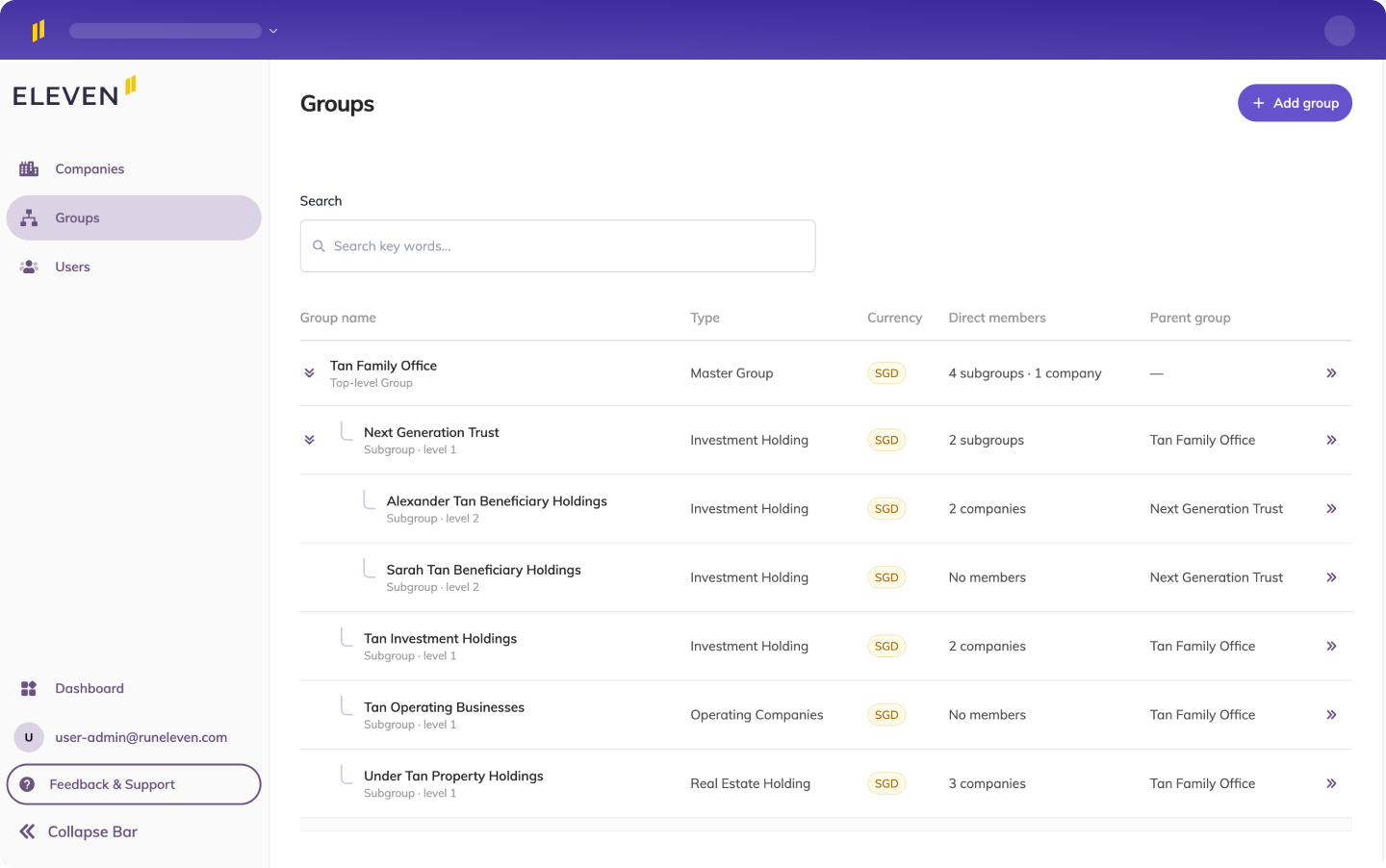
Each holding company, investment vehicle, trust, real estate SPV, operating business or personal account can maintain its own general ledger, chart of accounts, functional currency and reporting settings, while accountants and family office teams can move between entities from a single platform.
Eleven records investment transactions, tracks costs on the balance sheet, posts income and distributions, and supports accounting for liquid investments, private equity, real estate and operating businesses.
Eleven can connect directly to supported bank accounts and help reconcile transactions across the different banking relationships an SFO may maintain.
Group Management adds a structural layer on top of the individual ledgers. Rather than treating the family’s entities as a flat list, Eleven allows the office to model master holdings, investment sub-groups, trusts and operating businesses according to their actual relationships.
For an SFO with a growing number of entities and direct-investment SPVs, this provides a way to keep the underlying books separate while maintaining a view of how the entities fit together.
Eleven supports per-entity access for family members, advisors and external auditors, while its reporting and analytical dimensions can provide more granular management information without turning the general ledger itself into an unnecessarily complex structure.
What Accounting Foundation Does a Single Family Office Need?
An SFO's entity structure, ManCo, holding LPs or series LLCs, trusts, sometimes a private trust company, creates the same multi-entity accounting challenge every family office eventually faces, but often at greater complexity given the direct investing trend adding more special-purpose vehicles per deal.
- Each investment holding entity needs its own clean books that still roll up to a consolidated family view.
- The CFO's segregation from the investment function (a standard SFO governance practice) depends on financial reporting that's independently reliable, not assembled from the same data the investment team controls.
- Direct deal SPVs add entities faster than a purely allocative portfolio would, but the primary accounting strain is operational reconciliation rather than raw entity count. The central ManCo frequently fronts due diligence costs, legal retainers, and deal expenses, requiring systematic intercompany loan tracking, capital call accounting, and arm's-length expense allocations back to individual SPVs without manual cross-ledger journal entries.
- Writing direct checks into international operating companies or real estate assets introduces multi-currency exposure. The accounting infrastructure must handle automated foreign currency revaluations (under ASC 830/IAS 21) across deal-specific SPVs, rolling clean transactional books up to unified, base-currency reporting at the master family level.
Our guides on family office accounting software and what multi-entity accounting is cover what that infrastructure needs to do as an entity count grows with the deal pace.
Managing a growing web of investment entities and need consolidated reporting that scales with your deal flow? Start a free 14-day Eleven trial today →
Frequently Asked Questions (FAQs)
What is a single-family office?
A single-family office (SFO) is a private company owned by and dedicated exclusively to one family, managing that family's investments, tax planning, estate structuring, governance, and often lifestyle needs.
It makes sense starting around $100M in investable assets and offers the highest level of control and customization of any family office model, at the highest fixed cost.
Does a single-family office need to register with the SEC?
Generally no, if it qualifies under SEC Rule 202(a)(11)(G)-1. A qualifying family office, one that advises only family clients, is wholly owned and controlled by family clients and doesn't hold itself out publicly as an investment adviser, is excluded from the definition of investment adviser entirely, avoiding Form ADV filing and public AUM disclosure.
Multi-family offices generally cannot claim this same exemption once they exceed $100M in assets under management.
Why are single-family offices doing more direct investing?
Direct investments in private companies grew from roughly 9% of family office portfolios in 2010 to about 28% by 2025. Families increasingly prefer the control, longer hold periods (10-30 years versus a PE fund's 3-7 year cycle), and fee savings of investing directly rather than solely through third-party funds.
Most of this activity now happens through co-investments alongside a lead fund rather than solo-sourced deals, which reduces the internal diligence burden while still providing direct access and board rights.
How much does it cost to staff a single-family office?
Senior compensation is genuinely competitive with private equity and investment banking. A Chief Investment Officer typically earns $300K to over $1M, a Chief Financial Officer $200K to over $900K, with total office operating costs commonly running $1M to $5M annually for a fully staffed office, and up to $8M or more at the largest scale.
What is the biggest risk specific to the single-family office model?
Concentration and succession risk. Because an SFO typically depends on a small number of senior executives (often just a CEO, CIO, and CFO), the departure of a key person can be far more disruptive than at a multi-family office with a broader team.
Only about 35% of family offices have a documented succession plan for the office's own leadership, which is one of the most common points of failure when a founding executive eventually departs.
Was this article helpful?
Thank you! Your feedback has been received!
Oops! Something went wrong while submitting the form.