Full Xero Review With Updated US Pricing and Features (2026)
Home
/
Blog
/
What Is Revenue Recognition? ASC 606, IFRS 15, and Examples
What Is Revenue Recognition? ASC 606, IFRS 15, and Examples
Written by
Reviewed by
Revenue recognition errors cause more financial restatements than almost any other accounting issue. Learn how ASC 606 and IFRS 15 work, why timing matters, and how to avoid costly mistakes.

Revenue recognition is the accounting principle that determines when revenue gets recorded in financial statements, based on when it's earned, not when cash is received or an invoice is sent. ASC 606 (US GAAP) and IFRS 15 (international) standardize this through a five-step process centered on one question: when did the customer actually receive what was promised? Getting the timing wrong is one of the most common causes of financial restatements.
A SaaS company collects $12,000 upfront but delivers the service over 12 months. A construction firm works for months before sending an invoice. A software vendor bundles licensing, support, and implementation into one contract with staggered delivery.
In every case, when the cash arrives and when the revenue is actually earned are two different dates, and mixing them up is where most revenue recognition mistakes happen.
This guide walks through how ASC 606 and IFRS 15 solve that problem, the five-step process accountants apply in practice, and the mistakes that show up most often in audits.
If you’re evaluating software to handle this automatically rather than in a spreadsheet, see our revenue recognition software guide. This article covers the accounting concept itself.
What Is Revenue Recognition?
Revenue recognition is the accounting rule that determines when revenue should be recorded, and it's rarely when you'd assume.
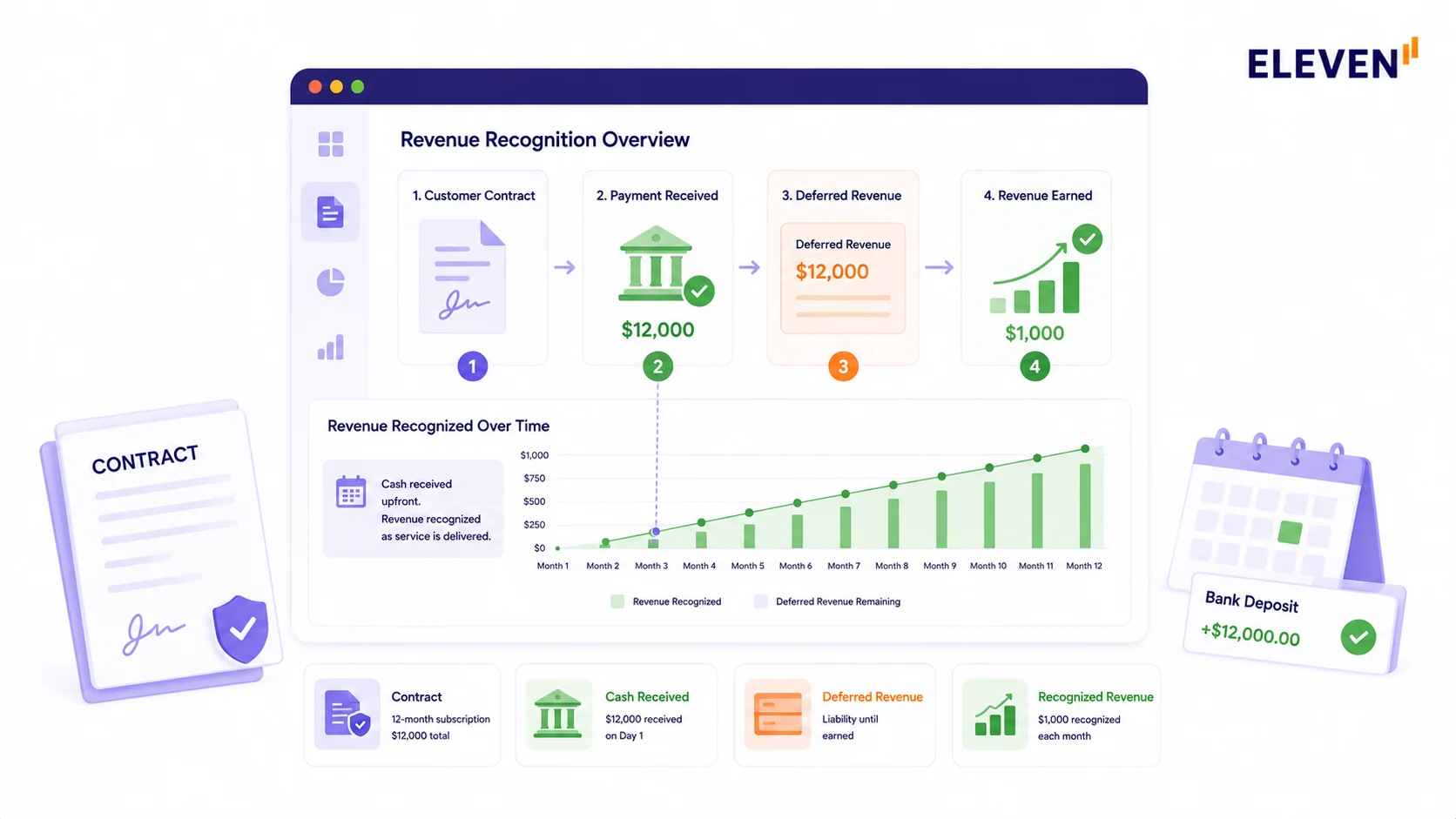
→ The principle is that revenue is recognized when it's earned, not when cash is received. Cash flow and actual business performance almost never land on the same date.
Without a consistent rule, two companies delivering identical services could report completely different revenue figures just because they bill differently.
ASC 606 and IFRS 15 exist so that reported revenue reflects real business activity, not invoicing structure or payment timing.
Why Does the Timing of Revenue Recognition Matter?
Three companies could provide identical consulting services. One recognizes revenue when the invoice is sent, another when the client pays, and a third upfront at contract signing.
It’s the same service, but there are three different revenue figures and no way to compare them fairly.
Insight: The shift from ASC 606/IFRS 15 is philosophical as much as procedural: instead of asking “When did we bill?” or “When did we get paid”, the standards ask, “When did the customer actually get value?” That single reframe is what makes revenue comparable across companies and industries and harder to manipulate for hitting a quarterly target.
What Are the 5 Steps of Revenue Recognition Under ASC 606?
ASC 606 and IFRS 15 direct entities to recognize revenue when promised goods or services transfer to the customer, in the amount the entity expects to receive in return. Here's how that breaks down in practice.
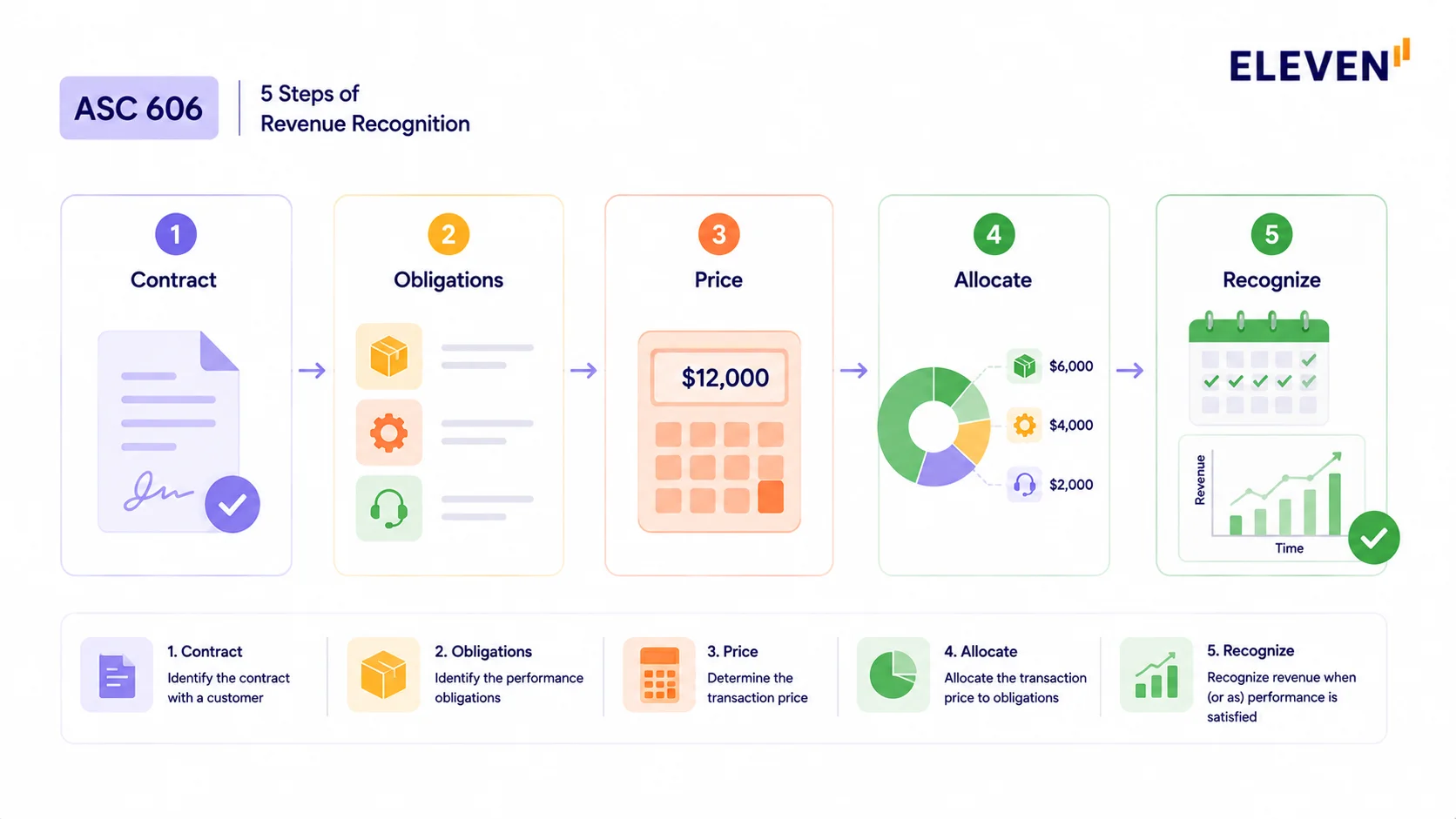
1. Identify the Contract With a Customer
A contract is an agreement (written, oral, or implied by customary business practice) that creates enforceable rights and obligations.
Before any revenue can be recognized, you need to confirm a valid, enforceable agreement exists with clear terms, not just a verbal commitment or a letter of intent.
2. Identify the Performance Obligations
A performance obligation is a distinct promise to transfer goods or services to the customer. Many contracts contain several: a software vendor might promise licensing, implementation, and ongoing support in one agreement.
Each is a separate performance obligation, and each gets evaluated for when revenue should be recognized.
3. Determine the Transaction Price
The transaction price is the total consideration the business expects to receive in exchange for the promised goods or services, excluding third-party collections like sales tax.
When contracts include variable consideration (discounts, rebates, refunds, performance bonuses, or milestone payments), that estimated amount can only be included if it is probable that a significant reversal in cumulative revenue will not occur once the uncertainty resolves (the variable consideration constraint).
4. Allocate the Transaction Price to Performance Obligations
Once you know what was promised and what you'll receive, the transaction price gets allocated across each performance obligation, typically based on relative value.
A contract bundling a $6,000 product with $4,000 in support services, for $10,000 total, allocates 60% of recognized revenue to the product and 40% to support.
5. Recognize Revenue When Obligations Are Satisfied
Revenue is recognized when (or as) the customer obtains control of the promised asset. Recognition occurs over time if any one of three specific criteria is met, regardless of contract duration:
- The customer simultaneously receives and consumes the benefits as the entity performs (e.g. routine advisory or cloud services).
- The entity’s performance creates or enhances an asset the customer controls as it’s created.
- The entity’s performance creates an asset with no alternative use to the vendor, and the vendor has an enforceable right to payment for performance completed to date.
If none of these three criteria are met, revenue is recognized at a point in time when legal title, physical possession, and the significant risks and rewards or ownership transfer.
What Does the 5-Step Process Look Like on a Contract?
A consulting firm signs a $50,000 contract for three months of strategic planning and implementation. Here’s what it looks like.
Note: If this contract were instead for a single deliverable, like a completed strategic plan document, revenue would recognize it at a point in time, when the deliverable is handed over and the client gains control of it, rather than spread across the engagement.
Why Is Revenue Recognition Getting More Complicated?
Today's business models separate billing from delivery in ways that demand consistent process and documentation.
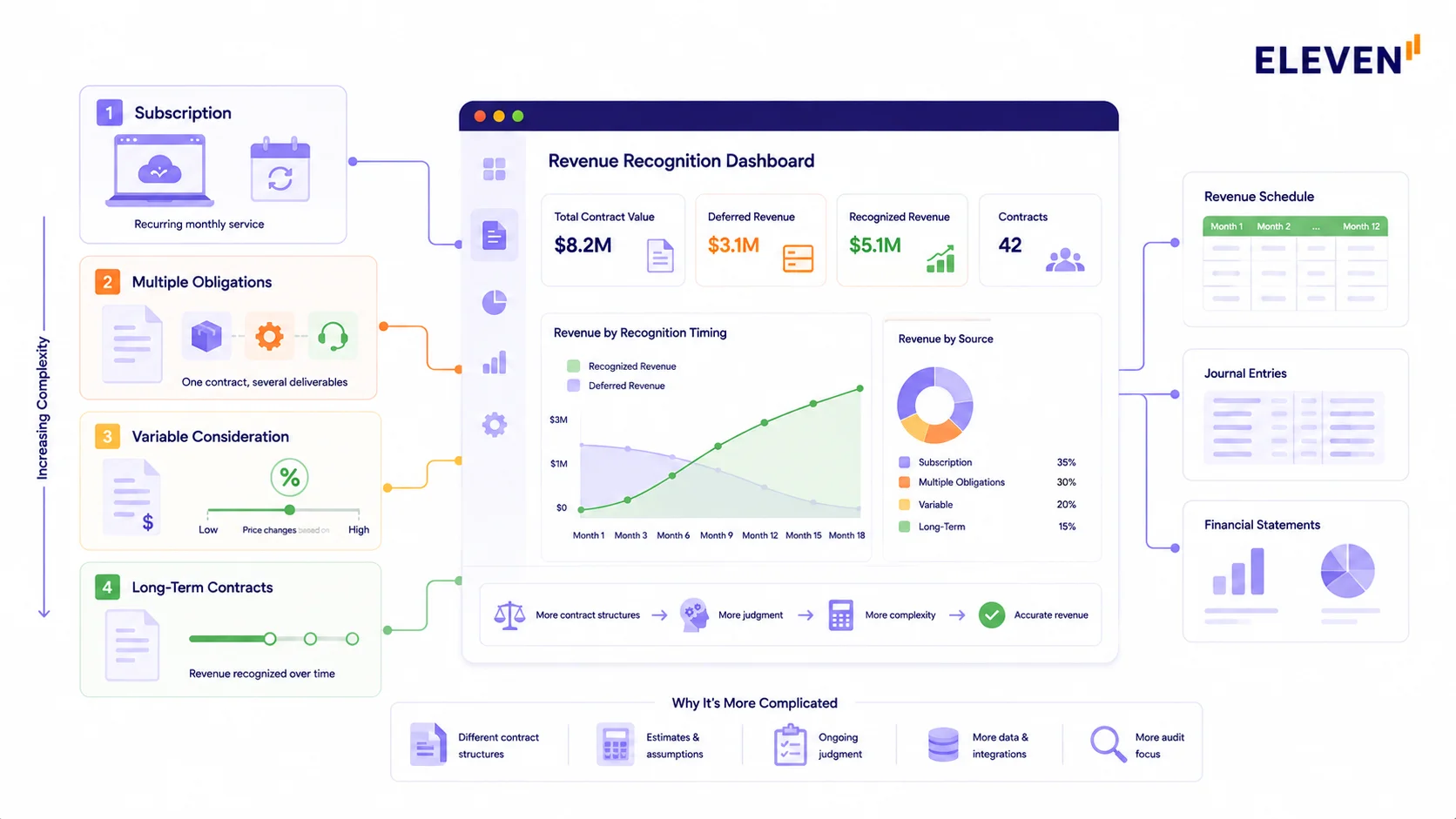
A SaaS company might sell licenses, onboarding, implementation, and customer success all in a single contract; each bundled component needs to be broken into its own performance obligation and tracked separately.
Prepaid, Gradually Consumed Services
These create the exact deferred revenue situation ASC 606 was built for: a customer pays annually upfront but consumes the service monthly, so the balance sits on the books as a liability until earned
Contract Modifications
Contract modifications follow three specific accounting paths rather than a full reset:
- Separate contract: If the modification adds distinct goods/services at their standalone selling prices, it is treated as a separate, new contract while the original remains untouched.
- Prospective treatment: If the remaining goods/services are distinct but not priced at standalone selling price, the remaining contract is treated as a prospective termination of the old contract and creation of a new one.
- Cumulative catch-up: If the remaining goods/services are not distinct (such as ongoing work-in-progress), the modification updates the transaction price and progress measure, recognized as a cumulative catch-up adjustment in the current period.
Revenue recognition is no longer a niche accounting concern. It now regularly involves sales, product, and finance teams interpreting contracts together. Getting it wrong triggers audit findings and, in worse cases, restatements.
What Are the Most Common Revenue Recognition Mistakes?
Most revenue recognition problems come from operational shortcuts and inconsistent processes, not from misunderstanding the standard.
- Recognizing revenue on invoice dates, not when performance obligations are satisfied. Both ASC 606 and IFRS 15 require revenue to reflect the transfer of control, not billing activity.
- Failing to separate bundled contracts into distinct performance obligations, which often causes revenue to be recognized too early, especially in service and subscription models.
- Misclassifying upfront payments as earned revenue instead of deferred revenue. Advance payments are liabilities until delivery actually occurs.
- Inconsistent treatment of similar contracts across periods. Even when individual entries look reasonable on their own, inconsistency raises audit risk and is a common trigger for restatements.
Why Does Deferred Revenue Matter?
Deferred revenue arises when customers pay before goods or services are delivered. Until the performance obligation is satisfied, that amount sits on the books as a liability, not income.
This prevents overstated profits and keeps financial statements aligned with reality.
Pro Tip: Deferred revenue is also a forecasting tool, not just a compliance requirement. Your deferred revenue balance represents cash you’ve already collected for work you still owe. Track it and you get a running signal for cash flow planning and budgeting, not just a line on the balance sheet.
How Do Auditors Review Revenue Recognition?
Revenue is consistently treated as a high-risk area across both private and public company audits due to the degree of management judgment and contract interpretation involved.
(In public company audits, PCAOB standards frequently designate it as a Critical Audit Matter, or CAM; in private audits under AICPA standards, it represents a significant risk area requiring detailed substantive testing.)
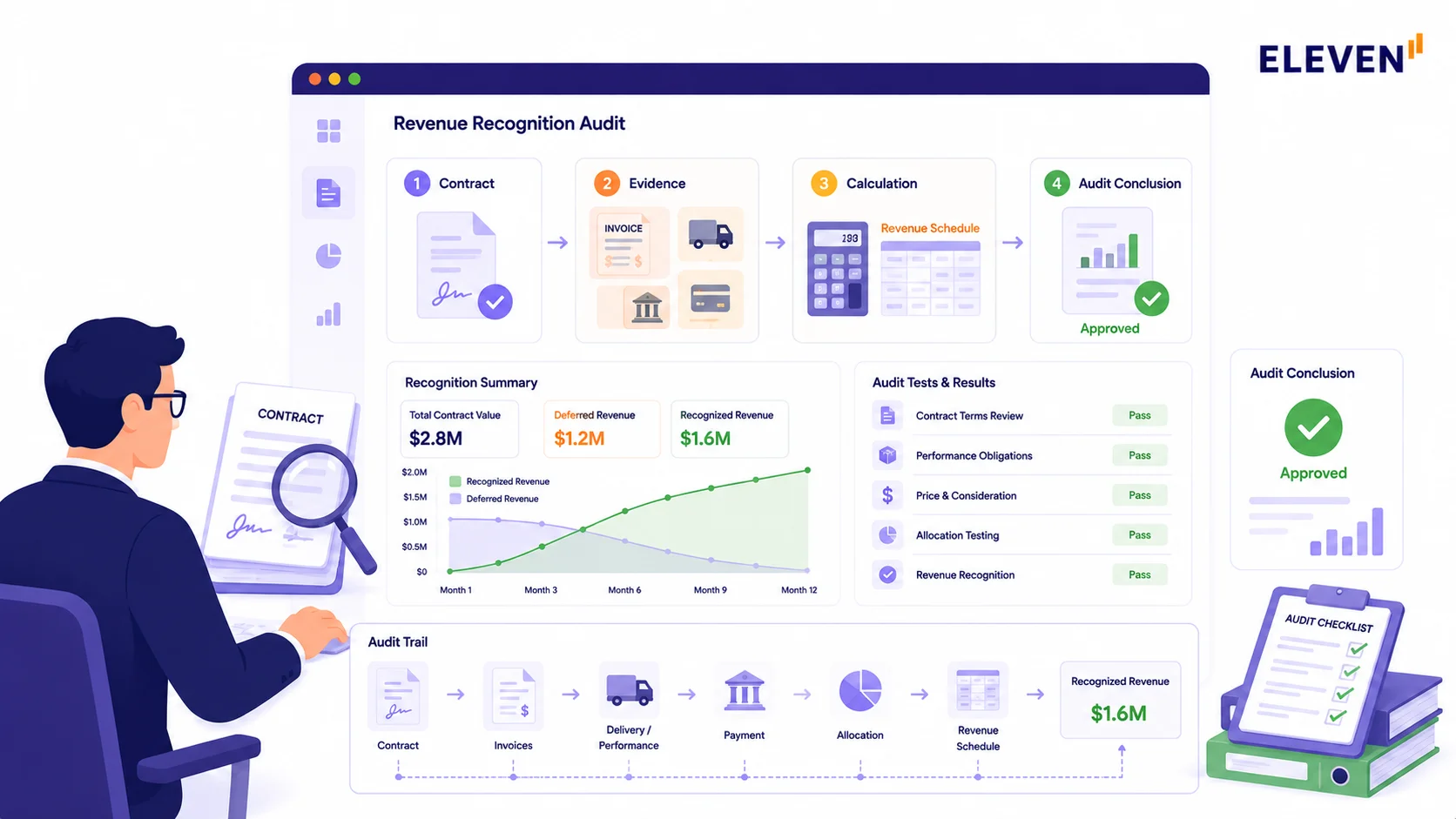
Auditors typically assess contract processes, test a sample of contracts for unusual terms, and verify recognition matches delivery timelines. Common focus areas:
- Contract existence and approval
- Identification of performance obligations
- Timing and consistency of revenue recognition
- Variable consideration and estimates
- Contract modifications
What to Watch For: Inconsistent application of ASC 606 across products or performance obligations raises audit risk. Documentation matters as much as the recognition decision itself; every revenue entry needs to trace back cleanly to contract terms and actual delivery, on demand.
Should You Automate Revenue Recognition or Manage It Manually?
Revenue recognition depends on professional judgment, but the accounting system underneath determines whether that judgment can be applied consistently.
Many errors trace back to fragmented data, manual entries, and poor transaction visibility, not a misunderstanding of the standard.
For contracts with complexity, multi-element bundles, usage-based pricing, frequent modifications, and a dedicated tool becomes worth the cost.
For simpler service-based revenue, recognized at delivery with few bundled elements, a well-configured accounting system handles this reliably without a dedicated layer on top.
Our revenue recognition software guide compares platforms built specifically for ASC 606 and IFRS 15 automation, from enterprise engines to lighter B2B tools.
What Accounting Foundation Does Revenue Recognition Depend On?
Modern accounting platforms reduce recognition risk by centralizing data, automating reconciliations, and making revenue-related transactions traceable and audit-ready. Eleven is built for accounting firms and family offices with exactly this in mind:
- Automated bookkeeping that reduces the manual entry errors most recognition mistakes trace back to
- Integrated document management, so every contract and supporting document is linked to the transaction it governs
- Multicurrency support with IAS 21-compliant FX handling for firms managing international client contracts
- Bank reconciliation that keeps the underlying transaction data clean and defensible
Eleven doesn't replace accounting judgment. It provides the clean foundation accountants need to apply ASC 606 and IFRS 15 confidently, and to support those decisions when an auditor asks for the trail.
Want revenue recognition decisions backed by clean, reconciled accounting data? Start a free 7-day Eleven trial today. →
Frequently Asked Questions (FAQs)
What is revenue recognition in simple terms?
Revenue recognition is the accounting rule for when revenue gets recorded in financial statements, based on when it's actually earned rather than when cash is received or an invoice is sent.
A company that bills a client upfront for a year of service doesn't record the full amount as revenue immediately; it recognizes a portion each month as the service is delivered.
What is the difference between ASC 606 and IFRS 15?
ASC 606 (US GAAP) and IFRS 15 (international) share the identical five-step framework and core transfer-of-control principle, but differ in key technical thresholds.
The most notable difference is Step 1's collectibility threshold:
- Under US GAAP (ASC 606), collection must be "probable," interpreted in practice as a roughly 75% to 80% likelihood.
- Under IFRS 15, "probable" is defined as "more likely than not" (greater than 50%). Other distinctions include specific disclosure requirements and rules governing shipping/handling as fulfillment activities.
What is deferred revenue?
Deferred revenue is money collected from a customer before the corresponding goods or services have been delivered. It's recorded as a liability, not income, until the performance obligation is satisfied.
A 12-month software subscription paid upfront creates deferred revenue that gets recognized incrementally as each month of service is delivered.
Why do companies get revenue recognition wrong?
Most errors come from operational shortcuts rather than misunderstanding the standard: recognizing revenue on invoice dates instead of delivery dates, failing to separate bundled contracts into distinct performance obligations, misclassifying upfront payments as immediate income, or applying recognition rules inconsistently across similar contracts.
Each of these increases audit risk and is a common trigger for financial restatements.
Does every business need to follow ASC 606 or IFRS 15?
Public companies and most private companies preparing GAAP or IFRS-compliant financial statements are required to follow these standards.
Even businesses without a strict compliance requirement benefit from applying the same principles, since accurate revenue timing produces financial statements that actually reflect business performance, which matters for lenders, investors, and internal decision-making alike.
Was this article helpful?
Thank you! Your feedback has been received!
Oops! Something went wrong while submitting the form.