Wave Accounting Review 2026: Is It Still Worth It?
Home
/
Blog
/
Virtual Family Office: What It Is and How to Build One (2026)
Virtual Family Office: What It Is and How to Build One (2026)
Written by
Reviewed by
Thisl guide to virtual family offices (VFO) breaks down how the lean coordinator model works, the essential tech stack and build order, cybersecurity considerations, cost drivers, and when to transition to a full general ledger.

A virtual family office (VFO) is a technology-enabled operating model where a lean internal coordinator, often a family principal or a part-time CFO, oversees a network of outsourced specialists (investment managers, tax advisors, legal counsel, and accountants) instead of building a full in-house team. It typically fits families in the $10M to $100M range who want institutional-quality oversight without the fixed cost of a fully staffed single-family office. The model lives or dies on two things: a genuinely capable coordinator and a technology stack that actually connects the outsourced pieces instead of leaving them fragmented.
60% of family offices run with six or fewer employees. For a meaningful share of them, it's the model working as designed. A virtual family office deliberately stays lean, replacing headcount with a coordinated network of outside specialists and a technology layer that ties them together.
This guide covers what a VFO actually is, who's really running it day to day, the tech stack it depends on and the order to build it in, and the honest tradeoffs against a fully staffed SFO.
For the full comparison against single-family offices, multi-family offices, and embedded structures, see our family office structure guide. This article focuses on the virtual model.
What Is a Virtual Family Office?
A virtual family office is a technology-enabled operating model that delivers the comprehensive services of a traditional family office: investment management, tax planning, estate coordination, and financial reporting without a physical office or a large in-house staff.
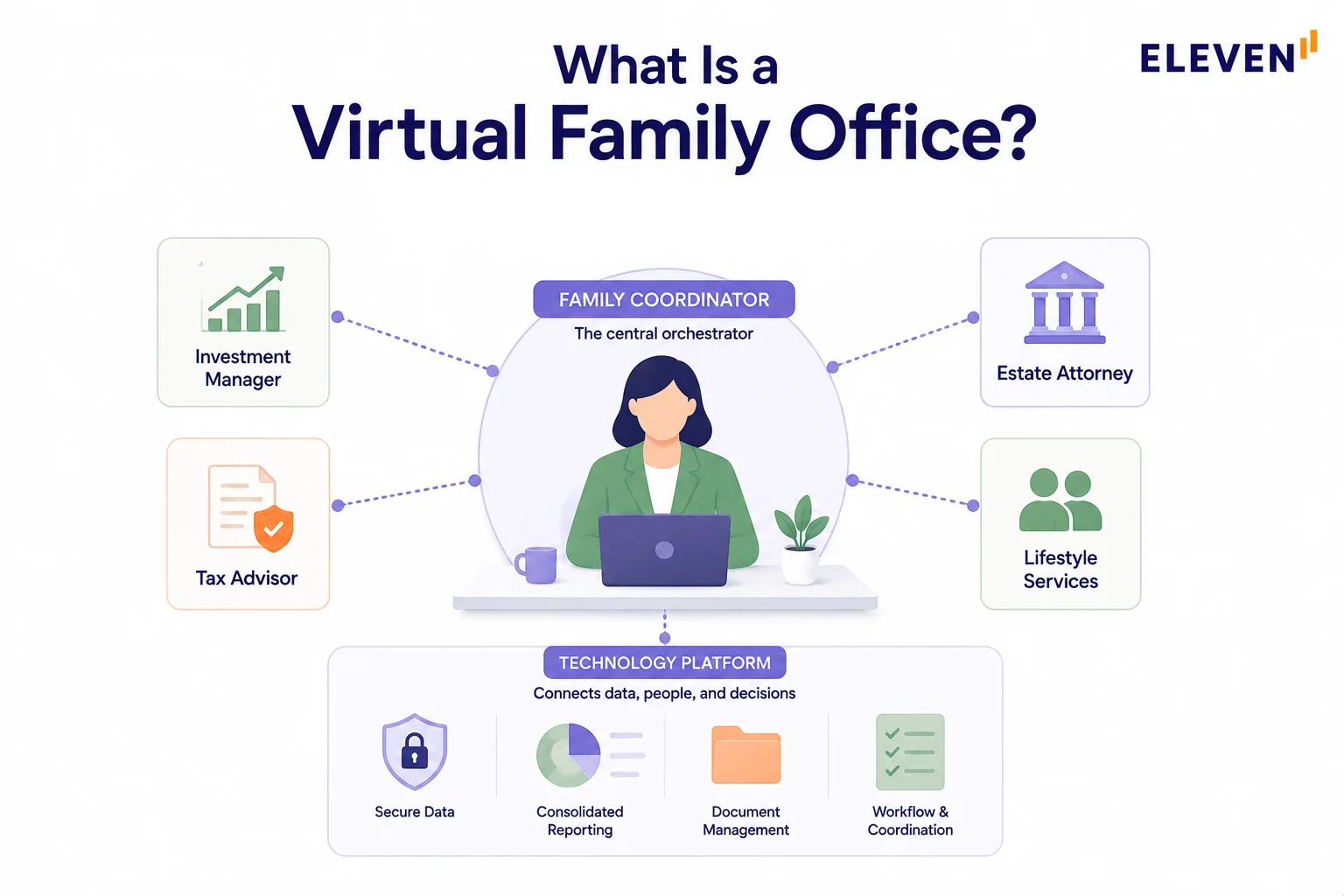
Instead of hiring a full executive team, a VFO runs on a central coordinator (a family principal, or more often a part-time or fractional CFO) who directs a network of specialized external providers.
The family gets institutional-grade oversight; the providers do the specialized work; the coordinator and the technology stack hold it all together.
Insight: A VFO is better understood as an operating model than a product. The families who get real value from it define decision rights, service scope, and data architecture first, then choose vendors, not the other way around. Buying software or hiring an advisor before that groundwork is done is the single most common reason VFOs end up fragmented instead of coordinated.
Who Is a Virtual Family Office For?
VFOs typically fit families in the $10M to $100M range, with optimal operational efficiency in the $25M to $100M range, depending on complexity.
Below that range, a strong wealth advisor relationship is usually sufficient. Above it, the fixed costs of a dedicated single-family office start to make more sense relative to the coordination overhead of managing many outsourced relationships.
Who Is Doing the Work in a Virtual Family Office?
The coordination role carries the entire model. Someone has to own it, and it's usually one of two people:
- A family principal who takes on coordination directly. This works when the principal has both the time and the financial fluency to manage several outside relationships without letting any one of them drift unsupervised.
- A fractional or part-time CFO brought in specifically to run the coordination function. This is the more common and more durable setup, since it doesn’t depend on a family member’s ongoing bandwidth, and it puts a financially literate person accountable for the whole picture.
Around that coordinator sits the actual service network: an investment manager or advisor, tax counsel, estate/trust attorneys, an accountant or bookkeeper, and often a concierge or lifestyle service provider for the operational side of things.
None of these providers see the full picture on their own; that's the coordinator's job, supported by the tech stack underneath.
Confidentiality and Cybersecurity Risk: A VFO distributes sensitive family data (custodial account numbers, K-1s, estate trust documents, and wire authorities) across multiple third-party vendor environments. Without strict protocols (role-based access controls, mandatory multi-factor authentication, and encrypted document portals), this multi-vendor footprint increases exposure to phishing, social engineering, and data breaches compared to an air-gapped SFO network.
What Technology Stack Does a Virtual Family Office Need?
This is where most VFOs succeed or fail. Without dedicated staff to catch gaps manually, the technology layer is what actually holds the coordinated network together, and 65% of family offices still run core functions on spreadsheets.
That’s an operational and security liability once the entity count or provider count grows past a handful.
The Right Order to Build the Technology Stack
A common mistake is starting with a general ledger out of habit. The more effective sequence starts with visibility and then adds transactional systems only where the office’s actual operations require them:
- Performance reporting and data aggregation. A consolidated view across custodians and asset classes comes first. This is what gives the family and the coordinator a single source of truth to work from.
- General ledger and accounting where actually needed. If the family is managing entities with real transaction volume (bill pay, intercompany activity, and multi-currency operations), a proper GL becomes necessary. If the office is mostly overseeing outsourced investments with minimal transactional activity, a full GL may be more system than the office needs yet.
- Bill pay. Layered on top of the GL once entity-level transaction volume justifies it.
- Task and workflow management and document management. These come last, once the data and financial layers are stable, to coordinate the people and paperwork around them.
Best-of-Breed vs. All-in-One
The modern VFO stack leverages best-of-breed platforms integrated via open APIs rather than legacy monolithic suites:
- Data aggregation and performance reporting: Custodial aggregators (e.g., Addepar, Canoe Intelligence, and Arch) normalize alternative asset statements, private equity capital calls, and liquid brokerage feeds.
- Multi-entity general ledger: Cloud platforms isolate entity-level ledgers while standardizing chart-of-accounts hierarchies. Specialized multi-entity platforms like Eleven provide multi-currency tracking, transaction tagging, and open API connectivity to feed consolidated models in Excel, while enterprise ERP suites like Sage Intacct automate fully integrated group eliminations in-platform.
- Treasury and bill pay: Specialized payment workflows (e.g., BILL or Plastiq, operating under Priority Technology Holdings following its 2023 Chapter 11 restructuring) maintain structured audit trails and dual-authorization controls for family distributions.
- Secure vault and workflow: Encrypted portals for estate documents and K-1 distribution across external CPAs and estate attorneys.
Pro Tip: Before adding any new tool to the stack, ask whether it has an open API and genuine integration history with the systems already in place. A platform that locks data in a closed environment creates a new dependency rather than removing an old one. That’s the fragmentation problem the tech stack is supposed to solve.
How to Set Up a Virtual Family Office
The sequence that avoids the most common failure mode, building the stack or hiring providers before agreeing on how decisions get made:
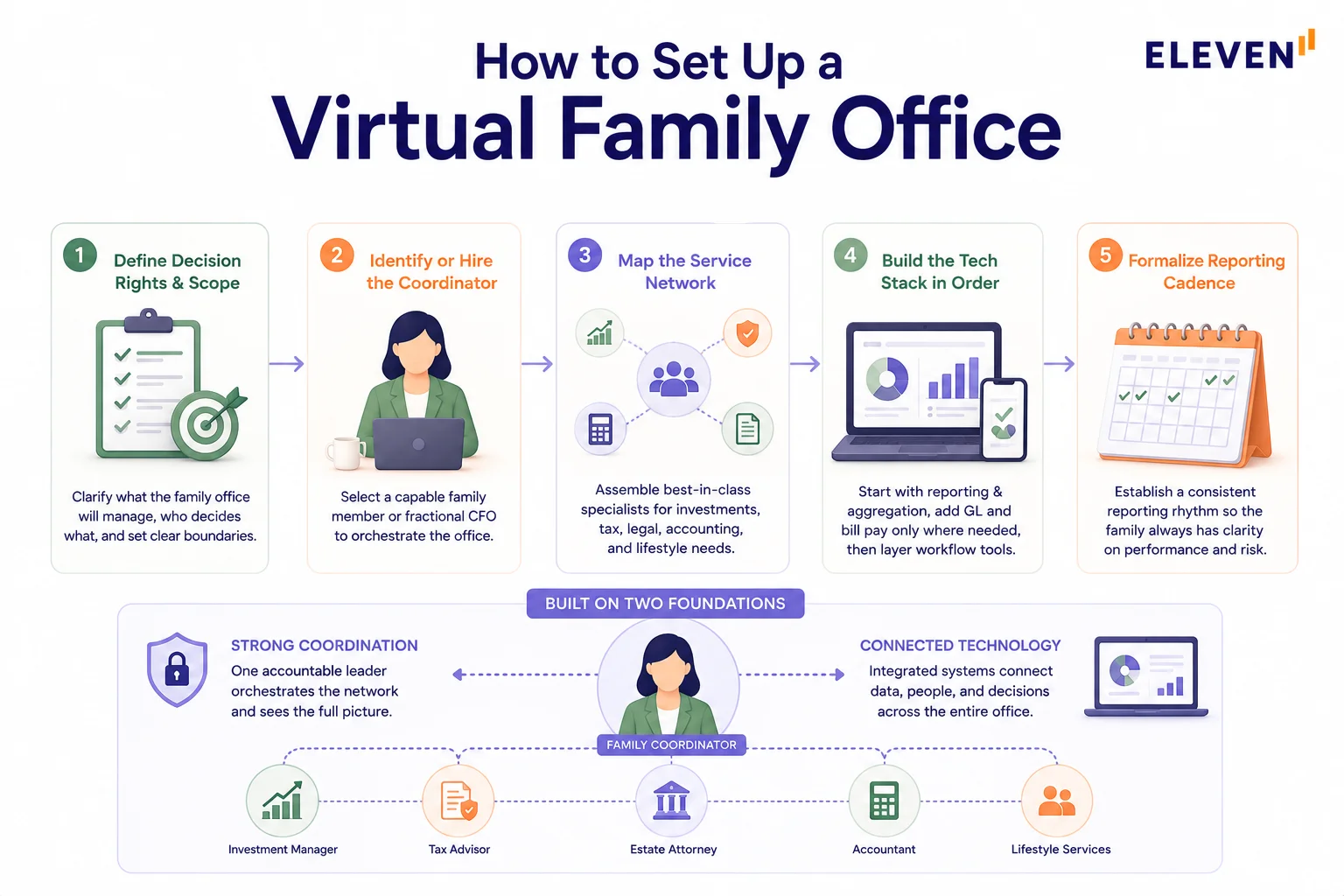
- Define decision rights and service scope first. What does the family actually need managed, and who has authority to approve what before any vendor conversation happens.
- Identify or hire the coordinator. This is the single most consequential early decision. Everything downstream depends on this person's capability and bandwidth.
- Map the required service network. Investment management, tax, legal, accounting, and lifestyle support decide what's needed now versus what can be added later.
- Build the tech stack in order, starting with reporting and aggregation, adding a GL and bill pay only where transaction volume justifies it.
- Formalize reporting cadence. Even without in-house staff, the family should receive consistent, scheduled reporting, not ad hoc updates whenever a provider happens to send one.
How Much Does a Virtual Family Office Cost?
VFO costs are structurally different from an SFO’s fixed overhead. They’re lower on paper but more variable in practice.
What to Watch For: A la carte specialist pricing can add up faster than families expect. Selecting exactly the services you need from best-in-class providers is a genuine advantage of the VFO model, but only if someone is actively tracking total spend across every relationship. Without that discipline, a VFO can end up costing close to what a lean SFO would, without the continuity benefits.
What Is the Difference Between a Virtual Family Office and a Single-Family Office?
For full comparisons across single-family, multi-family, and embedded offices, see our family office structure guide.
If you are deciding whether to transition beyond a conventional wealth advisor, the key differences center on multi-entity oversight and accounting integration:
What Accounting Foundation Does a Virtual Family Office Need?
The GL-vs-no-GL question is one of the most consequential technical decisions a VFO makes. If the office is mostly overseeing outsourced investment managers with minimal transactional activity, a full general ledger may genuinely be more system than needed early on.
But the moment the family holds multiple entities, real estate with operating expenses, intercompany loans, or multi-currency exposure, that calculus changes, and the 65% of family offices still running this on spreadsheets are the ones most exposed when it does.
- Multiple entities (holding LLCs, trusts, and investment vehicles) each need clean, separate books that still roll up to a consolidated view.
- Multi-currency holdings need proper FX revaluation, not a manual spreadsheet conversion at each report.
- Bank reconciliation needs to be automated and current, not a quarterly catch-up exercise.
When documentation is scattered across coordinator email threads, external CPA portals, and separate banking logins, it compromises audit readiness and compounds the cybersecurity risks outlined above. Attaching source receipts, contracts, and board approvals directly to ledger transactions within a central system establishes a single, immutable audit trail, ensuring third-party advisors only access what they need while preventing unverified wire requests and administrative blind spots.
Our guide on family office accounting software covers what to actually look for once a VFO reaches the point where a proper GL becomes necessary.
Reached the point where your VFO needs a real general ledger, not another spreadsheet? Start a 14-day free Eleven trial today →
Frequently Asked Questions (FAQs)
What is a virtual family office?
A virtual family office (VFO) is a technology-enabled operating model where a lean internal coordinator, typically a family principal or a fractional CFO, oversees a network of outsourced specialists (investment managers, tax advisors, legal counsel, and accountants) instead of a full in-house staff.
It delivers many of the services of a traditional family office at a fraction of the fixed cost, provided the coordination function is genuinely capable.
How much wealth do you need for a virtual family office?
VFOs typically fit families with $10M to $100M in investable assets, with some sources placing the practical range closer to $25M to $100M, depending on complexity.
Below that range, a strong wealth advisor relationship is usually sufficient on its own. Above roughly $100M, the fixed costs of a dedicated single-family office start to look more attractive relative to the ongoing coordination overhead of a virtual model.
Who runs a virtual family office day to day?
A central coordinator, most commonly a family principal or a part-time/fractional CFO, directs the network of outsourced providers and is the single point of accountability for the whole picture.
This role is the most consequential decision in setting up a VFO: without a genuinely capable coordinator, services tend to fragment across providers who each see only their own piece of the family's situation.
Does a virtual family office need a general ledger?
Not always, and not immediately. If the office is largely overseeing outsourced investments with minimal transactional activity, a full general ledger may be more system than is needed at first.
Once the family holds multiple entities, real estate with operating expenses, intercompany transactions, or multi-currency exposure, a proper GL becomes necessary to avoid the spreadsheet-based tracking that a majority of family offices still rely on and that becomes a real operational risk at that level of complexity.
What's the difference between a virtual family office and a multi-family office?
A virtual family office is built around one family's own coordinator directing a network of outsourced specialists exclusively for that family.
A multi-family office is an independent firm serving several families on shared staff and infrastructure. A VFO preserves more direct control and customization; an MFO trades some of that for lower cost through pooled resources across client families.
Was this article helpful?
Thank you! Your feedback has been received!
Oops! Something went wrong while submitting the form.