Family offices and investment firms manage layered entity structures across jurisdictions, currencies, and asset types. Eleven provides the general ledger backbone, with AI-powered data capture, multi-currency handling, and API access to the tools your analysts already work in.

Trusted by 100+ accounting firms like


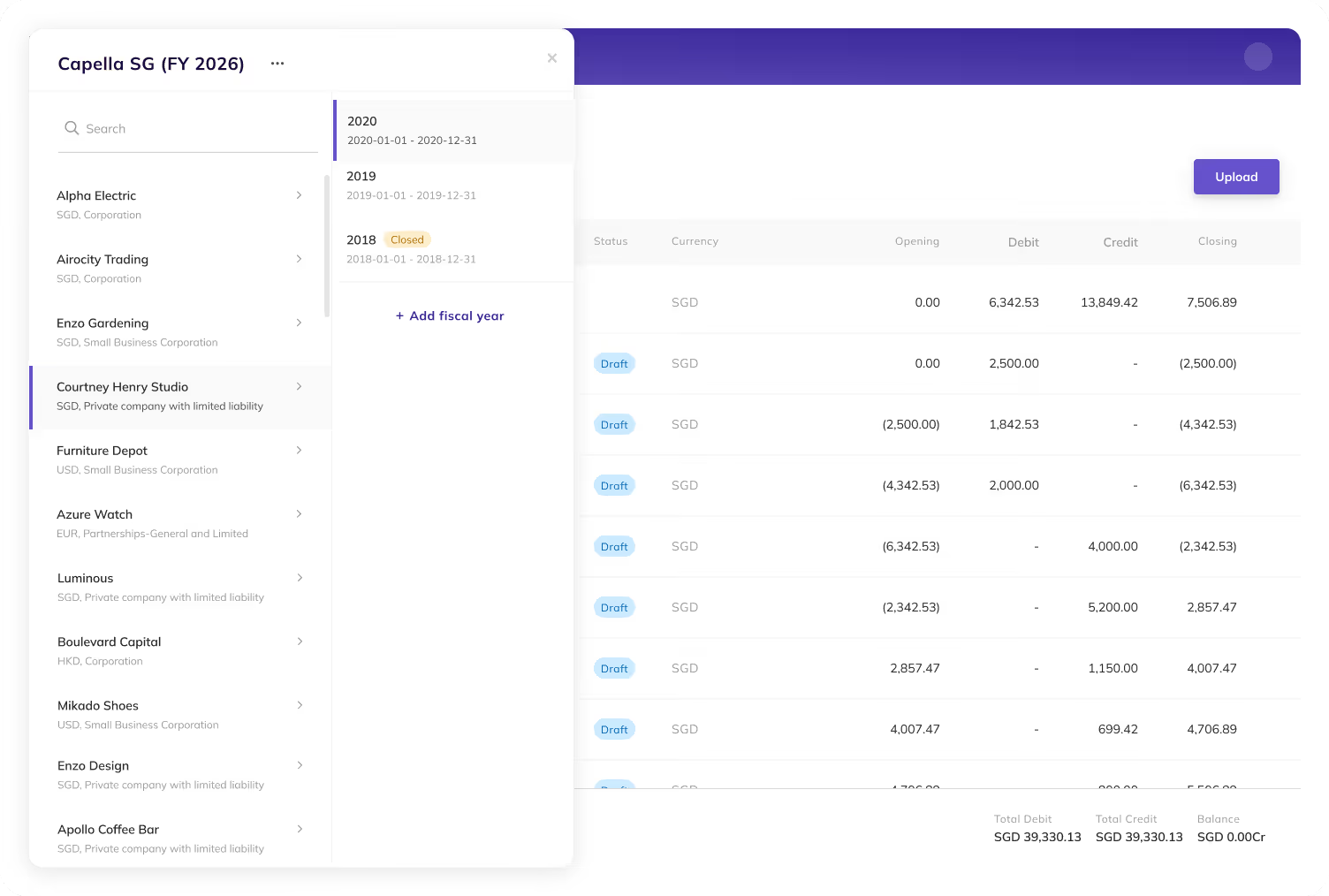
Most family offices accumulate entities over time. A holding company, an investment vehicle, a property SPV, a trust, a foundation, plus operating businesses across multiple jurisdictions. The bookkeeping for each lives in its own ledger; the connections between them live somewhere else.
Eleven holds every entity in a single platform. Accountants move between entities without separate logins or instances. Settings, charts of accounts, and access controls can be applied consistently across the portfolio or configured per entity where local requirements differ.

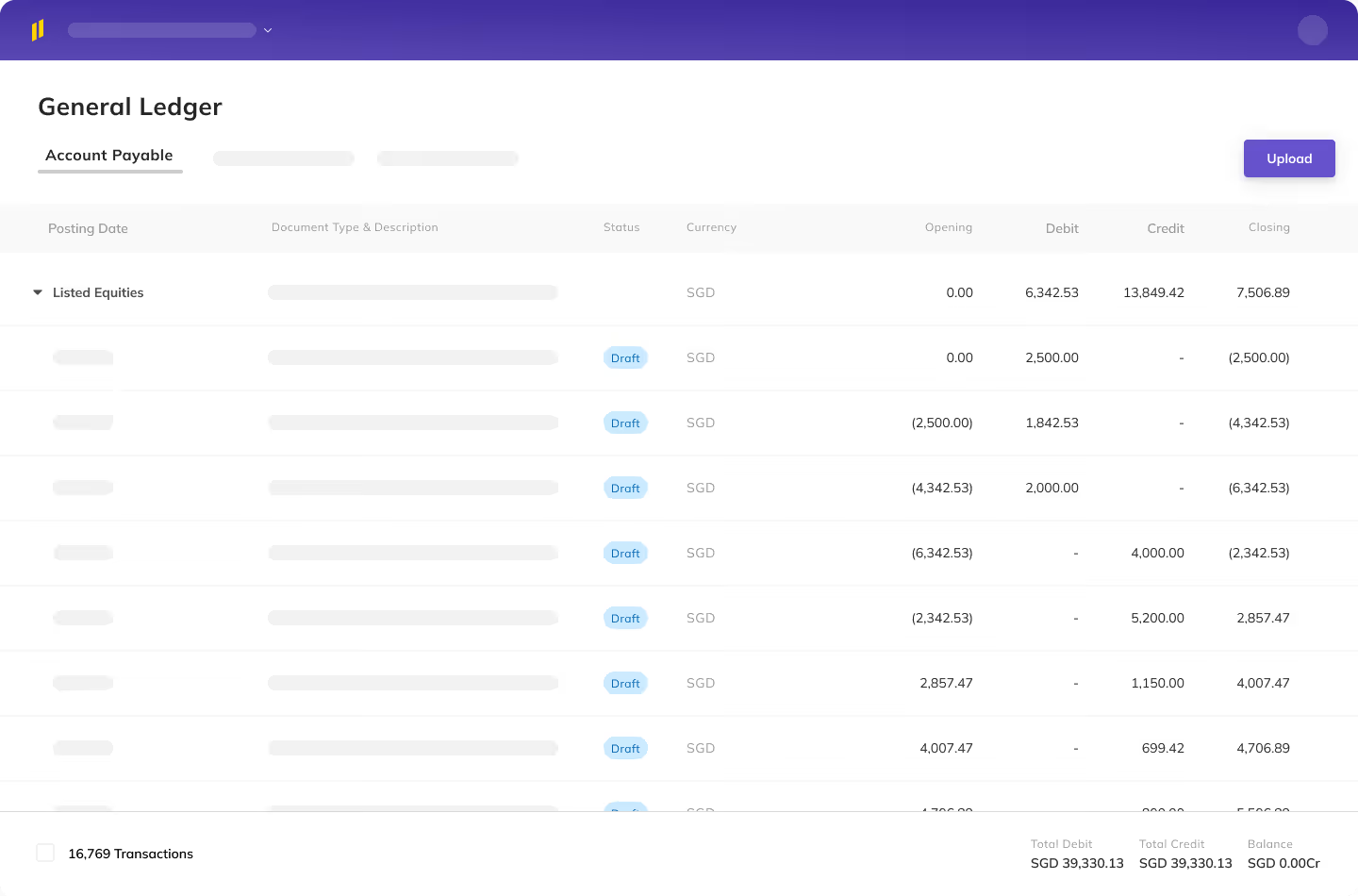
Family offices hold a mix of asset types: liquid investments, private equity, real estate, and operating businesses. The accounting for these varies considerably by asset class.
Eleven handles the general ledger side of investment accounting: recording investment transactions, tracking cost on the balance sheet, posting income and distributions, handling foreign-currency investments with automatic revaluation. For illiquid asset classes like private equity or real estate, where valuations update periodically rather than continuously, manual journal entries reflect changes in carrying value with full audit trail.
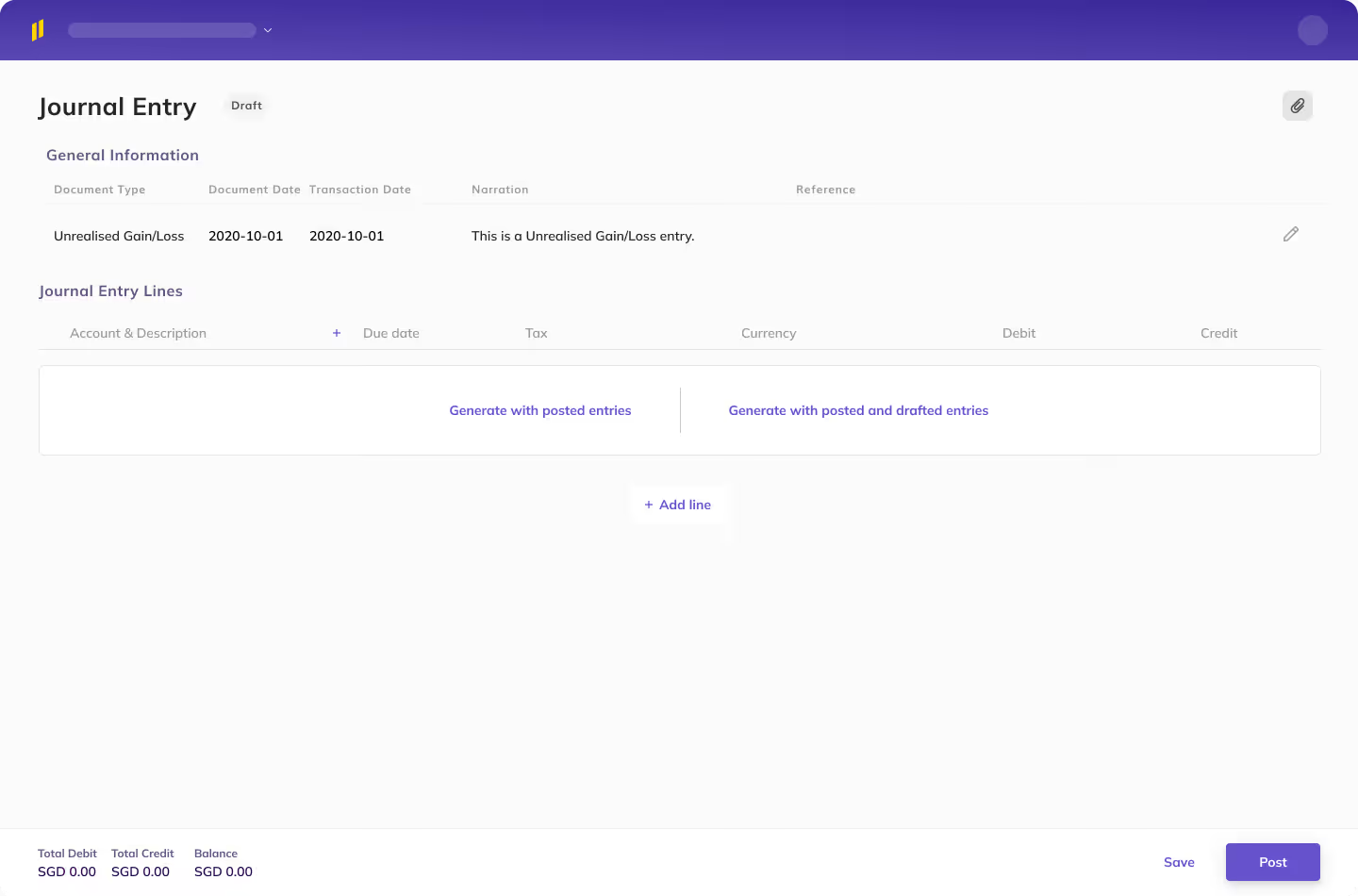
Family offices operate across jurisdictions by nature. Investments in one country, holding structures in another, beneficiaries in a third. Multi-currency support isn't optional; it's foundational.
Eleven handles multiple transaction currencies per entity, with automatic translation to each entity's functional currency. Period-end FX revaluation runs automatically: monetary accounts are identified, closing rates applied, and draft unrealised gain/loss journals generated for accountant review. Audit trail follows every revaluation.
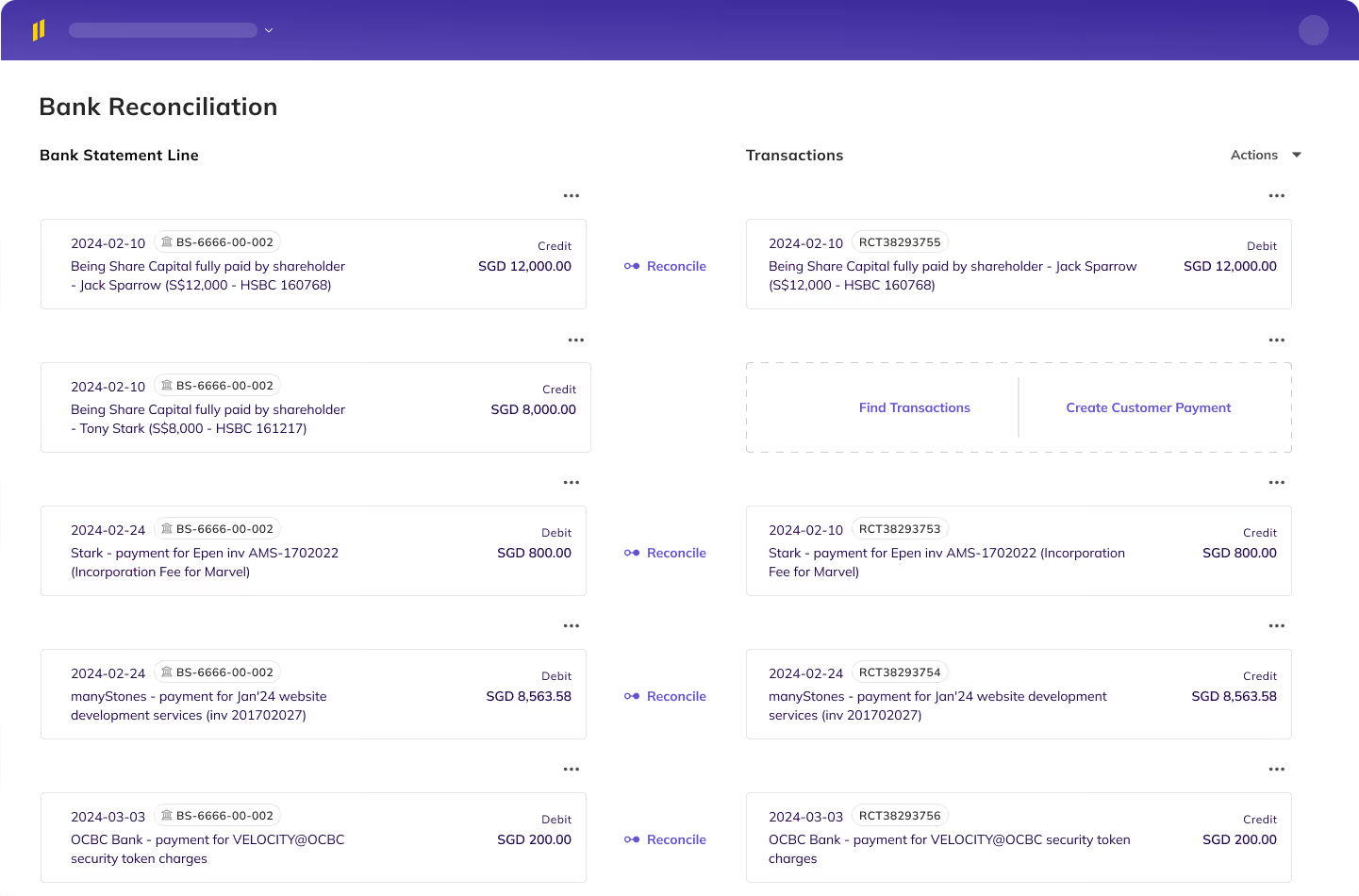
Family offices typically use a mix of relationships: a private bank for the principal accounts, commercial banks for operating entities, custodians for investment holdings.
Eleven supports direct bank feeds for connected accounts where coverage is available.
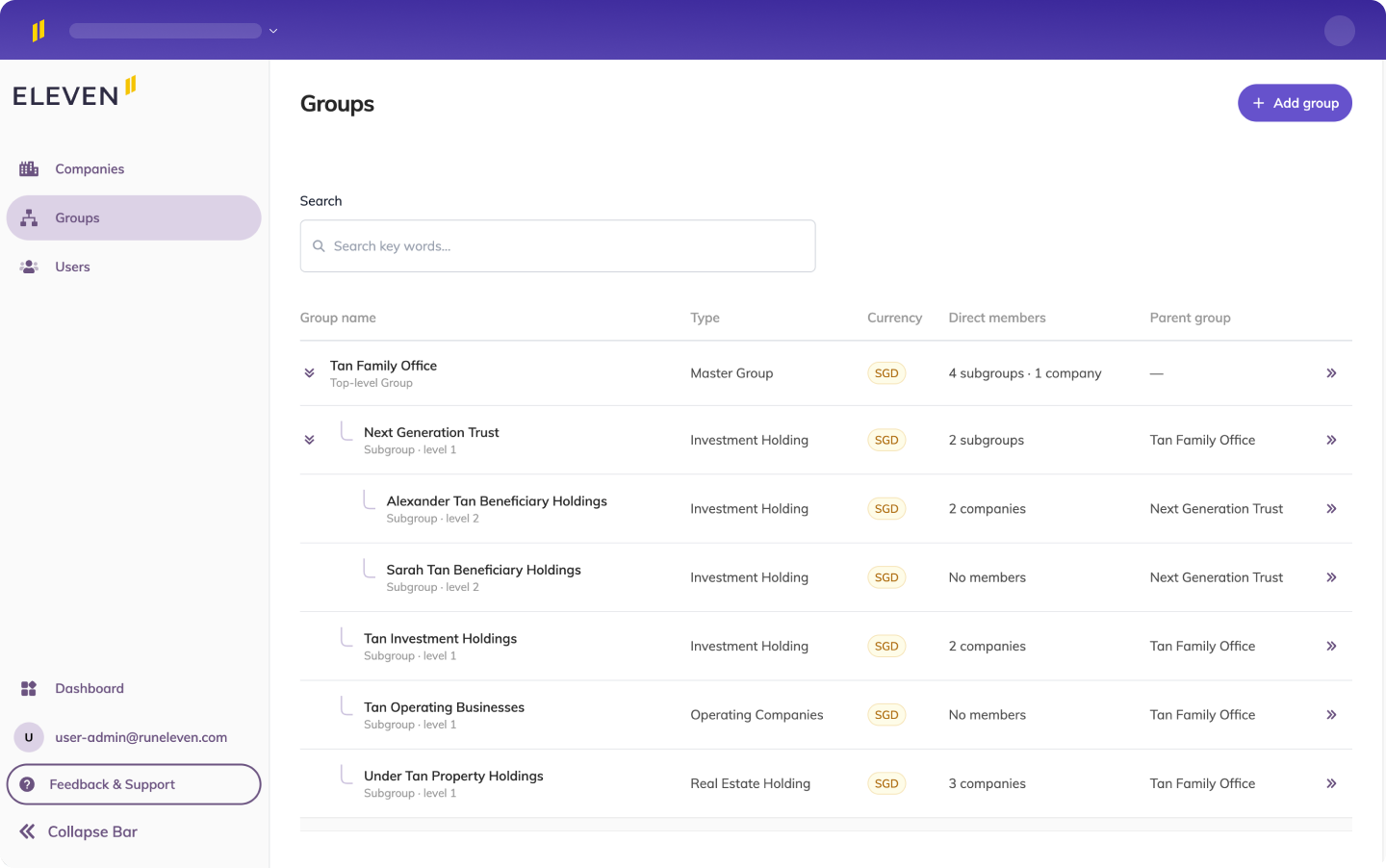
Master holdings, investment sub-groups, trusts, operating businesses and see how each Company fits into the picture. Not just a flat list of entities, but the actual hierarchy your family office runs on.

For families managing their own wealth in-house. One platform for every entity in the structure: holding companies, investment vehicles, trusts, real estate SPVs, operating businesses, and personal accounts.
Eleven scales from a handful of entities to a hundred or more, with per-entity access for family members, advisors, and external auditors. The chart of accounts stays clean while analytical dimensions capture the granular detail needed for management reporting.

For firms serving multiple families within a shared structure. Each family's entities sit in their own isolated environment, with strict data separation enforced at the database level. Staff can be granted access scoped to specific families and specific entities, never accidentally crossing client boundaries.
The same workflows, currency handling, and reporting tools work across all client families, while pricing and discounts apply at the firm level rather than per-family.





We are using cookies. Learn more.


.svg)


