Multicurrency Cash Flow Forecasting: A Practitioner’s Guide


A practitioner's guide to forecasting cash flow across multiple currencies. Covers mapping currency exposure by entity, building forecasts in layers instead of one blended number, using rate scenarios instead of single-point estimates, consolidating without losing entity-level detail, and the most common mistakes finance teams make when managing FX risk across multi-entity operations.

Multi-currency cash flow forecasting means projecting cash positions across entities that hold, receive, or pay in more than one currency, then translating those positions into a single reporting currency without losing visibility into the underlying FX exposure. This guide walks through a practical method for building forecasts that hold up as entity count grows and rates move.
I've sat across the table from enough CFOs to know how this fails. The forecast looks fine for months, then a rate moves and the cash position you reported to the board is wrong by a number large enough to matter.
It's never on day one of running a multicurrency operation. It's about eighteen months in, when the business has grown into three or four currencies and the spreadsheet that used to take an afternoon now takes two days. By then the real question of “Do we actually know our cash position right now, or are we looking at a snapshot that was already stale when we built it?” has usually gone unasked for a while.
This guide is the answer I give when that question comes up. Here’s a working method for multicurrency cash flow forecasting that holds up when entity count grows and rates move against you.
What Is Multicurrency Cash Flow Forecasting?
Multicurrency cash flow forecasting means projecting cash positions across entities that hold, receive, or pay in more than one currency, then translating those positions into a single reporting currency without losing visibility into the underlying FX exposure.
Done properly, it requires three things most firms don't have by default:
- A clear map of currency exposure by entity,
- A forecasting model that keeps local-currency and base-currency views separate until the right moment, and
- A process for updating the forecast as rates move rather than once a quarter.
Why Does Multicurrency Forecasting Break Down?
Single-currency cash forecasting is mechanical: project inflows, project outflows, net them by period, and you’re done.
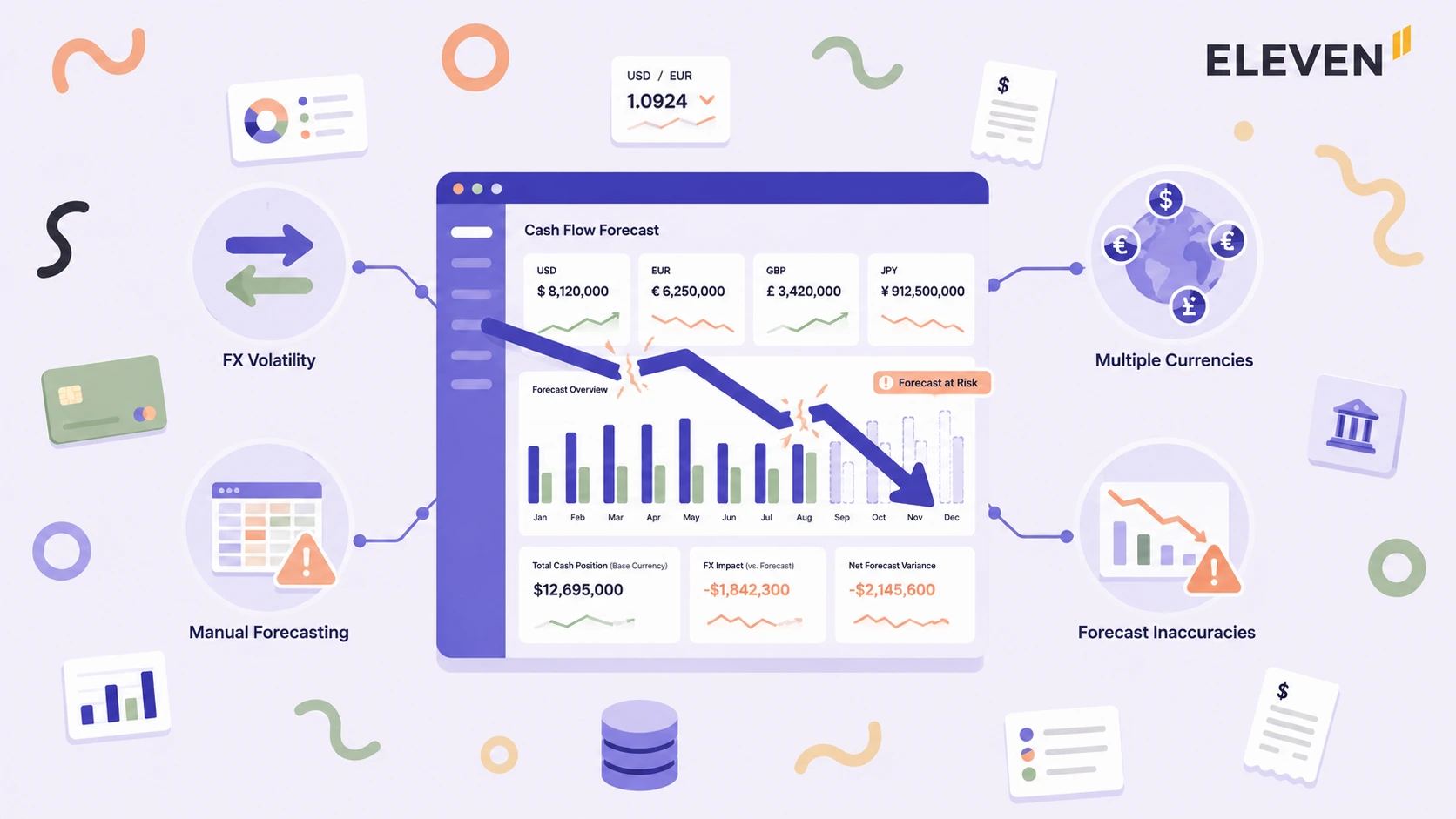
The moment a second currency enters the picture, you're no longer forecasting one number; you're forecasting a position and a rate simultaneously, and the rate is the part that moves without asking for your permission.
Here's where I've watched it go wrong, consistently, across firms of very different sizes:
- The forecast is built in one currency too early: Someone converts every entity's cash position into USD (or whatever the group reporting currency is) before building the forecast, instead of after. Once you've converted, you've baked today's exchange rate into next quarter's projection. Any rate movement between now and the forecast period changes the underlying numbers without changing the forecast, and that gap usually isn't visible until actuals come in.
- Exposure isn't separated from translation: There's a difference between money you're going to convert (because you owe a vendor in a different currency than you collect from customers) and money you're not going to convert (because the entity operates entirely in its own functional currency and conversion only happens for group reporting). Treating both the same way overstates your actual FX risk.
- The forecast updates on a calendar, not on a trigger: Monthly or quarterly forecast refreshes feel disciplined. They're actually a liability in multicurrency operations, because a 4% rate swing in the interim can move your projected cash position more than any operational change would. The forecast needs to be sensitive to rate movement, not just calendar dates.
Here’s what you need to remember: the single most useful mental model here is separating the question “How much cash will this entity have in its own currency” from the question “What will that be worth in our reporting currency?” Build the answer to the first question first. Apply the rate last, and apply it as a sensitivity, not a single fixed assumption.
How to Build a Multicurrency Cash Flow Forecast
Getting this right comes down to four moves, in order: map where your exposure actually sits, build the forecast in layers instead of one blended number, replace single-rate guessing with ranges, and consolidate without losing entity-level detail.

Each one is a separate failure point if skipped. Here's how I work through them.
Step 1: Map Your Actual Currency Exposure
Before you can forecast anything, you need an honest inventory of where currency risk actually sits in your structure.
Most firms think they know this, but most are actually wrong about at least one entity, usually because exposure has crept in through a vendor contract or a financing arrangement nobody flagged as a currency decision.
Separate Transactional Exposure from Translation Exposure
These are genuinely different problems and they need different treatment in your forecast.
If you get this distinction wrong, you’ll end up trying to hedge things that don’t need hedging (translation exposure on an entity that never converts its own cash) while leaving real transactional risk unmanaged.
One exposure type that doesn't fit neatly into either category: entities operating in hyperinflationary economies or currencies with restricted convertibility. Under the 2023 IAS 21 amendments effective for periods beginning January 1, 2025, when a currency lacks exchangeability, you can't simply apply a spot rate; you're required to estimate one using a prescribed methodology and provide enhanced disclosures. If any entity in your structure operates somewhere with capital controls or a currency board, build that estimation step into your forecast model now rather than discovering it during a period-end close.
Build an Exposure Map Entity-By-Entity
For every entity in the structure, you need four answers before you can forecast anything meaningfully:
- What currency does this entity actually operate in? Its functional currency, not the group's reporting currency, and not the currency its invoices happen to be denominated in if that differs from its operating currency.
- What inflows or outflows cross a currency boundary? Customer receipts in a different currency than costs are paid in, intercompany loans denominated in a currency other than the lending or borrowing entity's functional currency, or supplier contracts priced in a hard currency regardless of where the entity operates.
- What's the typical lag between transaction and settlement? A 90-day payment term on a foreign-currency invoice is 90 days of rate movement you're exposed to before you even know the final cash amount.
- Is any of this exposure already hedged or naturally offset? If an entity's foreign-currency receivables roughly match its foreign-currency payables in size and timing, you may have a natural hedge already in place that nobody's accounted for in the forecast.
Pro Tip: Run this exercise once, properly, and keep it as a living document rather than a one-time audit. The mistake I see most often is treating exposure mapping as a setup task instead of something that gets reviewed every time a new entity is added, a new vendor contract is signed in a foreign currency, or a financing arrangement changes. This should sit with treasury if you have a treasury function; otherwise it's the controller's responsibility, not line accounting's, since it requires visibility across entities that a single bookkeeper typically doesn't have. Whoever owns it, review it quarterly at minimum.
Step 2: Build the Forecast in Layers, Not in One Currency
The structural fix for the "converted too early" problem is to build the forecast in three distinct layers and resist the urge to collapse them into one number before you have to.
Layer 1: Local-Currency Cash Flow By Entity
Each entity's cash forecast lives in its own functional currency first. Receivables, payables, payroll, and intercompany settlements are all projected in the currency the entity actually transacts in. This is the layer I always build first when I sit down with a client's numbers, and it's also the one most spreadsheets skip straight past.
This layer never gets touched by an exchange rate assumption. It's the cleanest, most reliable part of the entire model because it isn't exposed to FX volatility at all.
Layer 2: Isolated Transactional Exposure
On top of the local-currency layer, identify the specific cash flows that genuinely cross a currency boundary, such as the USD invoice the EUR entity has to pay or the intercompany loan denominated in a currency other than the borrower's functional currency.
These get a rate assumption applied, but only these. This is where your actual FX risk concentrates, and isolating it means you can see it clearly instead of burying it inside a fully translated number.
Layer 3: Consolidated, Translated View
Only at the final stage do you translate everything into the group's presentation currency for the consolidated forecast. By this point you should be applying translation as a sensitivity range, not a single point estimate. More on that below.
What to watch for: If your current process produces only a single consolidated number with no way to see the local-currency layer underneath it, you don't actually have a multicurrency forecast. You have a single-currency forecast wearing a multicurrency disguise, and the moment a rate moves significantly, the model will be wrong in ways you can't diagnose because the local-currency detail isn't there to check against.
Step 3: Stop Using a Single-Rate Assumption
This is the part of multicurrency forecasting that gets oversimplified more than any other. A single forecast built on a single exchange rate assumption is precise and almost always wrong. The fix isn't a better point estimate; it's building the forecast to show a range.
Use Scenario Bands, Not a Single Number
For any material transactional exposure, run the forecast at three rate scenarios:
- The current spot rate,
- A stressed scenario reflecting recent volatility (I typically use the trailing 90-day high/low range for the relevant pair), and
- The forward rate if you have access to one. Present cash flow as a range across those scenarios, not a single confident figure.
A forecast that says “we expect $2.1M to $2.4M in consolidated cash depending on EUR/USD movement” is more useful and more honest than one that says “$2.27M” with false precision baked in.
Refresh on Rate Triggers, Not Just the Calendar
Set a threshold, but calibrate it to the pair. For major, lower-volatility pairs like USD/EUR or USD/GBP, a 2% to 3% move from the rate baked into your last forecast is a reasonable trigger.
For higher-volatility or thinly traded pairs (emerging-market currencies in particular), that threshold will fire constantly and you'll want to widen it, while shortening the review cycle itself so you're checking more often even if the trigger band is wider.
For firms with material exposure in volatile currency pairs, that threshold gets hit more often than a calendar-based refresh would catch.
Step 4: Consolidating Across Entities Without Losing the Detail
Once each entity has a local-currency forecast and the relevant exposure layer applied, consolidating into a group view shouldn’t destroy the detail you just built.
This is where manual processes consistently fail. The spreadsheet that consolidates five entities into one tab loses the entity-level transactional exposure the moment everything gets summed into a single translated total.
Here’s what a properly built consolidated forecast preserves:
- The ability to drill from the consolidated number back to any single entity's local-currency position.
- Visibility into how much of the consolidated total is sensitive to rate movement versus how much is translation-only and operationally fixed regardless of FX.
- Intercompany cash flows shown without double-counting; money moving between two entities in the same group shouldn't inflate the consolidated cash position.
Here’s what to remember: Intercompany cash flows are where I see the most consolidation errors in practice. If Entity A in EUR lends cash to Entity B in GBP, that movement needs to net out at the group level, and the FX translation on the intercompany balance needs to be tracked separately from the FX translation on third-party transactions. Conflating the two is the most common reason I see consolidated forecasts fail to reconcile cleanly to actuals.
Common Mistakes in Multicurrency Cash Flow Forecasting
These are the mistakes I see most often.
- Hedging the wrong exposure: Firms sometimes hedge translation exposure on entities that never actually convert their cash, while leaving real transactional exposure (the kind that affects actual cash received or paid) unhedged. Know which is which before deciding what, if anything, to hedge.
- Treating every currency pair as equally volatile: A USD/EUR exposure and a USD/ARS exposure are not remotely comparable in forecasting difficulty. Apply more frequent review cycles and wider scenario bands to higher-volatility pairs; don't apply a uniform process across currencies with very different risk profiles.
- Forecasting cash without forecasting the rate environment: If you know a central bank decision or major economic data release is scheduled inside your forecast window, that's a known catalyst for rate movement. Build a wider scenario band around that date rather than treating the forecast period as uniformly uncertain.
- Letting the spreadsheet become the source of truth: The moment a forecast model lives in a spreadsheet disconnected from the actual ledger, it drifts from reality. Every manual re-entry of a cash position is a chance for the forecast to diverge from what's actually happening in the books.
Does Multicurrency Accounting Software Help with Cash Flow Forecasting?
Most content on this topic oversells what multicurrency software fixes. No platform replaces the judgment of mapping exposure correctly or deciding which scenarios matter for your business.

What good infrastructure does is remove the mechanical failure points that make manual forecasting unreliable at scale, including the following:
- Real-time local-currency positions per entity, pulled directly from the ledger rather than re-keyed into a spreadsheet, so the forecast starts from data that's actually current.
- Automatic FX revaluation on monetary balances, so realized and unrealized gains and losses are calculated and posted without a manual month-end exercise, and the forecast can reflect current rates without someone updating formulas by hand.
- Consolidation that preserves entity-level detail, so the group view doesn't collapse the local-currency and transactional-exposure layers into an undifferentiated total.
This is the structural gap in most general-purpose accounting software: multicurrency support that handles the transaction layer competently but stops short of the consolidation and revaluation depth this kind of forecasting actually needs.
We cover exactly where that ceiling sits across the major platforms in our multicurrency accounting software comparison. Read it if you're trying to determine whether your current platform can support this process or whether you're forecasting around its limitations.
Before You Forecast: A Working Checklist
If you're building or auditing a multicurrency cash flow forecast, this is the sequence I'd actually use:
- Map every entity's functional currency and identify which cash flows cross a currency boundary.
- Separate transactional exposure (affects actual cash) from translation exposure (affects reported numbers only).
- Build the local-currency forecast for each entity before applying any exchange rate.
- Apply rate assumptions only to genuine transactional exposure, using scenario bands rather than a single rate.
- Consolidate without collapsing entity-level and exposure-level detail.
- Set a rate-movement threshold that triggers a forecast refresh, independent of the calendar cycle.
- Review the exposure map quarterly: new contracts, new entities, and new financing arrangements all change exposure quietly enough that nobody flags it as a currency decision.
Want to see what this looks like with real-time entity-level data instead of a spreadsheet? Start a free 14-day Eleven trial and see how automated FX revaluation and consolidated reporting work across your entity structure. →
Frequently Asked Questions (FAQs)
What is the difference between transactional and translation FX exposure?
Transactional exposure arises from cash flows actually denominated in a currency different from an entity's functional currency (a foreign-currency invoice or intercompany loan, for example), and it affects the real amount of cash received or paid.
Translation exposure arises when consolidating a foreign entity's results into the group's reporting currency for financial statements; it changes how the numbers look in group reporting but doesn't change the cash actually available to that entity. Forecasting and risk management should treat the two differently.
How often should a multicurrency cash flow forecast be updated?
Rather than relying solely on a calendar cadence, set a rate-movement threshold (commonly 2% to 3% movement in a material currency pair) that triggers an interim refresh regardless of where you are in the monthly or quarterly cycle.
Calendar-only refreshes leave the forecast stale during periods of rate volatility, which is exactly when accuracy matters most.
Should every currency exposure be hedged?
No. Hedging decisions depend on the size of the exposure, the volatility of the specific currency pair, and whether a natural hedge already exists (for example, foreign-currency receivables roughly offsetting foreign-currency payables in timing and amount).
Hedging translation exposure on an entity that never actually converts its cash is a common and avoidable mistake. It adds cost without managing real risk.
Can spreadsheets handle multicurrency cash flow forecasting at scale?
They can for a small number of entities and currency pairs, but the failure mode is consistent as complexity grows: manual re-entry introduces drift between the forecast and actual ledger data, rate assumptions get baked in too early and go stale, and consolidation tends to collapse entity-level detail into a single translated number.
Firms managing more than a handful of multicurrency entities typically need a system that pulls live entity-level data and preserves that detail through consolidation.
What's the most common mistake in multicurrency cash forecasting?
Converting cash positions into the group reporting currency too early in the forecasting process.
Once a forecast is built directly in the consolidated currency, today's exchange rate gets baked into a projection for a future period, and any rate movement between now and then quietly corrupts the model without anyone noticing until actuals come in wrong.
Building the forecast in local currency first, then applying rate assumptions only to genuine transactional exposure, avoids this.