Full Xero Review With Updated US Pricing and Features (2026)
Home
/
Blog
/
Cloud Accounting Software Pricing: What Firms Need to Know
Cloud Accounting Software Pricing: What Firms Need to Know
Written by
Reviewed by
A clear breakdown of cloud accounting pricing models, hidden costs, and how firms can choose the right setup as they grow.
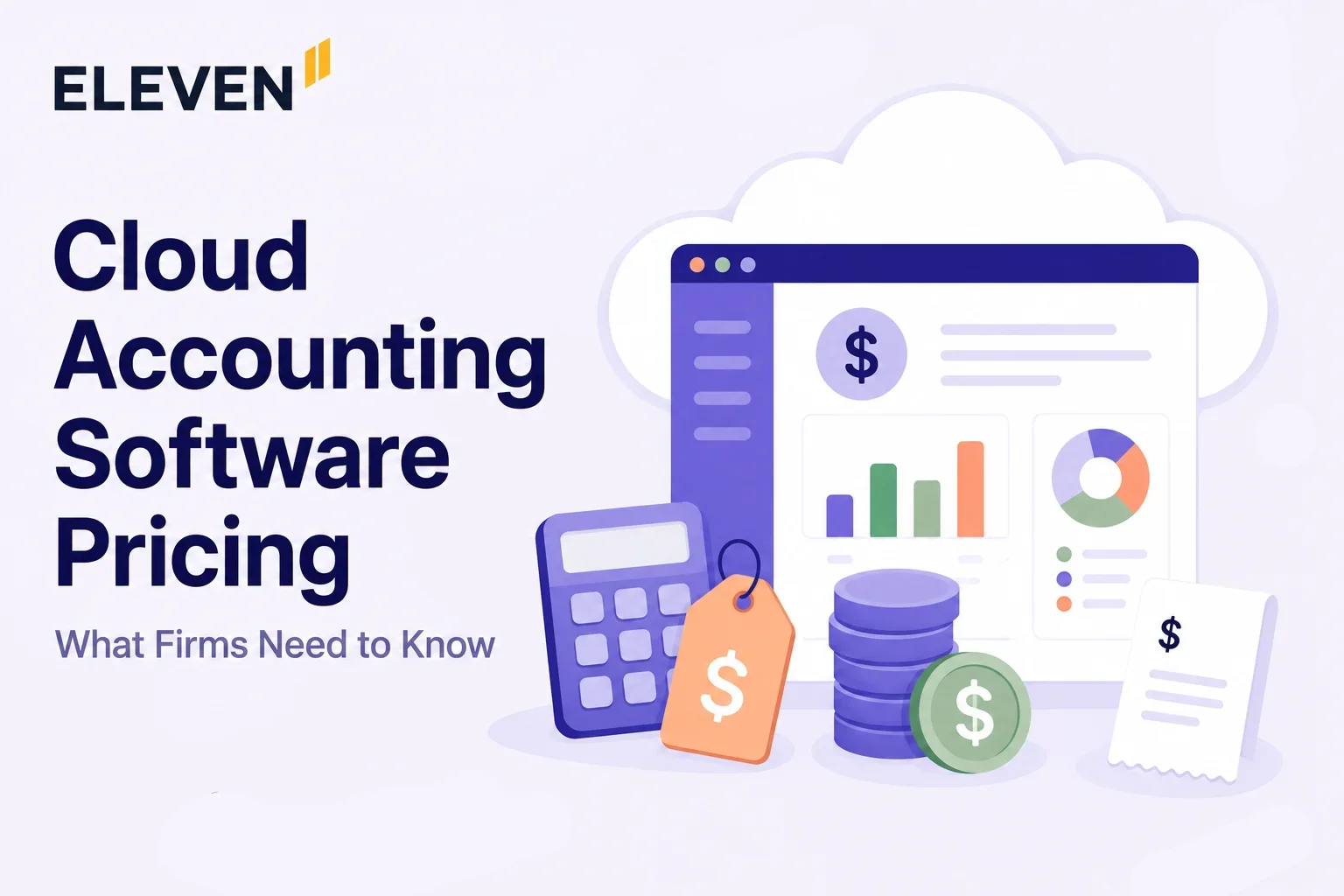
Cloud accounting platforms generally price by user, by entity, by flat tier, or by transaction volume, and the model matters more than the headline number. Two platforms that look identical at signup can diverge sharply in cost once a firm scales past a handful of clients. Promotional discounts (50% to 90% off for the first few months) make the entry price look smaller than the real ongoing cost, so the number to evaluate is the post-promotion rate, not the offer.
Cloud accounting pricing can erode your margins as you grow. Two platforms may look nearly identical upfront, but their pricing models diverge fast once you scale, affecting your firm’s long-term efficiency and profitability. What works fine at 10 entities can become a cost burden at 50 or 100.
This guide breaks down how cloud accounting pricing actually works, what to watch for in promotional offers, and how a platform like Eleven approaches pricing for multi-entity environments.
If you're still getting oriented on what cloud accounting even is before diving into pricing models, start with our cloud accounting overview; this guide assumes you already know the basics and want the pricing detail.
Pricing Note: All figures in this article are valid and up-to-date as of July 2026. QuickBooks Online's tiers will increase in pricing on August 1, 2026.
Why Cloud Accounting Pricing Isn’t One-Size-Fits-All
Most pricing guides focus on small business tools like QuickBooks or Xero: platforms designed for single-entity businesses with relatively straightforward needs.
For accounting firms managing dozens of clients, or family offices overseeing complex multi-entity portfolios, those same tools and pricing models start to break down. What looks simple at first becomes restrictive as operations scale.
At a high level, cloud accounting pricing follows a handful of common structures. The problem isn't the models themselves; it's how each one behaves as complexity increases.

1. Per-User Pricing
This model is common among general-purpose tools. It scales reasonably well as teams grow, but it says nothing about how many entities you can manage.
A firm can run into real operational limits without that constraint ever showing up in the pricing.
2. Per-Entity Pricing
Many cloud accounting platforms charge per entity. Every time a CPA firm onboards a new client, or a family office establishes a new subsidiary, the software bill increases.
- On the surface, this feels logical: you're paying for what you use. In practice, it can penalize growth when the per-entity cost isn't offset by genuine consolidation value.
- A platform charging per entity but delivering isolated ledgers with no native consolidation is billing for complexity without solving it.
The question to ask isn't whether a platform uses per-entity pricing. It's what you actually get per entity. QuickBooks Online and Xero both charge per company file or organization, and both deliver isolated ledgers with no native consolidation between them; the per-entity cost buys you a separate set of books. Eleven also charges per entity, but includes unlimited users, a unified dashboard, and IAS 21 multi-currency FX revaluation across all plans, with native group consolidation unlocking on Professional.
3. Tiered or Flat-Rate Pricing
Here, costs are fixed within a defined plan, regardless of how many entities or transactions you handle. For firms that are scaling, this creates predictability and removes the constant need to reassess pricing as you grow.
4. Transaction-Based Pricing
In this model, costs scale with activity rather than structure. For high-volume firms or family offices with active portfolios, this can become unpredictable fast, especially during periods of increased activity; a busy quarter shouldn't mean a surprise invoice.
In isolation, each model can make sense. In practice, the wrong structure can quietly limit growth, introduce cost volatility, or create hurdles that only show up once you've already committed.
Accounting Software Promotional Discounts
Almost every major platform leads with an introductory discount, and the headline numbers are genuinely large. The catch is that the discount period is short, and the fine print determines what you're actually paying once it ends.
What to Watch For: Read the actual terms before modeling a budget around a promotional rate. Xero's standard 80%-off offer, for example, applies only to new customers purchasing their first organization through a specific promo code, only to the base plan subscription, explicitly excludes add-ons, usage, and payment fees, can't be combined with other offers, and can be changed or cancelled by Xero at any time. None of that is unusual; it's standard for the category. The point is that the discounted rate is never the number to budget around for year two.
Pro Tip: When a vendor quotes you a promotional price, ask for the exact post-promotion rate in writing and model your costs against that number from day one, not the introductory one. If you're recommending a platform to a client or budgeting for a multi-year engagement, the promotional period is a rounding error compared to what you'll actually pay over time.
What Should Accounting Firms Prioritize in Pricing?
CPA firms and accounting practices have specific needs that generic pricing structures rarely address.

Pricing should be evaluated on how well a platform supports scale, not just its entry-level cost.
Unlimited Entity Management
- Evaluate per-entity pricing carefully. The key question is whether the platform delivers native consolidation, unified reporting, and a shared dashboard across those entities, or simply charges per isolated ledger.
- Look for flat-rate or tiered plans with unlimited entities at higher levels.
- Confirm you can onboard new clients without triggering an immediate cost increase that outpaces the revenue that client brings in.
Transaction Volume Limits
- Check for transaction caps at each pricing tier.
- Avoid platforms that force mid-cycle upgrades during high-volume periods.
- Prioritize tools that include unlimited transactions as a core feature rather than a paid add-on.
Approval Workflows and Audit Trails
- Confirm role-based access controls are included, not gated to a higher tier.
- Look for multi-level approval workflows out of the box.
- Ensure full audit logs are available without requiring a premium upgrade.
Migration and Onboarding Costs
- Clarify whether data migration is included or billed separately.
- Factor in training and implementation time as a real cost, even if it isn't a line item.
- Prioritize vendors offering white-glove onboarding rather than self-serve migration for complex multi-entity moves.
For a deeper look at how this plays out for firms specifically, see our guide on accounting software for CPA firms.
What Family Offices Should Look for in Pricing
Family offices operate differently from CPA firms but face similar challenges: multi-entity management, complex currency exposure, and strict documentation requirements.
Our family office accounting software guide covers these requirements in more depth if you're evaluating platforms specifically for this structure.
How Accounting Platform Pricing Compares
Pricing models are easier to evaluate with real numbers attached. Here's how a few well-known platforms actually price, as illustrations of the models above rather than a full comparison:
Note: This table illustrates the pricing model each platform uses, not a complete feature comparison. Check out our individual review for those. Also note that pricing changes over time and promotional rates aren't reflected here; confirm current pricing directly with each vendor before making a decision.
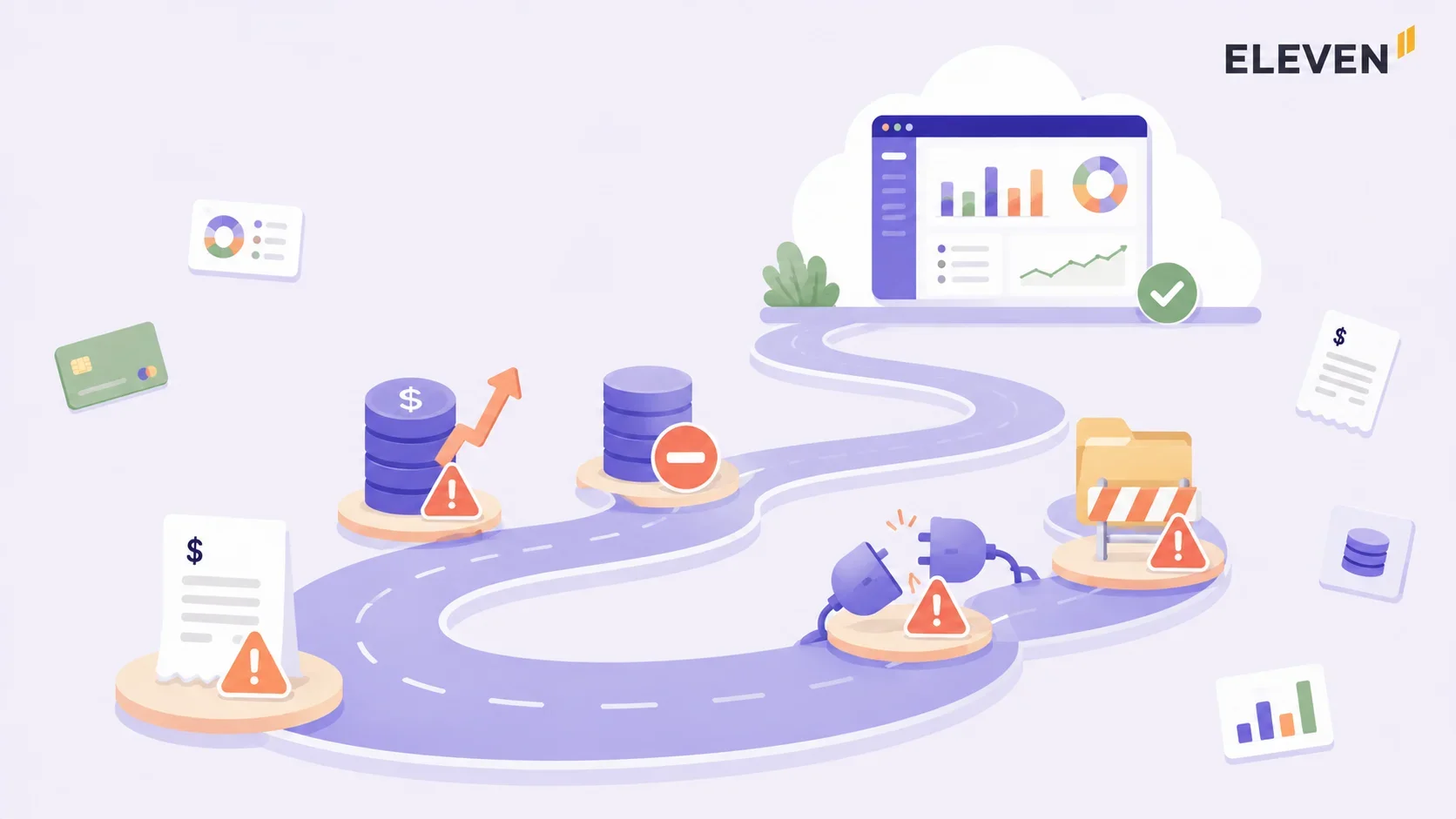
5 Common Pricing Mistakes Accounting Firms Make
Even experienced finance professionals underestimate the total cost of ownership when evaluating cloud accounting software, especially when pricing structures look straightforward on the surface.
1. Failing to Model Multi-Entity Scalability
A base price that looks reasonable for a single entity can spiral as your firm grows.
→ Adding 15–20 clients per year can quietly compress your margins if the platform charges steep per-entity fees without offering volume bundling or consolidation value.
2. Overlooking Hidden Transaction Caps
Straightforward pricing models often hide volume thresholds in the fine print.
→ Many platforms impose strict data or transaction limits that you might only hit during high-volume periods (like month-end or tax season). This forces unexpected, mid-cycle tier upgrades that disrupt both your budget and operational continuity.
3. Treating Migration as an Afterthought
The true cost of software includes the cost of getting your data into it.
→ Moving historical data from legacy systems can take weeks. If data migration, cleanup, and onboarding aren't negotiated upfront, you'll likely face steep, unexpected consulting fees on top of your new subscription.
4. Underestimating "Add-on" Inflation
A low base subscription price is often a hook that doesn't reflect actual operating requirements.
→ Essentials like automatic bank feeds, multi-currency handling, or robust document management frequently require paid modules or third-party integrations. Over time, these add-ons drastically inflate your true monthly cost.
5. Outgrowing General-Purpose Tools Too Quickly
Choosing a generic platform to save money works early on, but it scales poorly.
→ As your firm grows, limitations in advanced approval workflows, strict audit trails, and multi-entity consolidation will surface. You risk being forced to switch platforms right when your operations are too complex to handle the disruption easily.
How to Evaluate Cloud Accounting Pricing
Before requesting a proposal from any vendor, work through these questions:
- Does pricing scale by entity, by user, or by feature tier?
- What is the exact post-promotion price, in writing, not just the introductory rate?
- Are transaction volumes capped at any plan level?
- Is multi-currency accounting included, or a paid add-on?
- Does the platform support automated bank reconciliation, including private bank feeds?
- Is document management integrated natively, or does it require a third-party tool?
- Are approval workflows and audit logs available at the standard plan level?
- What are the migration costs from your current platform?
- Is onboarding support included, or billed separately?
- What is the upgrade path from starter to enterprise tiers, and what does it cost at each step?
Eleven: Pricing Built for Multi-Entity Complexity
Eleven is an accounting platform built specifically for accounting firms and family offices managing multiple client entities.
Unlike generic SMB tools that charge per entity while delivering isolated ledgers with no consolidation, Eleven's per-entity pricing includes unlimited users, a unified dashboard, IAS 21 FX revaluation, and integrated document management across all entities, with consolidated reporting unlocking on the Professional tier ($40/entity/month) and volume discounts scaling up to 40% off.
Accounting Firm Plans
Available add-ons at the Enterprise tier include cost and revenue accounting, custom roles and permissions, advanced approval workflows, and coming by the end of the year, automated intercompany transactions.
Family Office Plans
All plans include a 14-day free trial with no credit card required. Implementation, migration, training, document management, and AI automation are all included on the Professional tier and above, removing the hidden onboarding costs that inflate the true price of competing platforms once you factor in setup and consulting fees.
Final Thoughts
For accounting firms and family offices, the pricing model matters as much as the feature set. Flat-rate pricing doesn't inherently beat per-entity pricing; what matters is whether the cost you pay per entity, per user, or per transaction is buying you something that scales with your complexity, or just billing you for the privilege of having more clients.
Per-entity pricing without consolidation value penalizes growth. Paying per entity for isolated ledgers with no group reporting is a structural mismatch between cost and capability, and that mismatch only gets more expensive the longer it goes unaddressed.
Eleven is built for practices that need to scale, with transparent pricing, no entity caps at Enterprise, and implementation costs bundled in rather than bolted on after the fact.
Start your free trial of Eleven today and see how purpose-built accounting software can support your firm’s next stage of growth. →
Frequently Asked Questions (FAQs)
What is the most common cloud accounting pricing model?
Per-user and per-entity pricing are the two most common models among cloud accounting platforms.
Per-user pricing scales with headcount but says nothing about how many entities you can manage.
Per-entity pricing scales with client or subsidiary count, which can penalize growth unless the platform delivers genuine consolidation value for that per-entity cost.
Are promotional discounts on accounting software worth factoring into a budget?
Treat promotional pricing as temporary, not as the basis for a budget. Offers like 50% off for three months or 80% off for the first quarter are real, but they revert to full price afterward and often come with restrictions: limited to new customers, excluded from certain add-ons, or tied to a specific promo code.
Always model costs against the post-promotion rate.
Why does per-entity pricing penalize growth?
Per-entity pricing itself isn't the problem; it becomes a penalty when the per-entity cost doesn't come with consolidation value.
A platform charging per entity but requiring manual spreadsheet work to consolidate financials across those entities is charging for complexity without solving it. The right question isn't whether a platform charges per entity, but what that fee actually includes.
What hidden costs should firms watch for in cloud accounting pricing?
The most common hidden costs are data migration fees, paid add-on modules for features like multi-currency or document management, transaction volume caps that force mid-cycle upgrades, and implementation or training costs not included in the advertised subscription price.
Ask for a full cost breakdown, not just the base plan price, before committing.
How should family offices evaluate accounting software pricing differently from CPA firms?
Family offices should weight multi-currency depth (including IAS 21 compliance and FX revaluation, not just basic conversion), document management integration, and security certifications like SOC 2 more heavily than a typical CPA firm evaluation might.
These features are sometimes gated behind enterprise-only tiers, which is worth checking before assuming a mid-tier plan covers what's actually needed.
Was this article helpful?
Thank you! Your feedback has been received!
Oops! Something went wrong while submitting the form.