Full Xero Review With Updated US Pricing and Features (2026)
Home
/
Blog
/
Family Office Accounting Software: Definitions, Features, Benefits, and Tools
Family Office Accounting Software: Definitions, Features, Benefits, and Tools
Written by
Reviewed by
Managing a family office means handling multi-entity structures, cross-border tax obligations, and complex investment portfolios. This guide covers what family office accounting software does, what features to look for, and which tools serve this environment well.

Family office accounting software is a specialized platform designed to manage multiple legal entities, currencies, tax jurisdictions, investment types, and complex ownership structures in one system. Unlike general accounting software, it handles inter-entity transactions, multi-currency consolidation, audit trails, and compliance-grade reporting at the scale family offices actually operate.
Family office work is among the most complex environments in accounting. You're managing financial, investment, and non-financial affairs across multiple legal entities, jurisdictions, and asset classes, often for clients whose structures have been accumulating complexity for years.
General accounting software wasn't built for that. The tools designed for small businesses struggle when faced with inter-entity transactions, multi-currency consolidation, private equity reporting, and the audit and compliance standards that family offices are held to.
This guide covers what family office accounting software actually does, what it needs to handle, and which tools are worth considering.
What Is Family Office Accounting Software?
Family office accounting software is a specialized tool designed to help your firm manage clients' finances and investments, using automation to increase accuracy and reduce manual work.
In a family office, the documents and structures you manage can include trust funds, estates, personal assets, property, private equity, and more. I.e., very sensitive information that sustains a family across generations.
These operations get more complex as multi-entity structures and cross-jurisdictional obligations grow. The more assets you handle, the more reporting, tax regulations, and investment considerations you have to manage.
⚠️ A single error in a spreadsheet in this environment can impact a client's finances, leading to costly litigation and loss of trust. This is where family office accounting software makes the difference.
Family office accounting software handles multiple legal entities, multiple currencies and tax jurisdictions, investment types, complex ownership structures, and frequent audit and reporting requirements.
✅ These tools automate many processes so you can free up time to analyze reports and advise clients on the best investments or where they're losing money. The goal is to unify accounting,investment tracking, reconciliation, compliance, reporting, and financial management in one platform.
What Features Do Family Offices Need?
Not all accounting software is a match for a family office. You need a platform that can manage multiple assets, complex ownership structures, and cross-border obligations. Here are the features to look for and how they apply to your daily work.
Multi-Entity General Ledger and Consolidation
A multi-entity general ledger lets you manage multiple legal entities, such as holding companies, trusts, partnerships, and operating businesses , within one system.
Family office software automatically posts inter-entity entries and eliminates them during consolidation, saving time during monthly and quarterly closes and ensuring reports reflect an accurate view of the enterprise without duplicates.
✅ Pro Tip: If a family owns a holding company, several trusts, and an operating business, money moves between these entities regularly. The software tracks all inter-company entries so consolidated reports reflect true numbers, not inflated ones.
Multi-Currency Support
Multi-currency software manages transactions in different currencies, automatically reconciles into the reporting currency, and applies the correct exchange rates and jurisdiction-specific tax treatments. This removes the need for manual conversions or keeping up with fluctuating tax rules.

💡 For example, a family office may hold real estate in Spain, equities in California, and private equity in Sydney. Each investment generates returns, obligations, and expenses in different currencies, and each jurisdiction has its own framework. Keeping up with all of that manually becomes unmanageable quickly. The software handles it automatically.
Automated Data Integration and Reconciliation
Your accounting software should also have banking reconciliation to connect directly with banks, custodians, and brokers to import data feeds and automatically reconcile transactions.
Rather than manually inputting bank or brokerage statements into ledgers, the system pulls daily feeds directly from custodians and flags discrepancies.
💡 For example, if a custodian statement shows dividends received that haven't been recorded in the ledger yet, the system will notify you. This saves hours of manual work and keeps reports accurate and current.
Audit Trails and Compliance Tools
Audit trails are digital records that capture every transaction and every action taken within the system, including who made a change, when, and what changed.
Family offices are audited frequently for tax compliance, trustee reviews, or external audits. When that time comes, you can trace any transaction back to its source without assembling records manually under pressure.
Advanced Reporting, Dashboards, and Analytics
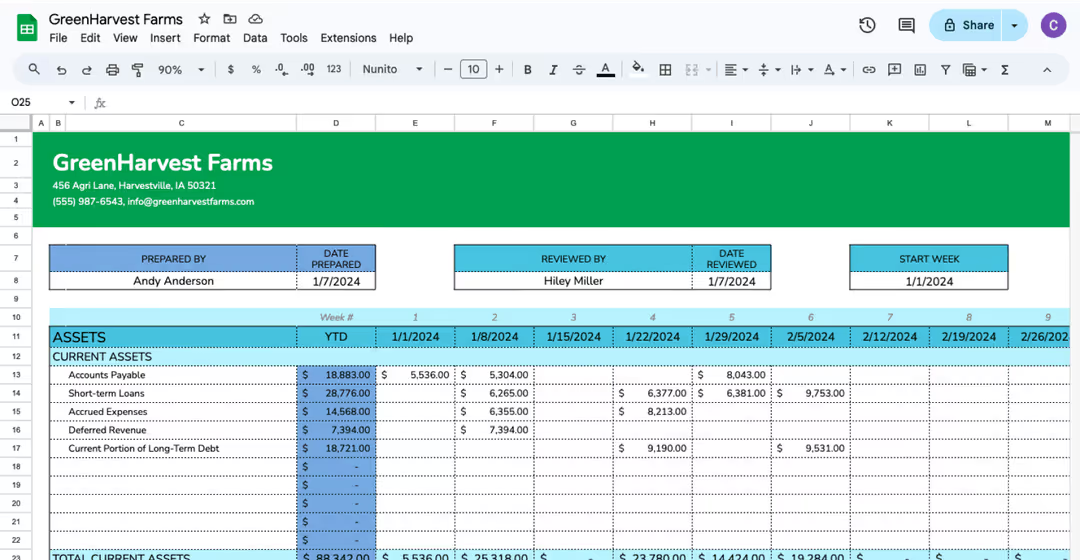
Your accounting software should produce financial statements, performance dashboards, cash flow forecasts, and analytical reports without weeks of preparation.
During a quarterly board meeting, your team can present a real-time performance report. The data is current rather than already outdated by the time the document is finished.
Security, Permissions, and Data Protection
You're handling very sensitive information. Your tool should restrict data access based on user roles and protect sensitive financial information through encryption and secure hosting.
Where multiple advisers or external accountants require access, permissions must be tightly controlled.
💡 For example, a client's family member may be able to view investment performance dashboards but not underlying general ledger entries. An external adviser may only see data relevant to their specific filing. These controls reduce risk while still allowing the collaboration that family office work requires.
Scalability
Before choosing a tool, consider the size of your firm and your growth expectations.
If your firm is growing, or growth is a near-term goal, you need a scalable solution that can adapt to new entities, currencies, and reporting requirements without requiring you to rebuild your systems each time.
What Are the Benefits of Using Accounting Software in a Family Office?
The benefits of family office accounting software go beyond simple bookkeeping. Your firm needs it because it touches every aspect of financial management, including operational efficiency, governance, and long-term wealth preservation.
Higher Accuracy, Lower Risk
When managing reconciliations, inter-company entries, and currency conversions, there's a constant risk of errors.
Manual spreadsheets leave room for misclassifications or omissions, which can lead to incorrect financial reports or tax compliance issues.
A mistyped journal entry could affect portfolio performance or distort tax obligations across jurisdictions.
With automation and proper software, every entry aligns with real-time data, protecting your family office from financial misreporting and regulatory penalties.
Save Time and Improve Operational Efficiency
A family office deals with countless recurring tasks: reconciling custodial accounts, consolidating multi-entity ledgers, and preparing financial reports.
Without automation, these processes eat too much time; many accountants report spending over ten hours a week on manual data entry alone.
Accounting software eliminates repetitive data entry and manual report preparation, freeing your time for higher-value activities, such as evaluating new investments, conducting risk analysis, or advising clients on strategic financial decisions.
Better Visibility and Smarter Decisions
Family leaders, trustees, and advisers need more than static financial statements. They need real-time visibility into wealth performance across all entities, currencies, and asset classes.
Accounting software delivers dashboards that consolidate data so you can track liquidity, measure investment returns, and assess risk exposure at any given moment.
For example, if a family office anticipates a large capital distribution, the software can project the cash flow impact before commitments are finalized. That kind of visibility prevents surprises.
Governance, Compliance, and Audit Readiness
Family offices are held to increasingly high standards of governance by regulatory bodies, tax authorities, and the family itself.
Accounting platforms with built-in audit trails and compliance tools, including support for IFRS and GAAP, ensure your office is always ready for audits or trustee reviews.
Instead of scrambling to assemble records during tax season, your team can provide auditors with a clean, traceable financial history.
Scalable Infrastructure to Support Growth
Family offices rarely stay static. Over time, you may add new entities, expand into different asset classes, or diversify internationally. Traditional systems such as spreadsheets or small-scale accounting packages often buckle under this growth.
Family office software lets you add new entities, currencies, or investment types without restructuring the entire system. When a new trust is formed or the family invests in renewable energy projects abroad, your system adapts without disruption.
Take on a Strategic Role
With routine tasks automated, you're freed from being a record-keeper or tax filer. Instead, you can take the insights generated by the software and become a trusted advisor.
Rather than simply reporting past expenses, you can model future cash flows to determine whether the family can comfortably invest in a new venture or increase philanthropic commitments.
You can analyze historical investment data to recommend reallocating capital into higher-performing asset classes.
Your role evolves from operational support to strategic leadership, directly contributing to the preservation and growth of family wealth across generations.
This also answers a very popular question and fear among accounting firms: Will AI replace accountants? No, but it will help you take on a more valuable role.
What Is the Best Accounting Software for Family Offices?
The best tool for your family office depends on your structure, whether you run an SFO or an MFO, whether your clients are international, how complex the asset classes are, and where you're headed. That said, some tools consistently standout for this environment.
Eleven
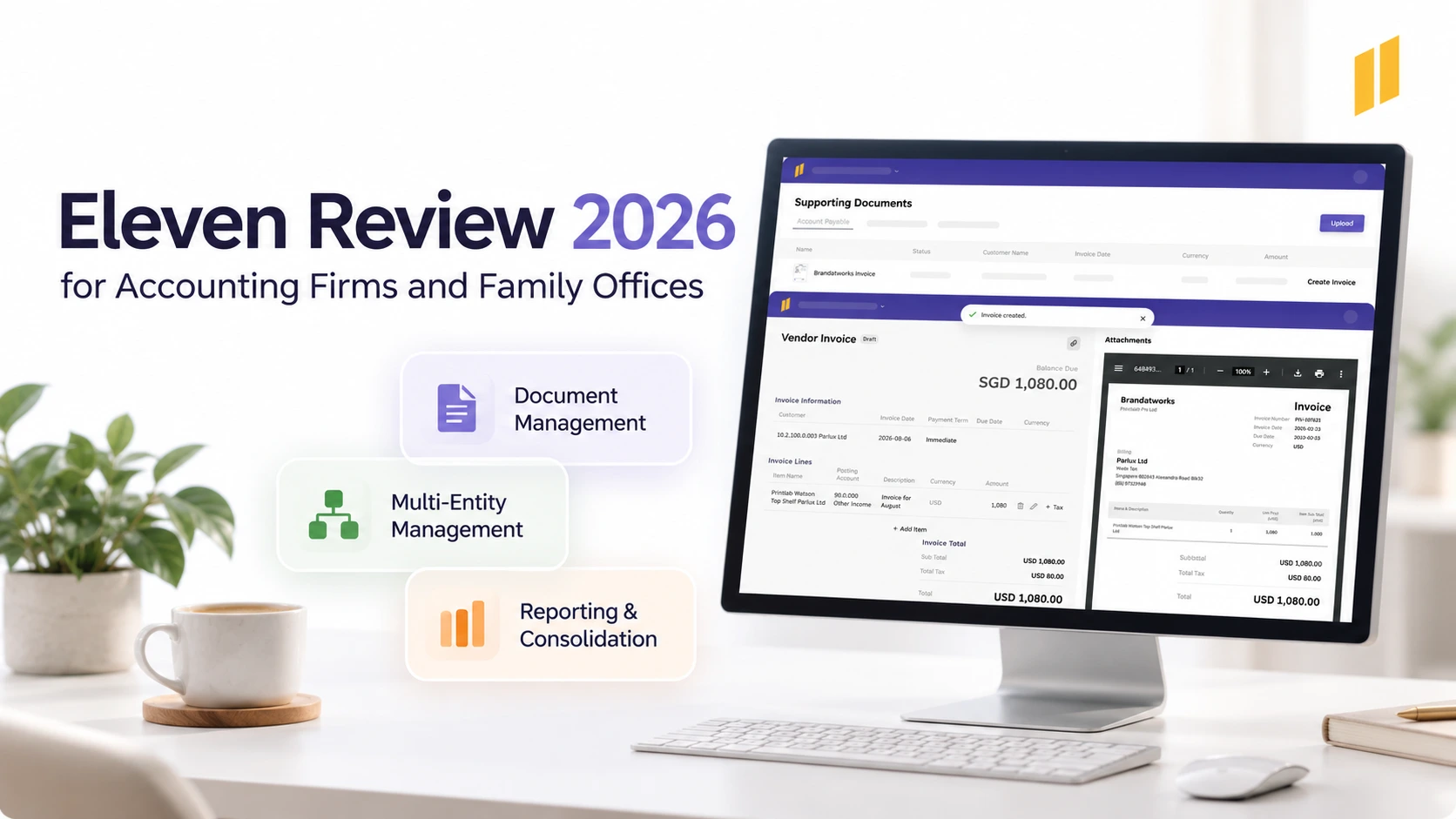
Eleven is built specifically for family offices and CPA firms managing multi-entity structures, global portfolios, and complex investment activity. It consolidates financial data from multiple entities, currencies, and jurisdictions into a single accurate view, removing the need for manual spreadsheet reconciliation across structures.
- Multi-entity architecture: each entity has its own general ledger, chart of accounts, and functional currency, all operating under a single unified platform.
- 170+ currencies with IAS 21-compliant FX revaluation: realized and unrealized gains and losses calculated automatically on every transaction.
- Consolidated reporting: group financial statements generated natively in a chosen base currency; no spreadsheet export required.
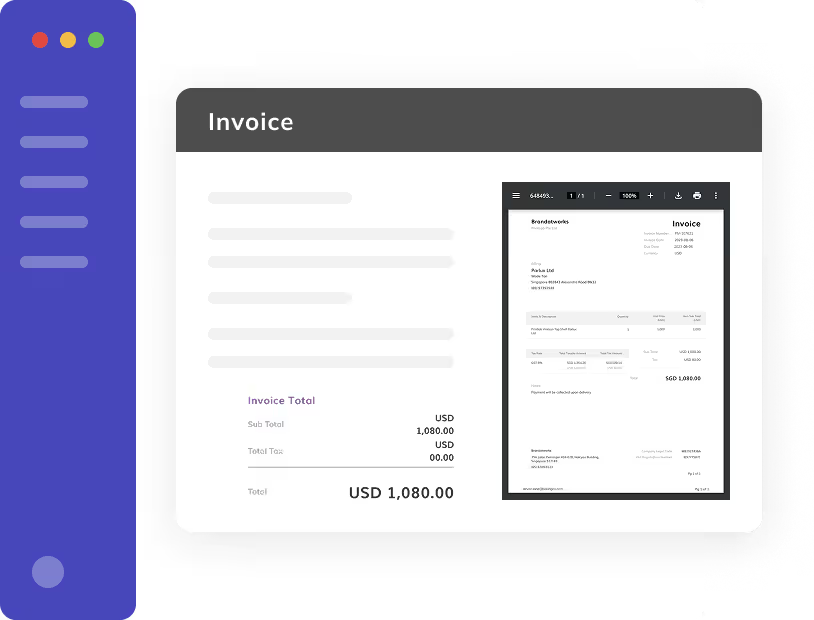
- AI bookkeeping: invoices, receipts, and bills in any currency extracted and matched automatically from PDFs and scanned documents.
- Native DMS via Dokmee: every document linked to its transaction with full version history, stored with encryption and access controls.
- Integrations with Excel, Google Sheets, and Power BI: existing workflows aren't disrupted; automation layers on top.
Managing a family office or advising one? Start your free trial and see how Eleven handles multi-entity, multi-currency, and operations in practice.
Asset Vantage
A platform built by a family office and technology group for complex wealth management.
Its features include data aggregation, general ledger, portfolio performance and analytics, partnership accounting, global reach, and bank reconciliation. It's a strong fit for mid to large single family offices.
SoftLedger
A cloud-based accounting platform offering real-time reporting, automatic inter-company entries, and multi-entity consolidation. A good fit for smaller family offices that need flexibility, clean dashboards, and strong API integrations without the overhead of an enterprise system.
Archway Platform
This tool is built for both SFOs and MFOs, combining investment management with accounting and reporting. Its features include investment data aggregation, ownership management, illiquid asset management, reporting templates, automated reporting schedules, and a general ledger.
Sage Intacct
Sage Intacct is one of the more established cloud-based accounting platforms and is commonly used by organizations with complex entity structures.
It offers multi-entity and multi-currency accounting, customizable reporting, audit trails, compliance tools, and strong integrations.
It's a strong fit for organizations that need depth in financial management and are comfortable with an implementation-heavy setup and per-user pricing.
How to Choose the Right Family Office Accounting Software
The right platform is the one that fits how your office currently operates and where it's headed. Before committing to any tool, work through these questions:
- Can the software handle all of your existing entities and easily scale to new ones as your structure evolves?
- Does it provide proper accounting and reporting for private equity, real estate, or other non-traditional investments?
- Can the platform integrate seamlessly with your custodians, banks, and brokers?
- Does the system allow you to create custom dashboards and reports, schedule recurring statements, and generate ad-hoc analyses when needed?
- Are there strong controls for permissions, a reliable audit trail, and data residency options that meet your compliance requirements?
- How long will it take to set up, including migrating historical data, and what level of training and support does the vendor provide?
- Will the system adapt to organizational growth, new jurisdictions, or changes in reporting requirements without major disruption?
- What are the ongoing maintenance and customization costs, and do they deliver sufficient value for the family office?
Eleven was designed to answer all of those questions for family offices and CPA firms managing multi-entity, international structures. Test it against your current workflows for free.
Frequently Asked Questions (FAQs)
What is the difference between general accounting software and family office accounting software?
General accounting software is designed for businesses managing their own finances, with a focus on bookkeeping, invoicing, and payroll. Family office accounting software is built for professionals managing other people's wealth across multiple entities, jurisdictions, and asset classes.
The key differences are in multi-entity consolidation, investment reporting, compliance-grade security, and audit readiness.
What is an SFO and an MFO?
A single family office (SFO) serves one family exclusively. A multi-family office (MFO) serves multiple wealthy families within a shared professional structure.
The accounting and reporting demands differ: MFOs typically need stronger multi-entity architecture and more flexible permissions to maintain separation between client families.
Do small family offices need dedicated software?
It depends on the complexity of the assets being managed. Small family offices with straightforward structures can sometimes manage with a general accounting platform, but as entity count, asset class diversity, and reporting requirements grow, dedicated software becomes necessary to maintain accuracy and avoid compliance risk.
How long does it take to implement family office accounting software?
Implementation timelines vary depending on the complexity of existing data, the number of entities, and the depth of historical records that need to be migrated. A smaller office with clean records might be operational within a few weeks.
A larger office with complex structures and years of historical data should expect a more involved process. The vendor's onboarding support is an important factor in how smoothly that transition goes.
What should a family office prioritize when choosing software?
Multi-entity and multi-currency support, compliance-grade security, a built-in audit trail, and flexible reporting are the baseline requirements for most family offices.
Beyond that, the priority depends on where your firm's complexity lives: investment tracking depth, custodian integration, illiquid asset handling, or scalability for growth.
Was this article helpful?
Thank you! Your feedback has been received!
Oops! Something went wrong while submitting the form.