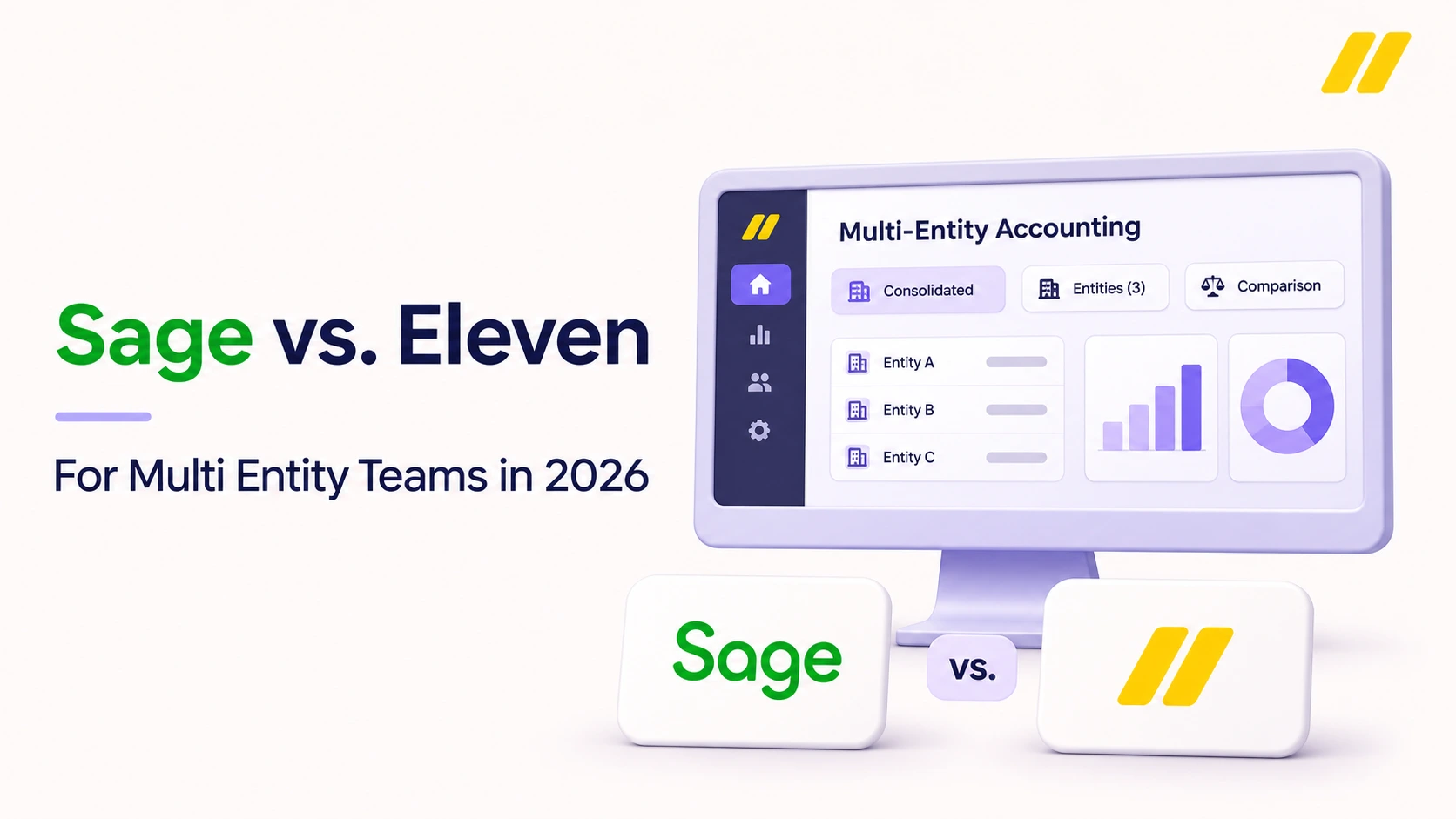
Sage vs Eleven for Multi-Entity Teams in 2026
Home
/
Blog
/
Sage Intacct Review in 2026 With Full Pricing Breakdown
Sage Intacct Review in 2026 With Full Pricing Breakdown
Written by
Reviewed by
An in-depth review of Sage Intacct's features, pricing, implementation costs, and suitability for growing businesses and accounting firms.
Sage Intacct offers multi-entity accounting, native consolidation, dimensional reporting, and advanced financial controls for organizations with complex accounting needs. This review examines its features, pricing estimates, implementation costs, and customer feedback. It also covers the Sage Intacct Accountants Program and compares the platform with Eleven to help firms decide whether its capabilities justify the investment.
Sage Intacct is a cloud financial platform built for organizations that have outgrown basic bookkeeping, with multi-entity accounting, native consolidation, dimensional reporting, and strong financial controls.
That depth comes with trade-offs. Pricing is quote-only, implementation often costs as much as a year of subscription, and setup usually takes a few months.
In this Sage Intacct review, we cover what the platform does well, what it costs in 2026, where users struggle, and who might be better served by something simpler.
Before we start: Eleven publishes this review and competes with Sage Intacct for some multi-entity buyers. We used Sage's documentation, published estimates from Sage implementation partners, as well as third-party reviews. All information is up-to-date as of October 2026.
What Should You Know About Sage Intacct Before Buying?
Sage Intacct is a strong fit for organizations with complex accounting needs, and a bigger investment than most bookkeeping-focused teams require. These are the points that matter most:
- Who it's for: mid-sized businesses, corporate groups, nonprofits, and finance teams that need consolidation, allocations, and controls.
- What it costs: quote-only. Partner estimates put entry subscriptions around $9,000 to $12,000 a year, with many customers spending $25,000 to $35,000.
- What it costs in year one: in one partner's example, $68,000 to $83,000 once implementation is included.
- How long it takes: Sage says three to six months to implement.
- What users say: they praise reporting and consolidation, and complain most about onboarding, support, and the learning curve.
Here's how it looks at a glance:
What Is Sage Intacct?
Sage Intacct is a cloud financial management platform for growing businesses and organizations with complex reporting needs.
It's part of the Sage family but very different from Sage 50, which is small-business accounting with desktop and hosted versions. Our Sage vs Eleven comparison covers both.
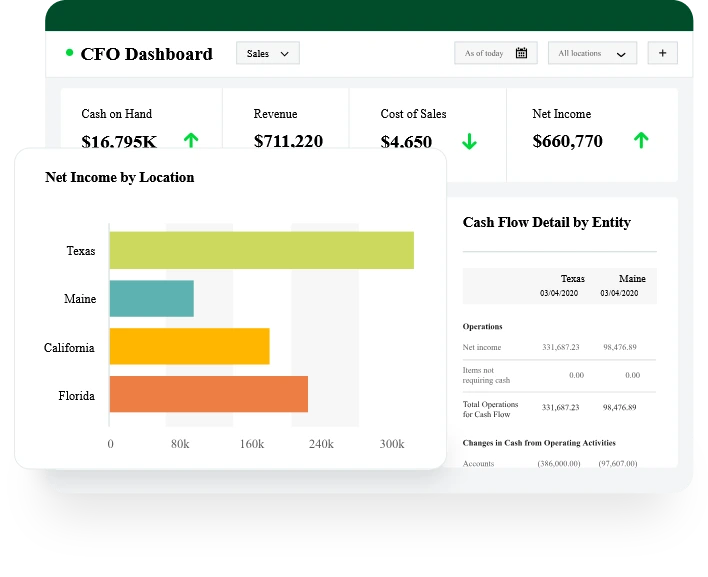
Intacct is highly configurable. A nonprofit might use it to manage restricted funds and grants, while a software company might use it for recurring revenue recognition.
It has industry capabilities for healthcare, nonprofits, professional services, and construction, and Sage runs an accountants program for firms that provide outsourced finance and advisory services.
What Features Does Sage Intacct Offer?
Core accounting, dimensional reporting, multi-entity consolidation, AI-assisted automation, and a long list of optional modules. Here's what matters most day to day.
How Does Sage Intacct Handle Core Accounting?
Core accounting is where Intacct feels most complete, and it pairs that coverage with strong controls.
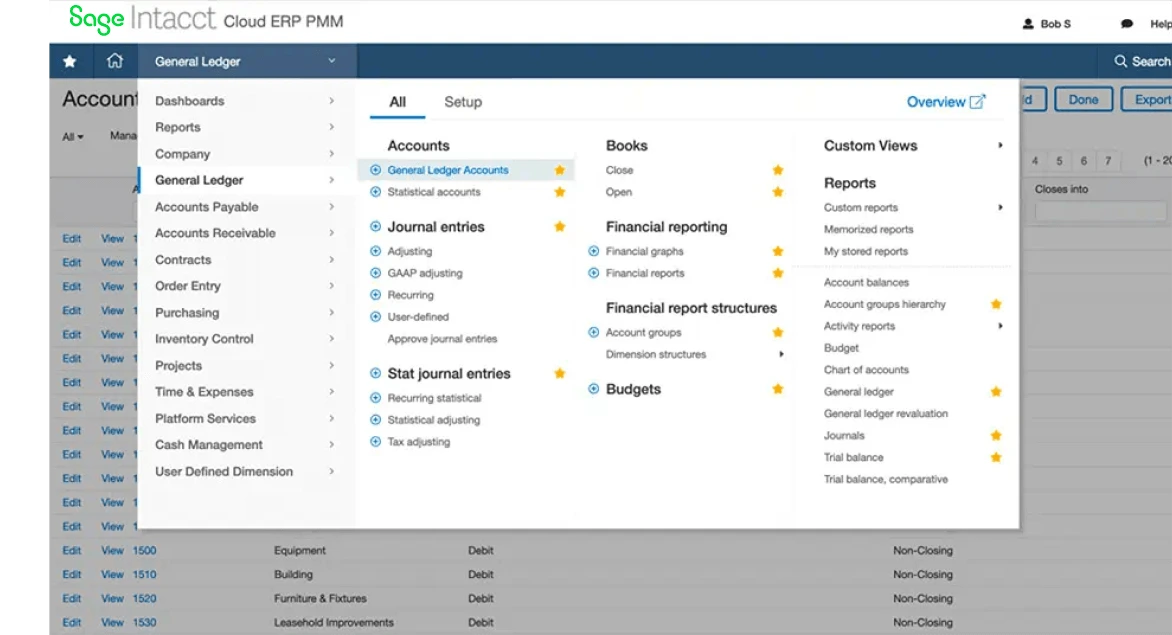
It covers the general ledger, payables, receivables, cash management, and purchasing, plus recurring journals, approval workflows, and detailed audit trails.
If you process hundreds of supplier invoices a month, you can route them through approvals and keep the documents attached, so you're not hunting through email when an auditor asks.
Permissions and approval rules help separate duties. The flip side is that fixing a posted transaction often means a reversal or adjusting entry rather than an edit. That protects the audit trail but takes getting used to if you're coming from lighter software.
What Makes Sage Intacct's Reporting Different?
Reporting is one of Intacct's strongest areas, largely because of how it organizes data. Instead of creating a general ledger account for every department, project, or location, you tag transactions with dimensions and report across any combination of them.
A company with five locations and three service lines can compare margins by location and service without a bloated chart of accounts.
You also get dashboards, drill-down to source records, scheduled reports, and KPI tracking. Some advanced interactive reporting tools cost extra, so check your quote. Complex reports take practice to build.
How Does Sage Intacct Handle Multiple Entities and Consolidation?
Multi-entity accounting is built into the platform, and native consolidation is one of Intacct's biggest advantages over simpler tools.
You keep separate books for each entity in one environment, control access, and report across the group. Depending on the applications you buy, Intacct supports:
- Domestic consolidation for groups with a common base currency
- Global consolidation with currency translation and cumulative translation adjustments (CTA)
- Advanced Ownership Consolidation for multi-level structures, partially owned subsidiaries, and non-controlling interests (NCI)
- Configured intercompany eliminations, including the parent's investment against the subsidiary's equity
Take a parent company with subsidiaries in the US, Canada, and Europe. Intacct can keep each entity's books, translate results into the group currency, and eliminate configured intercompany balances without moving the entire process into spreadsheets.
For groups with more complex ownership, Advanced Ownership Consolidation also generates non-controlling interest entries and tracks changes in ownership percentages over time. That matters when a parent controls a subsidiary without owning all of it.
The full setup isn't included in every subscription, though. Check that your quote covers the currencies, ownership structures, and elimination rules your group actually needs.
How Good Is Sage Intacct's AI and Automation?
Sage has been expanding Intacct's AI features quickly over the past year. Sage Copilot and the platform's automation tools now cover:
- AP automation that extracts invoice data, matches purchase orders, and flags duplicates
- Anomaly detection for unusual transactions
- AI-assisted insights and natural-language questions
- Tools for coordinating the month-end close
Sage's May 2026 update made three-way matching generally available in AP Automation, so teams can compare invoices, purchase orders, and receipts before paying.
Not every AI feature is in the core package, some arrived through early-access programs, and none of it removes the need to review exceptions.
What Integrations and Modules Are Available?
Intacct has one of the broader ecosystems in its category, with integrations and optional modules for more specialized accounting needs.
It connects to Salesforce, expense tools, and industry systems through its marketplace and APIs, and offers applications for:
- Project accounting and time management
- Revenue recognition and contract management, including ASC 606 requirements
- Fixed assets and lease accounting, including ASC 842
- Inventory management
- Budgeting, planning, and analysis
- Grant tracking and nonprofit fund accounting, including reporting requirements under ASC 958
These modules become useful when your organization needs to satisfy specific accounting standards or prepare for an audit.
A software company, for example, may need ASC 606 revenue schedules, while a nonprofit may need to track restricted contributions and report its net assets under ASC 958.
That flexibility also makes buying and implementation more complicated. If you only need the general ledger, payables, receivables, and bank reconciliation, you may not need those additional applications.
How Much Does Sage Intacct Cost in 2026?
Pricing is one of the harder parts of evaluating Intacct because Sage doesn't publish it.
Every subscription is quoted on your users, entities, and applications, but Sage implementation partners publish estimates based on their own projects:
Independent partner estimates, not official Sage prices or quotes.
The ranges are wide because configurations are. Your cost rises with entities, full users, reporting applications, integrations, and modules, so ask for an itemized quote, not just a headline number.
What Does Sage Intacct Cost in the First Year?
Your first year usually costs well above the subscription itself because implementation is billed on top.
RKL's example for three entities, five business users, and ten employee users looks like this:
That can be money well spent if it replaces weeks of manual consolidation. For a firm handling straightforward client bookkeeping, though, the standard pricing can be hard to justify.
There's an important exception for accounting firms. The Sage Intacct Accountants Program offers partner benefits that can change the calculation.
Program materials describe free use of Sage Intacct for a firm's own books and preferred pricing for clients receiving outsourced accounting or CFO services. If you’re a firm, confirm Sage’s current partner terms rather than assume the standard estimates above apply.
Note: Before signing, get prices in writing for extra users and entities, advanced modules, data migration, integrations, training, and support. If you're an accounting firm, ask about Accountants Program eligibility and partner pricing, too.
How Long Does Sage Intacct Take to Implement?
Implementation is a real project rather than a quick setup, and Sage says it typically takes three to six months depending on complexity.
Some partners report faster projects for suitable setups; Cargas averages around 90 days.
A simple migration moves your chart of accounts, history, and main workflows. A bigger one adds new dimensions, consolidation structures, custom integrations, and new approval processes.
For multi-entity groups, settle the financial structure early, because redesigning the chart of accounts or intercompany setup mid-project slows everything down. Before committing, ask your partner:
- Which data and documents will be migrated?
- Which accounting and reporting structures will they configure?
- Who owns integrations and testing?
- How will opening balances and reports be validated?
- What support do you get after go-live?
Ask for a demo using your own requirements rather than a generic tour.
What Do Sage Intacct Users Say?
Reviews are mostly positive, with implementation and support as the recurring pain points.
Intacct holds 4.3 out of 5 on both G2 (4,520+ reviews) and Capterra (715+). Some reviews are incentivized, and the ones below aren't a representative sample.
Users who invested in a good setup often describe actual gains, especially in reporting and close times:
"The drag and drop interface saves me navigation time daily."
Lindsay S., Senior Accountant, G2, September 2026
Sara B. shared an observed difference in task time.
"Since implementing Sage Intacct, we’ve gone from a 4–6 week timeframe for receiving financials to closing our books and having financials within two weeks.”
Sara B., Chief Financial Officer, G2, July 2026
However, some users found the transition very difficult. Brian V., for example, noted:
“The initial setup was quite a struggle; it was a huge conceptual change for my staff to move from the traditional account number structure to the dimension structure, which posed many challenges.”
Brian V., Controller, multi-entity organization, G2, July 2026
Onboarding and support come up most often on the other side, even from users who like the product:
"It was a huge step up from Quickbooks and has helped us to track and manage 50+ grants at a time with ease.”
Nicole W., Administrative Director, nonprofit, G2, July 2026
Not all users are happy with the platform, though.
"The onboarding and configuration was handled so poorly that we haven't been able to close our books for almost a year."
Jacob C., CEO, health and wellness, Capterra, December 2025
A September 2026 G2 reviewer in computer and network security also praised multi-currency consolidation but criticized support response times, Sage Copilot, and renewal pricing.
The lesson is that your configuration, implementation partner, and support plan matter as much as the software.
What Are Sage Intacct's Pros and Cons?
Based on Sage's documentation, partner pricing, and user reviews, here's where Intacct shines and where it asks more of you:
Who Should Use Sage Intacct?
Choose Sage Intacct if:
- You run a corporate group that needs native consolidated statements.
- Your finance team needs dimensional reporting, allocations, and strong controls.
- You need modules for revenue recognition, grants, or project accounting.
- You can invest in implementation, training, and ongoing configuration.
- You've outgrown simpler accounting software's reporting or controls.
Look elsewhere if you're a small business that needs basic bookkeeping, or an accounting firm keeping dozens of straightforward client ledgers.
Intacct can serve accounting practices, but its architecture is often more than those engagements need.
Is Eleven a Better Sage Intacct Alternative for Accounting Firms?
Eleven can be a great alternative to Sage depending on what your firm actually needs.
For CPA firms and family offices that mainly need efficient multi-entity bookkeeping, Eleven is built for keeping many entities' books in one platform, with published pricing and no separate implementation project.
Here's how they compare:
On Eleven's pricing, 20 entities on Professional cost $8,160 a year and 50 entities cost $19,200, with implementation and migration included.
That isn't the same as a full Intacct setup with native consolidation and specialist modules, and if you need eliminations inside your accounting platform, Intacct may be the stronger choice.
But if your team mainly processes transactions, reconciles accounts, and prepares client reports, you may not need to pay for that complexity.
Need Faster Bookkeeping, Not a Six-Month ERP Project? Switch to Eleven
If your Intacct quote is climbing and most of your work is keeping clean books for many entities, it's worth asking what you're really paying for.
Many firms and family offices need speed across dozens of ledgers far more than they need a consolidation engine, and that's exactly the work Eleven is built for.
Eleven puts every entity in one cloud platform, each with its own ledger, so your whole team works from one login.
Get unlimited users, AI capture for invoices and bank statements, 170+ currencies with automatic revaluation, and published per-entity pricing you can work out before a sales call. Professional includes implementation and migration, so there's no separate project to budget for.
See what your Intacct budget could cover instead. Start your free Eleven trial and run your own entities through it before you sign another renewal.
Frequently Asked Questions (FAQs)
Is Sage Intacct good accounting software?
Yes. Its financial management, multi-entity accounting, and reporting make it a strong fit for organizations with complex needs.
For smaller businesses or firms with straightforward bookkeeping, the cost and setup may not pay off.
How much does Sage Intacct cost per month?
Sage doesn't publish a monthly price; subscriptions are quoted annually. Partners report entry-level subscriptions around $9,000 to $12,000 a year, which works out to roughly $750 to $1,000 a month, but there's no standard month-to-month plan.
Larger setups cost considerably more.
Is Sage Intacct the same as Sage 50?
No. Sage 50 is small-business accounting with desktop and hosted versions. Sage Intacct is a cloud financial management platform for more complex reporting, automation, and controls.
Does Sage Intacct offer consolidated reporting?
Yes. It supports native multi-entity accounting and consolidation, with extra applications for currency translation, complex ownership, and automated intercompany eliminations. Your subscription must include the right applications.
How long does Sage Intacct implementation take?
Sage says three to six months. Some partners report shorter projects, but the timeline depends on your structure, data, reporting, integrations, and testing.
Is Sage Intacct better than QuickBooks Online?
If you need advanced reporting, controls, or native consolidation, yes. QuickBooks Online is easier to adopt for simple small-business accounting and has lower published prices. Our QuickBooks review covers it in detail.
What's a cheaper alternative to Sage Intacct?
For firms and family offices focused on multi-entity bookkeeping, Eleven starts at $35 per entity per month with volume discounts for larger portfolios. It doesn't include native automated consolidation, so formal group reporting runs through an external reporting workflow.
Was this article helpful?
Thank you! Your feedback has been received!
Oops! Something went wrong while submitting the form.