Sage vs Eleven for Multi-Entity Teams in 2026
Home
/
Blog
/
Intercompany Accounting Explained With Examples and Best Practices
Intercompany Accounting Explained With Examples and Best Practices
Written by
Reviewed by
A practical guide to intercompany journal entries, eliminations, reconciliation, foreign currencies, and month-end controls.
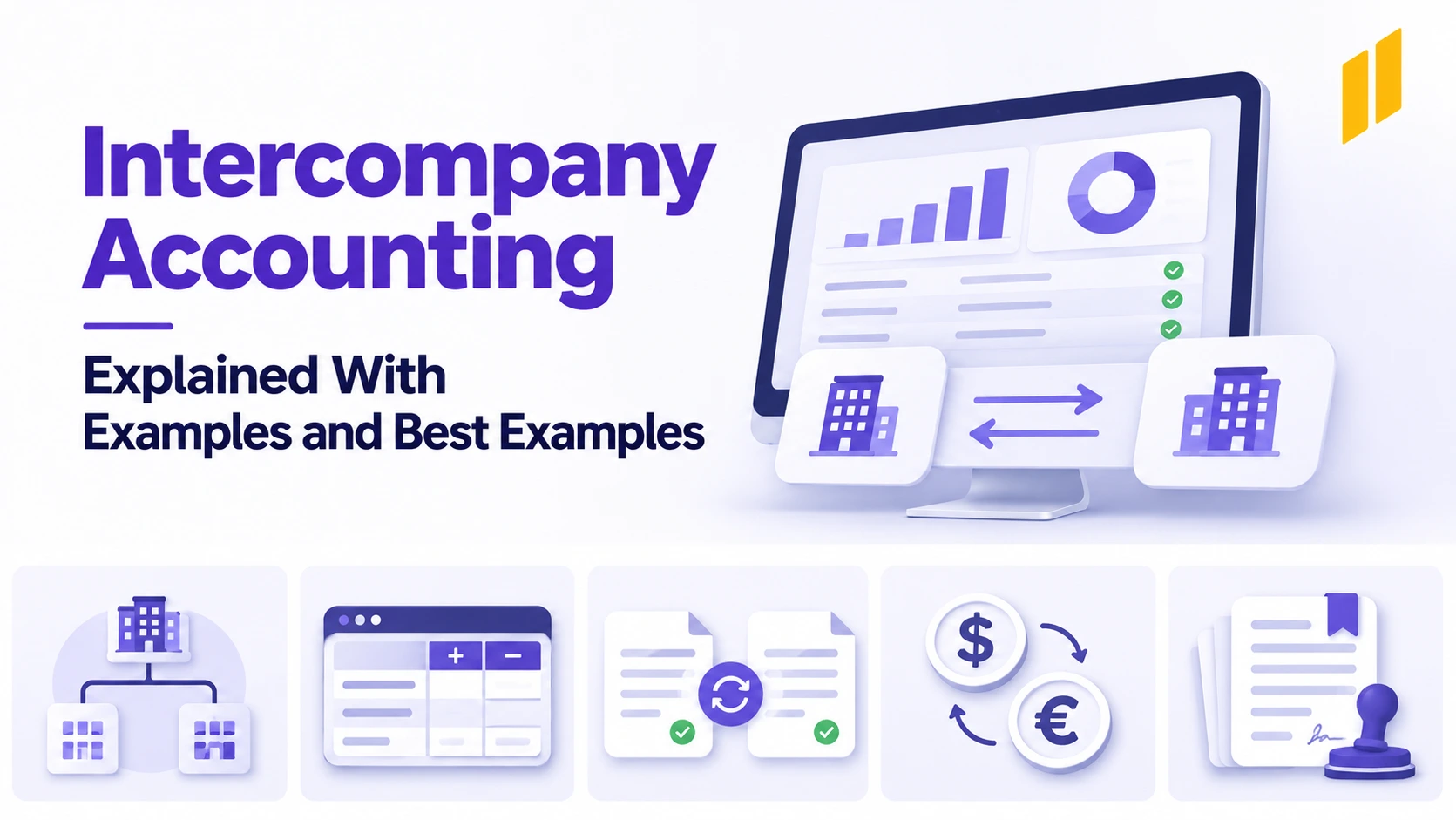
Intercompany accounting keeps transactions between group entities accurate in their individual ledgers while removing internal activity from consolidated financial statements. This guide covers journal entries for services, loans, inventory transfers, and dividends, followed by a practical reconciliation process. It also explains foreign-currency treatment, transfer pricing documentation, and the controls that help teams close their books accurately.
Intercompany accounting is how a group of companies records, reconciles, and eliminates the transactions between its own entities.
One company pays the bill and another receives the benefit, and by month-end both teams need to agree on what happened and who owes whom.
This guide walks through the journal entries behind the most common transactions, a reconciliation process that resolves differences before close, and how currencies and transfer pricing fit in.
How we researched this: We checked the relevant US GAAP and IFRS guidance, including ASC 810, ASC 830, ASC 850, ASC 326, IFRS 10, IAS 21, IAS 24, and IFRS 9. We also consulted IRS transfer pricing guidance and US consolidated tax return rules. All companies and amounts in the examples are fictional. This guide explains the general principles, not how they apply to your group's specific circumstances.
What Is Intercompany Accounting?
Intercompany accounting is the process of recording and reconciling transactions between separate legal entities in the same group, then adjusting for them when preparing group financial statements.
Common examples include:
- A parent lending money to a subsidiary,
- One group company selling inventory to another, or
- A service company charging subsidiaries for IT support.
Each entity records the transaction in its own books, so a receivable in one usually has a matching payable in the other. At consolidation, those transactions are eliminated so that internal trading doesn't look like business with outside parties.
The reporting boundary matters. Two clients of the same accounting firm don't become intercompany counterparties just because their books sit in the same software.
Our guide to multi-entity accounting explains the broader setup.
“US accounting and tax treatment can differ. Eliminating intercompany transactions from consolidated financial statements doesn't automatically settle their tax treatment. For example, qualifying common-control loans are excluded from CECL under ASC 326-20, while consolidated federal income-tax returns have separate rules for recognizing intercompany gains and losses. Your accountant should review both treatments based on the group's structure.”
— Carl Nnaji, CPA | Founder, Kiwi Consulting Group & Expert Reviewer at Eleven
What Is the Difference Between Intercompany and Intracompany Accounting?
The difference between intercompany and intracompany accounting is whether the activity crosses a legal-entity boundary.
Here's how the three related terms compare:
Related-party rules reach further than consolidation. Under IAS 24 and US GAAP's ASC 850, relevant related-party transactions may need to be disclosed in an entity's own financial statements, even when they're eliminated from the consolidated group accounts.
How Does Intercompany Accounting Work?
Intercompany accounting works in three separate stages, and finishing one doesn't finish the others:
- Reconciliation is agreement between records. Settlement is payment.
- Elimination is a reporting adjustment.
- Paying an intercompany invoice doesn't remove the internal revenue and expense from the group's results for the year.
Both major frameworks require elimination. Under US GAAP, ASC 810-10-45-1 requires intra-entity balances and transactions to be eliminated (reproduced in Deloitte's DART).
Under IFRS, IFRS 10 paragraph B86(c) requires full elimination of intragroup activity, including profit still sitting in assets inside the group.
Not every company connected to an owner belongs in the same consolidation, so define the reporting group before deciding what to eliminate.
What Are the Most Common Intercompany Transactions?
Sales of goods, services, loans, asset transfers, royalties, and dividends cover most intercompany transactions.
The purpose of the transaction decides the accounting:
A payment between group companies isn't automatically an expense. Funding could be a loan or an equity contribution, and a recharge could be a service or a reimbursement.
Understand the arrangement before you choose the journal entry. Transfer pricing sets the terms of these transactions; it isn't a separate transaction type.
What Do Intercompany Journal Entries Look Like?
The examples below use invented companies and amounts. Unless stated otherwise, both entities use USD, are wholly owned within the same group, and apply the same accounting policies.
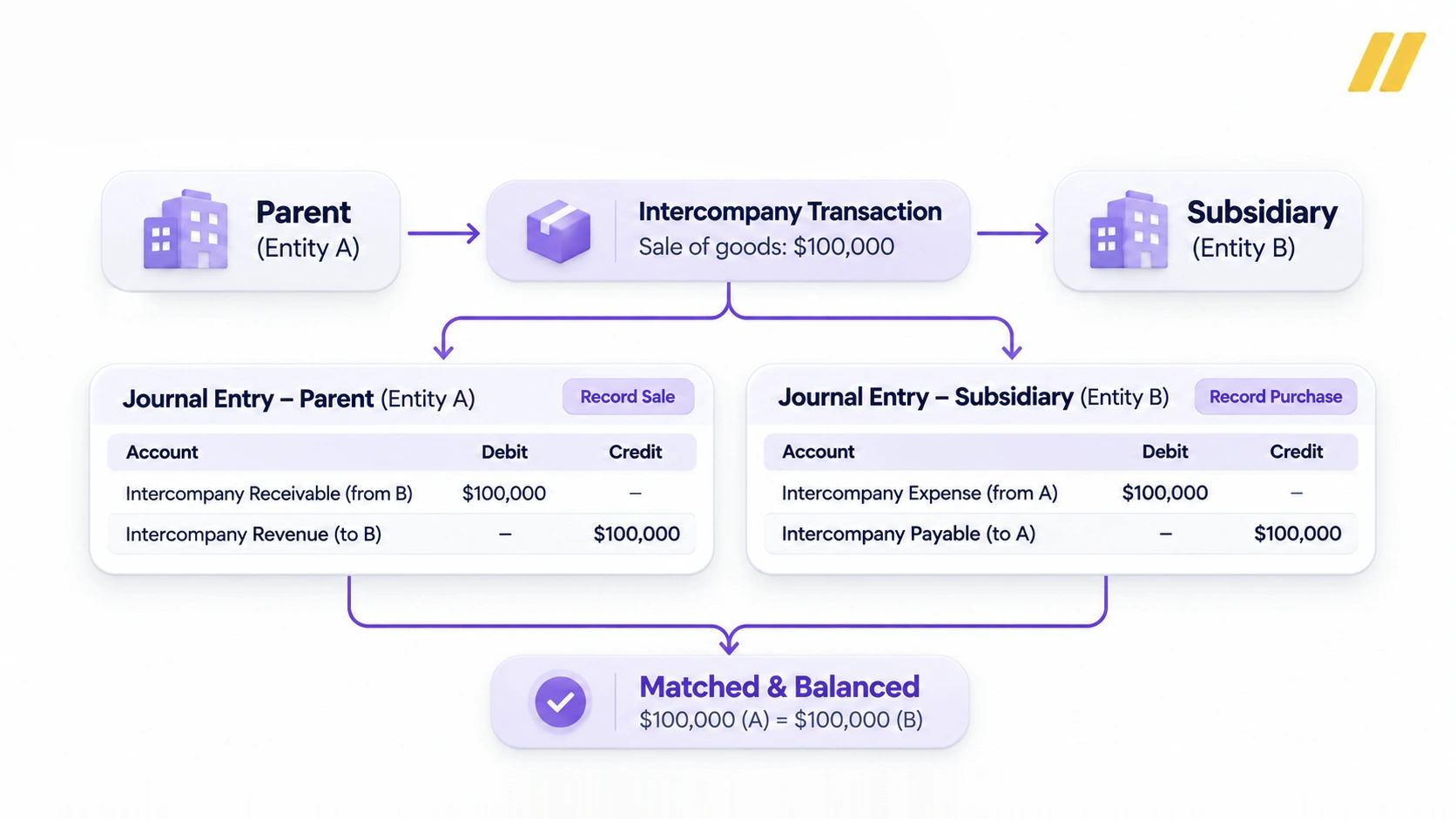
Tax entries are left out to keep the mechanics clear.
How to Record Intercompany Service Charges
Company A provides $10,000 of management services to Company B. B expenses them immediately, and the invoice is unpaid at period-end. Each entity records its side:
At consolidation, two adjustments remove the internal activity:
These are group reporting adjustments, not corrections to A's or B's own books.
A's external costs of delivering the service, such as payroll, stay in the group's expenses. If B pays the invoice later, the balance disappears from both books, but the internal revenue and expense still need eliminating from the period's group results.
How to Record Intercompany Loans and Interest
Company A lends Company B $100,000 on ordinary terms, and $500 of interest accrues. The entries in each entity look like this:
At consolidation, eliminate the $100,000 loan balances, the $500 interest balances, and the $500 of interest income and expense. Remove the internal funding from the consolidated cash flow statement too.
Agree on the interest calculation before either side posts it. Different day-count conventions or start dates can produce two reasonable-looking accruals that never match.
How to Eliminate Unrealized Profit on Inventory
Eliminating the invoice isn't enough when the goods are still inside the group.
Company A buys inventory for $100,000 and sells it to Company B for $130,000. B sells 60% to outside customers and still holds 40% at period-end.
The unrealized profit works out like this:
The group can't recognize that $12,000 until the goods are sold outside the group. The consolidation entries are:
That leaves closing inventory at $40,000, the group's original cost.
Note that the $30,000 profit is a 30% markup on cost but only about a 23.08% margin on the $130,000 transfer price. Applying 30% to B's $52,000 of inventory would give $15,600 and overstate the adjustment by $3,600.
Keep a schedule of opening and closing unrealized profit so the adjustment releases when the goods leave the group. Tax effects need separate treatment under your framework.
How to Record and Eliminate Intercompany Dividends
Dividends between group companies need attention too because moving money from a subsidiary to its parent doesn't create income for the group as a whole.
Suppose Company A owns 100% of Company B. B declares and pays an $8,000 dividend to A. For this example, assume A recognizes the dividend as income in its separate financial statements, as permitted under the cost method in IFRS accounting.
The entries look like this:
The consolidation adjustment removes A's internal dividend income and reverses B's corresponding distribution from group equity.
The $8,000 also cancels out of consolidated cash flows because the money simply moved between two companies in the same group.
The entries can differ depending on how the parent accounts for its investment. Under the equity method, for example, the dividend reduces the investment's carrying amount rather than becoming dividend income.
Either way, an internal dividend shouldn't inflate the group's consolidated profit.
How to Reconcile Intercompany Accounts
To reconcile intercompany accounts, compare each pair of entities, match the transactions behind the balances, explain every difference, and get both sides to sign off.
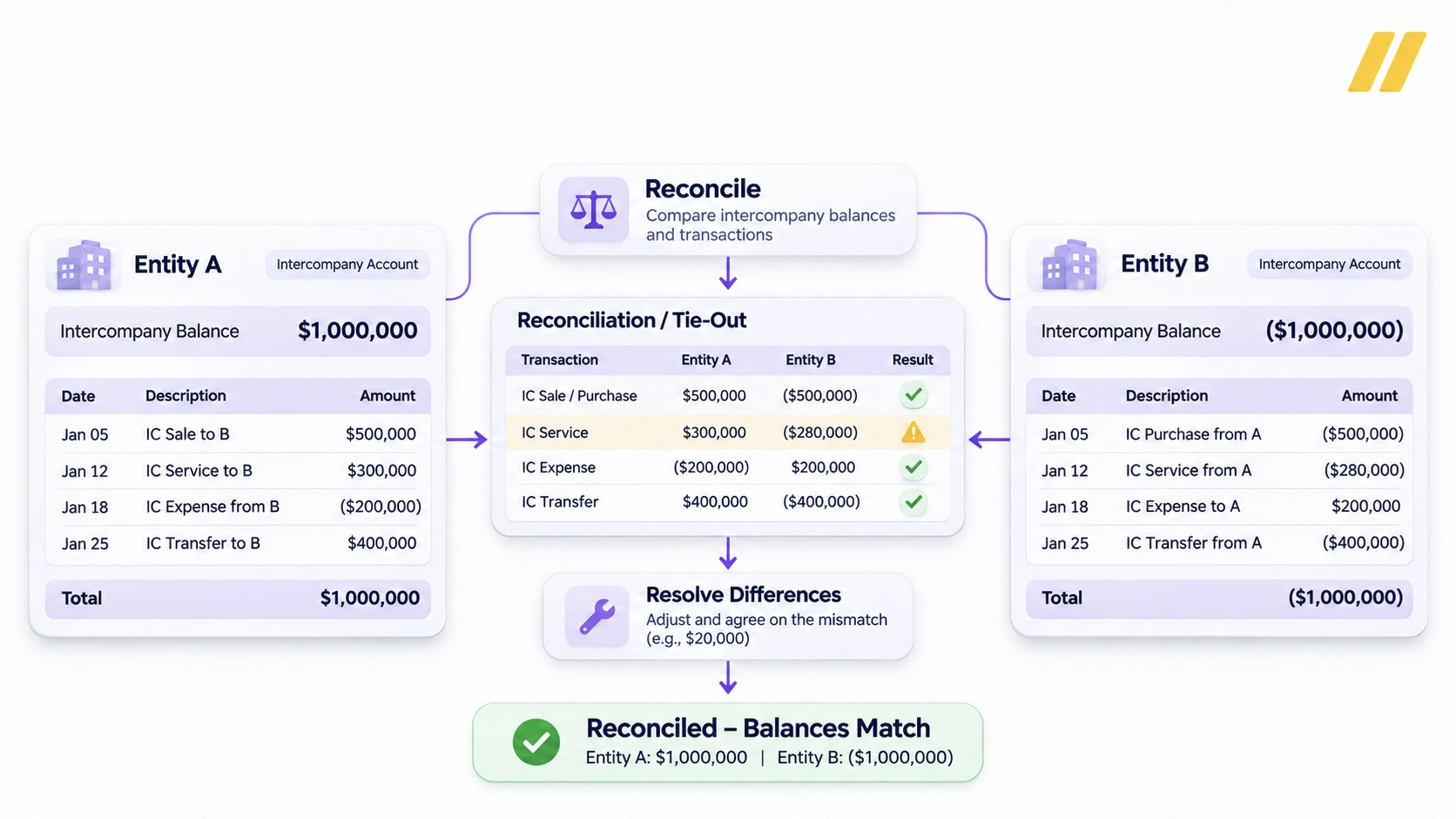
A zero at the bottom of a group spreadsheet isn't enough if differences between unrelated pairs cancel each other out.
Step 1: Set the Scope and Freeze the Data
List the entities and accounts included, agree on the reporting date, and keep the version of each extract you compared.
If either side posts a correction, record the journal reference instead of quietly replacing the file.
Step 2: Match by Counterparty and Currency
Compare A's balance with B to B's balance with A, and use document references to find the transactions behind the totals.
A useful reconciliation file captures these fields:
Match the contractual amount in the transaction currency first, then explain currency differences.
Comparing a USD receivable with an unconverted EUR payable will look like missing activity when it isn't.
Step 3: Explain the Difference Before Posting a Correction
Say A shows a $12,500 receivable from B, but B shows a $10,000 payable. A's file includes a $2,500 March service invoice that B hasn't recorded.
- If the services were delivered and the amount is agreed, B records the $2,500 and links it to the invoice when it's processed.
- If the work wasn't delivered or the charge is disputed, that's a different problem.
A balancing entry posted just to make the numbers match hides the difference instead of explaining it.
Step 4: Resolve Exceptions and Sign Off
Give every open item a cause, an owner, and a deadline. Typical causes are missing invoices, duplicates, credit notes, cut-off, currency, settlement, and pricing disputes.
Have both entities acknowledge the agreed balance, show material open items to the group reviewer, and keep the support so next month's preparer doesn't have to rebuild it from emails.
What Are the Best Practices for Intercompany Accounting?
Most of the speed comes from making transactions easy to agree on when they happen, not from fixing them at month-end. These practices help:
- Write a shared intercompany policy
Decide who raises each charge, who approves it, the settlement currency, and the deadline.
For recurring services, document the allocation basis, such as headcount for people costs or seats for software.
- Map accounts consistently
Use one group reporting map and required counterparty codes, and keep loans separate from trading balances and principal separate from interest.
A single "due to/from group" account hides what a balance represents.
- Agree on a cut-off calendar
Set a billing deadline ahead of the reporting pack, with a process for late invoices and unbilled services.
- Review exceptions during the month
Start with high-value and recurring transactions while the people involved still remember the details.
- Control settlement and manual journals
Agree on which balances get paid, rolled into funding, or netted, and separate who prepares and approves manual entries. Netting settlements doesn't automatically permit net presentation in the financial statements.
For context, APQC's benchmark shows a median of 6 calendar days to complete monthly consolidated financial statements, from the first trial balance to finished statements.
It's also worth tracking a few internal measures each month. These are suggestions, not industry benchmarks:
Standardizing early pays off as the group grows. With 10 entities there are up to 45 possible entity pairs, and with 20 there are up to 190
The formula is n × (n − 1) ÷ 2
How Do Foreign Currencies Affect Intercompany Accounting?
Foreign currencies add a layer that matching the invoice doesn't solve because the invoice currency, each entity's functional currency, and the group's presentation currency can all differ.
Under IAS 21, foreign-currency transactions are first recorded at the spot rate on the transaction date, and foreign-currency monetary balances are retranslated at the closing rate at period-end.
US GAAP's ASC 830 also addresses foreign-currency transactions and translation. Both frameworks distinguish ordinary monetary balances from certain long-term intragroup balances that are effectively part of a net investment.
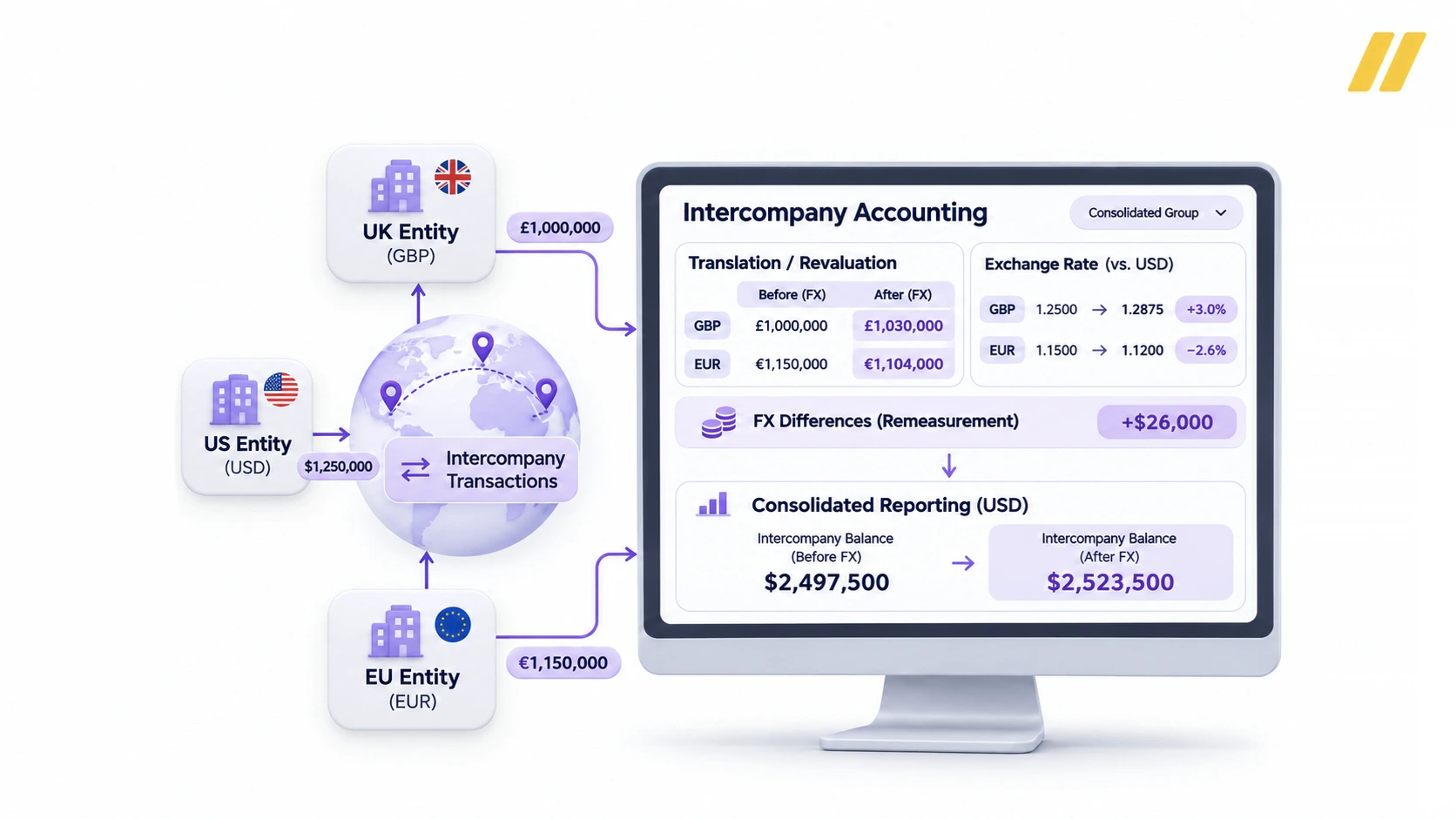
Here's a simple example: A USD-functional company holds a €10,000 intercompany receivable.
- At $1.10 per euro, it first records $11,000.
- If the closing rate is $1.12, the receivable becomes $11,200, a $200 exchange gain.
- The EUR-functional counterparty's €10,000 payable doesn't change.
Note: Don't eliminate that $200 gain just because the receivable is intercompany. Under IAS 21 paragraph 45, exchange differences on ordinary intragroup monetary balances remain in consolidated profit or loss, while qualifying net-investment balances receive different treatment. The IFRS Interpretations Committee's March 2026 discussion concerned how the remaining exchange differences should be classified under IFRS 18, not whether IAS 21 requires them to remain in the consolidated results.
Translating a foreign subsidiary's statements into the group's presentation currency is a separate process from revaluing an invoice in an entity's own books, so keep the two apart.
For tools that handle revaluation, see our guide to multi-currency accounting software.
What Transfer Pricing Documentation Do You Need?
You need evidence that each intercompany price reflects arm's-length terms because reconciled balances only prove the two ledgers agree, not that the price is right for tax.
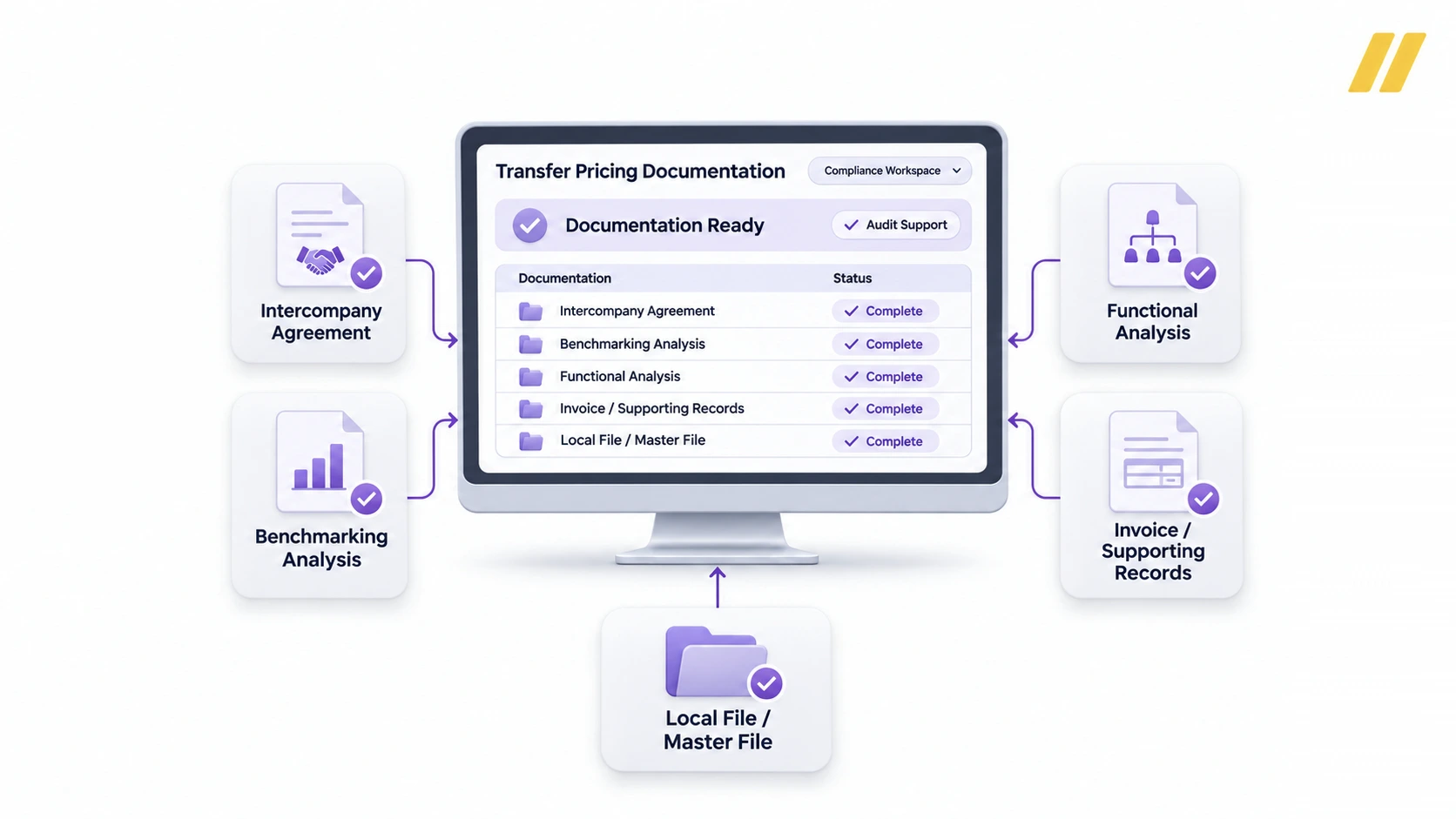
The IRS explains that Section 482 lets it adjust the results of commonly controlled taxpayers, comparing controlled transactions with transactions between unrelated parties in similar circumstances.
For US corporations filing a consolidated federal tax return, Treas. Reg. §1.1502-13 also governs how intercompany income, gains, and deductions affect the group's taxable income. Its matching and acceleration rules can defer or otherwise adjust when those items are recognized for tax purposes.
For each material transaction type, keep the agreement, evidence of what was supplied, and the pricing method. A shared-service charge might need the cost pool, the allocation calculation, and the markup treatment. A loan needs its own terms and interest support.
Don't treat a fixed markup as automatically acceptable for every service or country. The IRS's documentation guidance stresses explaining the method and the comparability analysis. Eliminating a transaction in the group accounts doesn't erase any entity's tax obligations.
What Should Intercompany Accounting Software Handle?
Intercompany accounting software should handle the full workflow, not just store several entities.
"Multi-entity" on a feature list doesn't prove a complete intercompany process. Run these tests in any demo:
A controlled spreadsheet can work for a small, stable group. Warning signs include files being replaced repeatedly, competing versions, and adjustments that depend on one person's memory.
Transaction volume and complexity matter more than any set number of entities.
Platforms differ a lot here. NetSuite handles intercompany inside its OneWorld add-on, as our NetSuite review explains, while reporting add-ons for Xero and QuickBooks eliminate balances only at the reporting layer.
Stop Chasing Intercompany Balances Across Separate Books
If your group is small and stable, a well-controlled spreadsheet and the process above will get you a long way.
As the number of entities, currencies, and monthly transactions grows, keeping the books organized becomes harder. That's where a shared accounting environment can help.
If your firm or family office manages multiple entities, Eleven lets your team maintain their books in one working environment, with unlimited users, support for 170+ currencies, and IAS 21 period-end revaluation.
See Eleven in action with a walkthrough built around your firm's multi-entity bookkeeping workflow.
Intercompany Accounting FAQs
What are intercompany receivables and payables?
An intercompany receivable is an amount one group company is owed by another, and the counterparty records the matching payable.
Tie each balance to a specific entity and transaction so it can be reconciled and eliminated.
Do you eliminate only the parent's ownership percentage?
No. For a fully consolidated subsidiary, intragroup balances and transactions are eliminated in full.
Splitting the effect between the parent and non-controlling interests is a separate step, which ASC 810-10-45-18 addresses. Equity-accounted investments follow different rules.
Can you write off a difference to finish a reconciliation?
Only when the treatment is justified and approved. First find out whether it's an error, a currency movement, a dispute, or something else.
A threshold can guide review, but it shouldn't become permission for unsupported balancing entries.
Does an intercompany loan disappear from the lender's own accounts?
No. Elimination applies to the consolidated group accounts, so the lender still carries the loan in its own separate books.
Under IFRS 9, the lender generally needs to assess expected credit losses on an intercompany loan measured at amortized cost.
US GAAP takes a different approach. ASC 326-20-15-3(f) excludes loans and receivables between entities under common control from the CECL model. That exception doesn't extend to every related-party loan, so the actual ownership relationship matters.
Was this article helpful?
Thank you! Your feedback has been received!
Oops! Something went wrong while submitting the form.