8 Best Dunning Software for B2B and Professional Firms (2026)
Home
/
Blog
/
QuickBooks vs Eleven in a Full Feature Comparison (2026)
QuickBooks vs Eleven in a Full Feature Comparison (2026)
Written by
Reviewed by
Compare QuickBooks Online vs Eleven on multi-entity accounting, accountant discounts, user limits, and 5-year costs. Discover how portfolio-based pricing stacks up against per-company subscriptions for 10 to 200 entities.
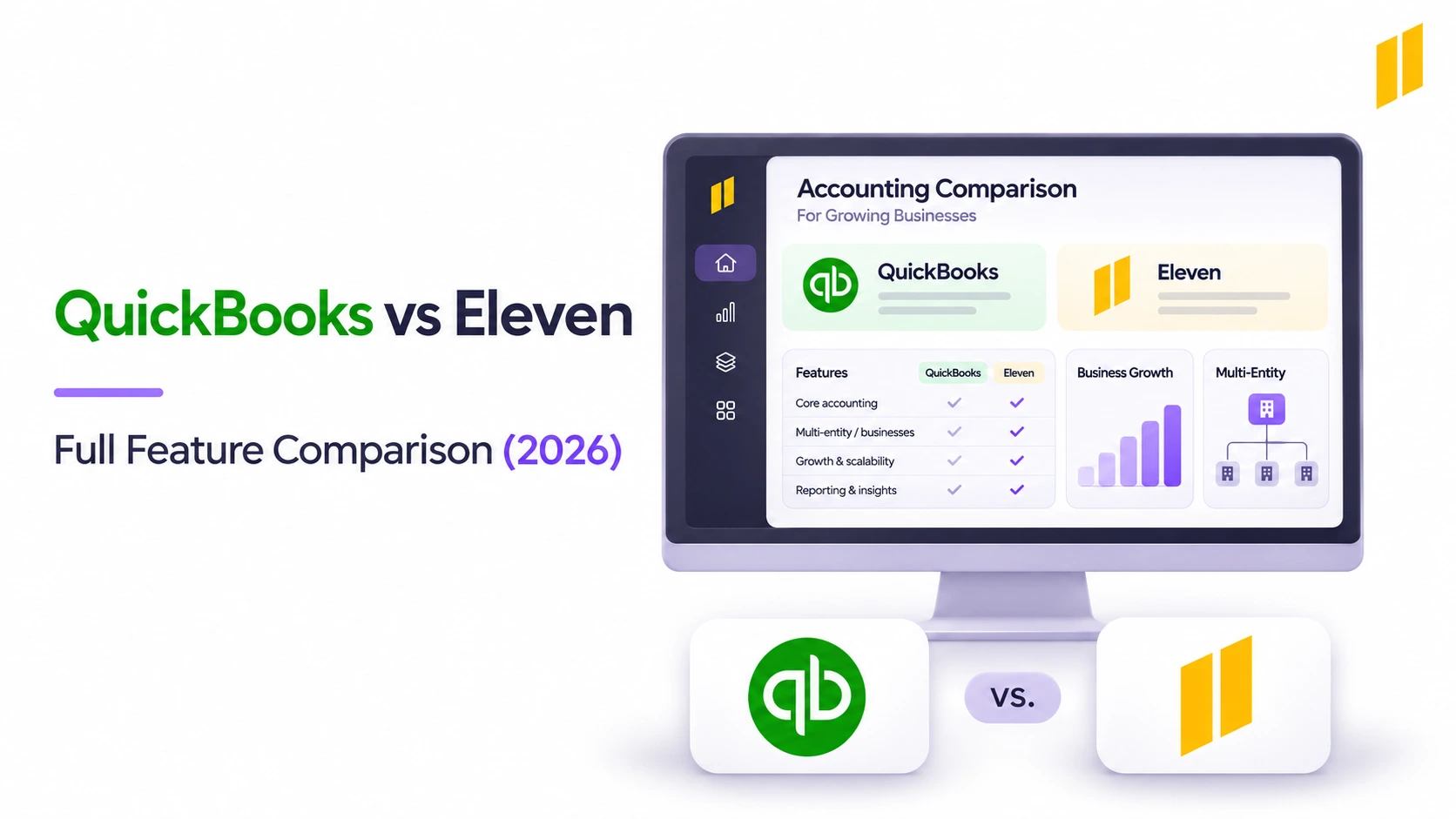
Managing multiple companies in QuickBooks Online gets expensive fast, even with accountant discounts. This guide compares QuickBooks Online and Eleven across 10 to 200 entities over five years, weighing real pricing, user limits, and core features. QuickBooks remains the practical pick for single businesses that need built-in payroll, sales tax filing, and native inventory tools. But for accounting firms and family offices juggling dozens of ledgers, Eleven's flat per-entity pricing, unlimited users, and AI document extraction can cut software spend by thousands every year.
QuickBooks Online vs Eleven is a question of scale. One $140 QuickBooks Online Plus subscription is easy to budget for, but 50 of them cost $84,000 a year at list price, and still $58,800 with Intuit's accountant discount.
Eleven keeps every entity's ledger in one platform, with unlimited users and per-entity pricing that drops as your portfolio grows.
This comparison covers features, users, pricing, and what 10 to 200 companies cost on each, including Intuit's accountant discounts, so you can see whether switching would actually save your firm money.
Before we start: Eleven publishes this comparison. We've included every discount Intuit offers accountants because a comparison against list prices alone wouldn't be fair, and we point out where QuickBooks is the better fit.
How Do QuickBooks Online and Eleven Compare?
QuickBooks Online charges a subscription per company with user limits, while Eleven charges per entity with unlimited users.
QuickBooks has the more mature ecosystem: invoicing, payroll, inventory, and thousands of accountants and apps. Eleven is built for the work of managing many ledgers at once.
How Do QuickBooks Online and Eleven Manage Multiple Companies?
In QuickBooks Online, each business has its own company file and subscription.
QuickBooks Online Accountant lets your firm manage clients from one login, but their books and subscriptions stay separate.
Intuit is retiring QuickBooks Online Accountant on December 31, 2026, and moving firms to Intuit Accountant Suite. The replacement's Core plan remains free and includes the existing accountant tools.
A firm with 30 clients, 10 on Plus and 20 on Essentials, still manages 30 subscriptions, along with their upgrades and connected apps. That works for many practices, but the cost and admin add up as the client list grows.
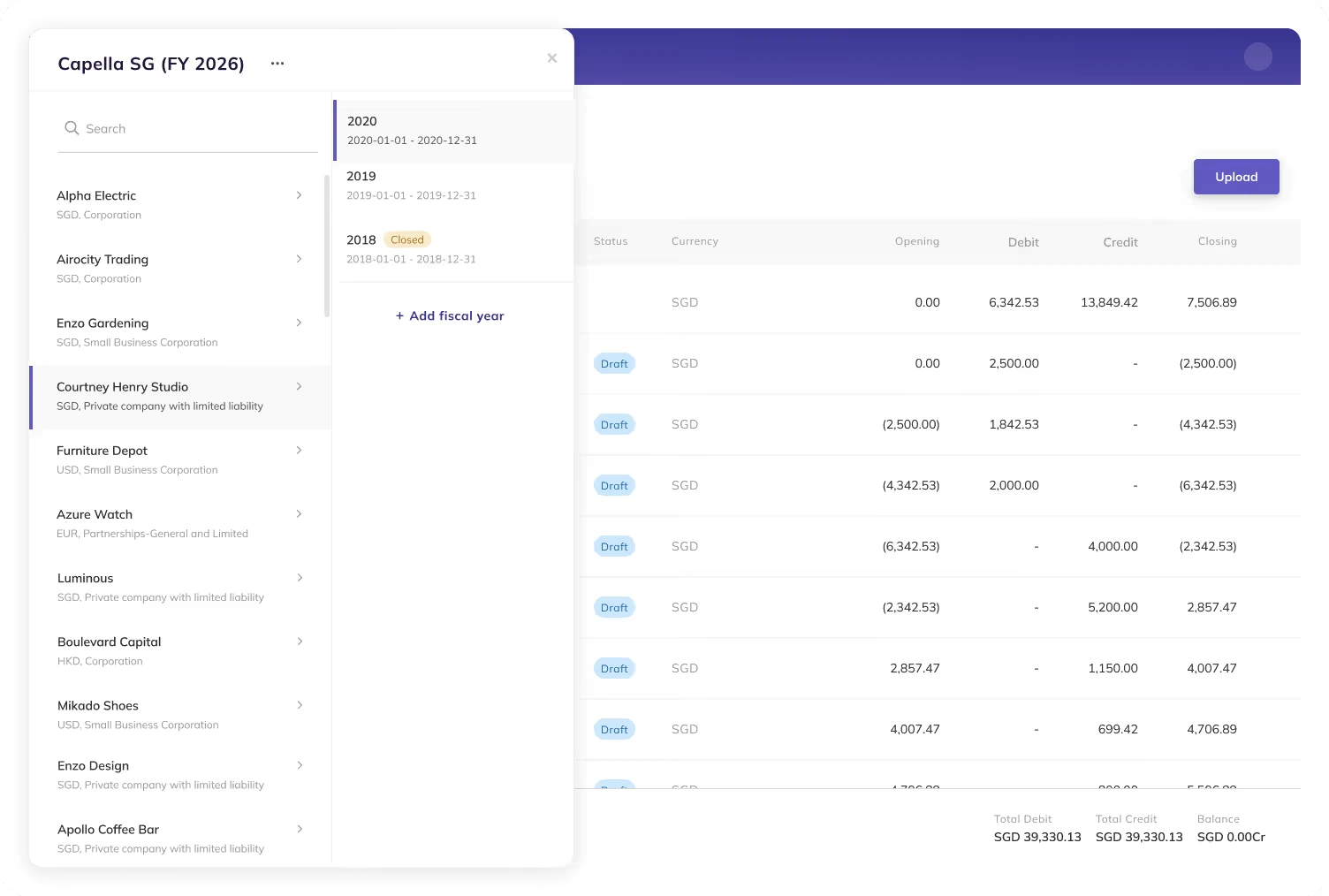
In Eleven, every client or legal entity keeps its own ledger inside one platform. A family office overseeing 40 companies (investment holdings, property entities, and operating businesses) keeps separate books for each while the finance team works across all of them. Every plan includes unlimited users, so adding an accountant never raises the bill.
Do QuickBooks User Limits Mean You'll Need to Upgrade?
You only need to upgrade if a company needs more full users than its plan allows. Adding accountants at your firm doesn't force client upgrades.
QuickBooks limits billable users by plan:
Plus and Advanced also allow non-billable reports-only roles.
Where limits do bite is when a company needs a sixth full user:
- Moving from Plus to Advanced raises its subscription from $140 to $340 a month, which is $2,400 more a year per company.
- Five companies in that position would cost $12,000 more a year at list price.
- Eleven avoids that particular cost by including unlimited users on every plan, though its more advanced permission controls sit on Enterprise.
How Do QuickBooks Online and Eleven Compare on Features?
QuickBooks covers more of a business's operations, and Eleven focuses on processing many entities' books.
How Do They Handle 1099s and US Sales Tax?
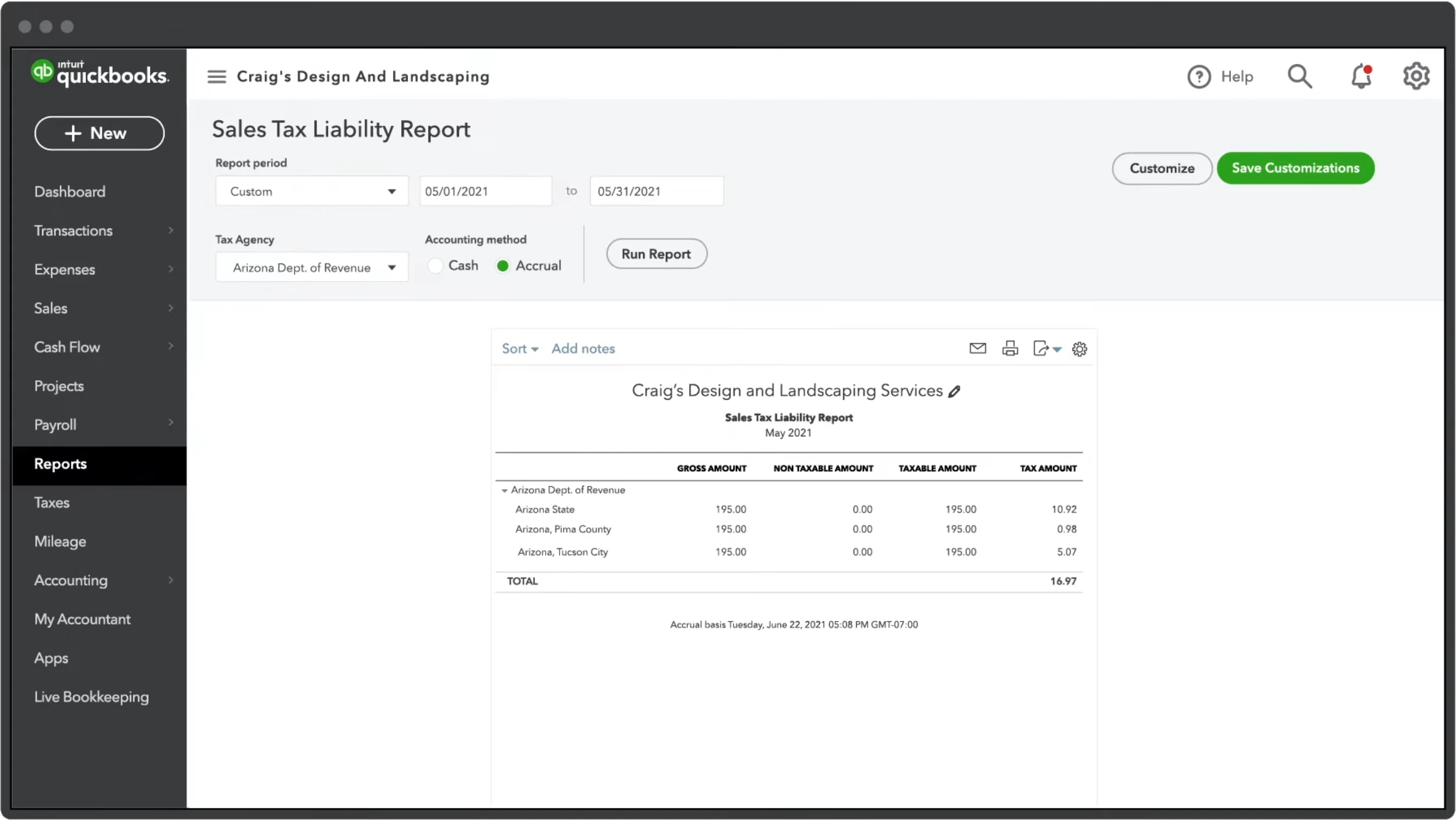
For US firms, QuickBooks has the advantage here. QuickBooks Online can prepare and e-file 1099-NEC and 1099-MISC forms using contractor payment records, although filing fees may apply.
Eleven doesn't currently offer a native 1099 preparation or e-filing workflow, so firms would need to handle that separately.
QuickBooks also calculates sales tax automatically based on the transaction and applicable tax rules.
Eleven's tax engine supports US sales tax entries and other tax treatments, but it doesn't prepare or file sales tax returns.
If your clients rely on QuickBooks for these workflows, check what you'll need to replace before switching.
Which Is Better for Invoice and Document Processing?
Eleven is better, especially when you're processing documents for many clients. QuickBooks has mature invoicing, expense tracking, bill management, and AI categorization that varies by plan.
Eleven extracts data from invoices and bank statements automatically, so your team reviews entries instead of typing them. Across five accountants each handling hundreds of invoices a month, that time adds up.
Alpadis, for example, reported that its accountants processed invoices 78% faster after ten months on Eleven. That’s one customer’s story, but it shows the kind of time-saving Eleven can enable.
Which Handles Multiple Currencies Better?
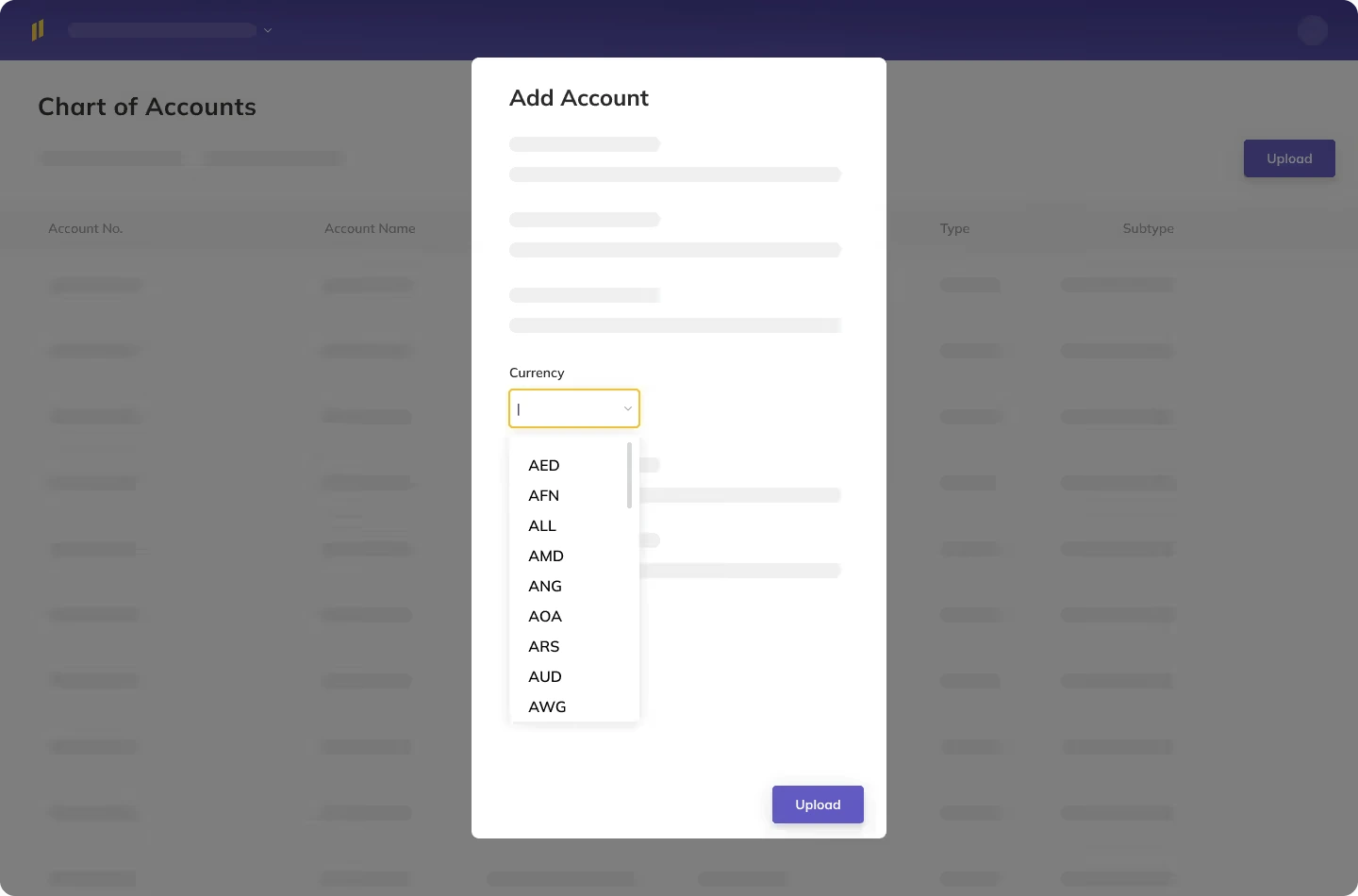
Both Eleven and QuickBooks Online offer multi-currency below their top plans, but Eleven includes it on every plan.
QuickBooks Online supports multi-currency from Essentials up, so a client trading abroad doesn't need Advanced. Eleven includes 170+ currencies and period-end FX revaluation for IAS 21 and ASC 830 accounting workflows from Standard.
That covers foreign-currency balances within an entity. Translating financial statements and consolidating a whole group is a separate process.
When Do QuickBooks' Inventory, Payroll, and Integrations Matter More?
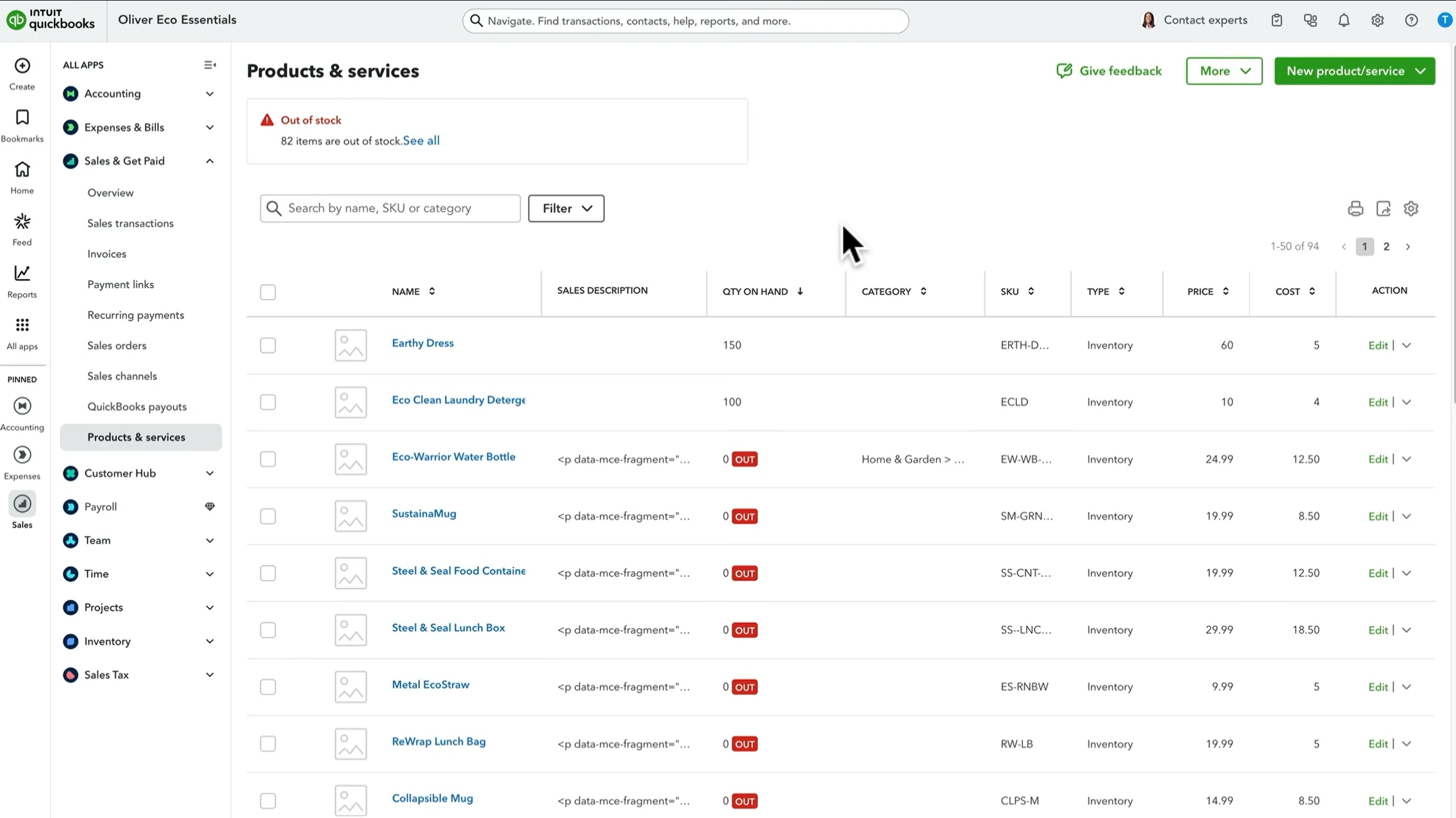
When your clients run operations, not just books, QuickBooks Online’s integrations may be more helpful.
QuickBooks Plus includes inventory, project profitability, and budgeting, and QuickBooks connects to payroll, payments, e-commerce, and hundreds of apps.
Eleven doesn't replace a payroll or inventory system. If most of your work is general ledgers, invoices, bank reconciliation, and reporting, Eleven's narrower focus is an advantage.
Which Is Better for Multi-Entity Reporting?
It depends on whether you need formal consolidation. Regular QuickBooks Online plans report on each company separately and don't consolidate across companies.
Intuit's answer is Intuit Enterprise Suite, a separate product with multi-entity accounting, consolidated reports, intercompany journals, and configured eliminations. It's priced by quote, not at regular QuickBooks rates.
Eleven produces reports for each entity and gives you API access to one or many entities, so your team can build portfolio reports in Excel, Power BI, Google Sheets, Tableau, or Metabase.
Eleven doesn't currently automate formal consolidation or intercompany eliminations, so those happen in your reporting workflow.
Note: If your group needs built-in consolidation with eliminations, Intuit Enterprise Suite is the stronger option. If you keep separate books for many clients and already report in a spreadsheet or BI tool, Eleven fits that workflow without a consolidation engine you don't need.
How Much Does QuickBooks Online Cost in 2026?
QuickBooks Online's four standard accounting plans cost $38 to $340 per company per month at list price. Intuit also offers Free and Lite products for simpler solo-business needs. Accounting firms can get 30% off.
Source: Intuit US pricing, October 2026. Excludes tax, add-ons, and promotions.
What Discounts Does QuickBooks Offer Accounting Firms?
Through ProAdvisor pricing, firms that bill clients directly get 30% off qualifying QuickBooks Online subscriptions, ongoing. This ongoing 30% discount applies to eligible subscriptions under ProAdvisor Preferred Pricing. Existing client subscriptions don't automatically qualify when transferred to firm billing, so check your actual rates before calculating potential savings.
That makes Plus $98 a month instead of $140, and 25 Plus subscriptions $29,400 a year instead of $42,000. A separate direct-billing discount gives eligible new clients 30% off for 12 months only.
Two more options can lower the cost of staying:
- QuickBooks Ledger costs $10 a month through the accountant channel, for simpler engagements such as some low-activity businesses. Existing QuickBooks Online subscriptions can't simply be downgraded to it.
- The multi-company offer lets eligible firms add up to 10 extra Plus subscriptions for one client with several companies, at $45 each per month for two years, under Intuit's terms. It isn't a discount for every client.
So the fair comparison is Eleven against what your firm actually pays, not the full list price.
How Much Does Eleven Cost?
Eleven costs $35 per entity per month on Standard and $40 on Professional, with unlimited users and training on every plan.
Professional and Enterprise include implementation and migration, whereas Standard charges for them separately. Enterprise is quoted.
The discount applies to every entity in the tier:
Based on Eleven's October 2026 pricing under an annual agreement. Excludes external reporting tools.
Is Eleven Cheaper Than QuickBooks Online for Multiple Companies?
For firms running many Plus or Essentials subscriptions, yes, even after Intuit's accountant discount.
Here are the annual costs, using Plus because it's the plan many growing companies need:
October 2026 prices. The discounted column assumes every company qualifies for ongoing 30% firm billing; Eleven uses its published volume discounts. Subscription comparison only; the products aren't identical.
Most portfolios mix plans. Take 50 companies, 30 on Essentials and 20 on Plus:
- At list price, it’s $64,200 a year
- With the 30% firm discount, it’s $44,940 a year
- On Eleven Professional, it comes down to $19,200 a year
- The difference is $25,740 a year before migration and feature differences
The plan mix matters a lot. If most of your files are very simple and qualify for Ledger at $10 a month, the savings shrink, and QuickBooks may even cost less.
The bigger your Essentials, Plus, and Advanced portfolio, the bigger Eleven's advantage.
How Much Could Switching Save Over Five Years?
For 50 companies on discounted Plus, roughly $198,000 to $219,000 over five years, depending on price increases.
We didn't assume one vendor raises prices and the other doesn't, so both scenarios treat them the same:
Illustrative only. Assumes 50 entities throughout and continued discount eligibility. Excludes switching costs, tax, and future pricing changes by either company.
The point isn't to predict prices in 2031. It's that a lower starting cost compounds over the years you'll actually use the system.
What Else Should You Count Before Switching to Eleven from QuickBooks Online?
Count the costs that stay, the ones that go, and the ones you'd need to replace. Check your current QuickBooks invoices against this list:
Only count something as a saving if you can actually stop paying for it.
How Do You Plan the Migration?
To migrate from QuickBooks Online to Eleven, start with a few representative companies before moving the whole portfolio.
Eleven includes implementation, migration, and training on Professional and Enterprise, but your team still prepares the records, approves account mappings, and checks the migrated balances.
For a firm moving 25 clients, settle these questions first:
1. What needs to move?
Agree on the transaction history, documents, outstanding items, and opening balances for each company.
2. Which integrations need replacing?
Review bank connections, payment services, and any apps your clients rely on.
3. Do the balances match?
Compare the trial balances at the cutover date and assign someone to investigate any differences.
4. How long should both systems run?
Leave enough overlap to check the migrated records before closing the old subscriptions.
5. How will you preserve QuickBooks history?
After cancelling a paid QuickBooks Online subscription, you generally retain read-only access for one year.
Export the reports, audit log records, and supporting attachments your clients need before that window closes.
A client with eight years of QuickBooks history needs a different migration plan from one with a single year. Some firms retain accounting records for seven years or longer, depending on the client's requirements, so don't rely on QuickBooks' one-year read-only window as your long-term archive.
Should You Choose QuickBooks Online or Eleven?
Choose based on how many companies you manage and what they need:
You don't need to move every client at once. Start with the companies paying for an expensive QuickBooks plan while using only a fraction of it.
For a broader view, see our guides to QuickBooks alternatives and accounting software for CPA firms.
Paying for 50 QuickBooks Files? See What They'd Cost in Eleven
If your firm pays a separate QuickBooks subscription for every client, even at the accountant discount, the per-company math adds up every year.
We recommend pulling your QuickBooks invoices, listing each client's plan, and comparing the total against Eleven's per-entity rates.
Eleven puts every client entity in one cloud platform, each with its own ledger, so your team works from one login instead of dozens of company files.
Get unlimited users, AI capture for invoices and bank statements, 170+ currencies on every plan, and per-entity pricing that drops as your portfolio grows, and free migration and implementation on Professional.
Frequently Asked Questions (FAQs)
Is Eleven cheaper than QuickBooks Online?
It can be much cheaper for firms with many company subscriptions. Fifty QuickBooks Online Plus companies cost $58,800 a year with the ongoing 30% firm discount, compared with $19,200 for 50 entities on Eleven Professional.
Your actual savings depend on your plan mix and switching costs.
Does QuickBooks Online offer discounts for multiple companies?
Yes. Eligible firms get an ongoing 30% ProAdvisor discount on firm-billed subscriptions, and Intuit offers QuickBooks Ledger and a limited multi-company Offer. Each has restrictions, so they aren't universal rates.
How many users does Eleven allow compared with QuickBooks Online?
Eleven includes unlimited users on every plan. QuickBooks Online allows 1 to 25 billable users depending on the plan, plus accountant and limited roles, so adding an external accountant doesn't require an upgrade.
Does Eleven support consolidated reporting?
Eleven provides reports for each entity and API access to one or many entities, so you can build group reports in Excel, Power BI, or Google Sheets.
It doesn't currently automate consolidation or intercompany eliminations. Intuit Enterprise Suite offers native consolidation.
Can I move multiple QuickBooks companies to Eleven?
Yes. Eleven is built for many separate entity ledgers and includes migration on Professional and Enterprise.
The scope of history, documents, and integrations depends on your project.
Is QuickBooks Online better for small businesses?
For many single-company businesses, yes. QuickBooks offers invoicing, inventory, payroll connections, and a wide range of integrations.
Eleven makes more sense when managing several companies is a big part of your work.
Was this article helpful?
Thank you! Your feedback has been received!
Oops! Something went wrong while submitting the form.